Aoyama Trading Co., Ltd. announced on October 15, 2026 that, starting with its 2026 autumn/winter products, it will begin progressively attaching dedicated tags encouraging the collection of used clothing. The initiative covers nearly all products, from suits to casual items, and aims to accelerate the company’s resource circulation project “WEAR SHiFT.”
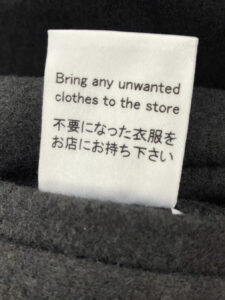
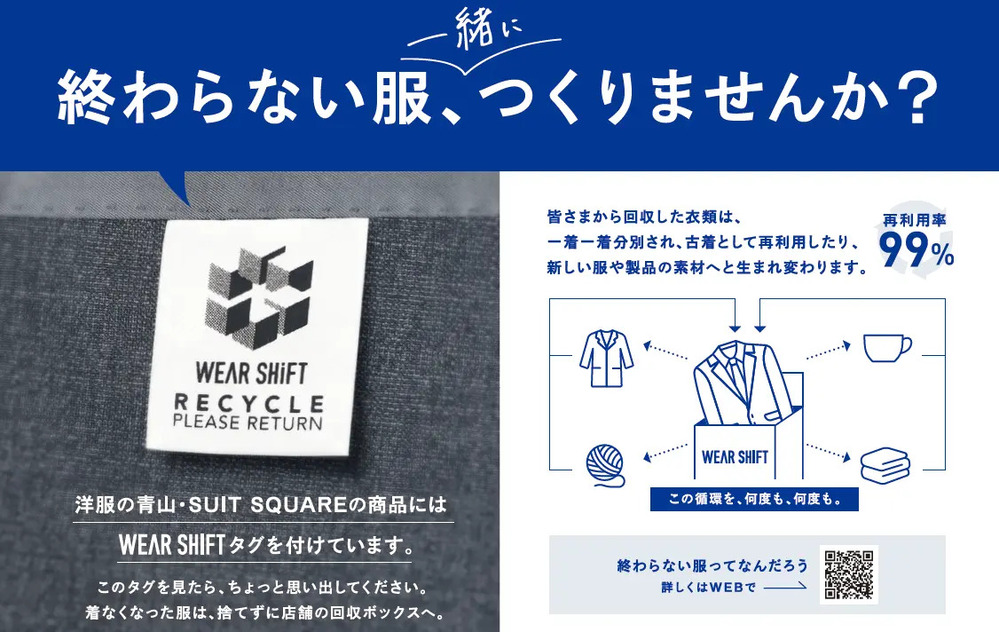
To avoid compromising the garment’s design, the tags are sewn into inconspicuous locations such as the inside of pockets or linings. They carry a message urging customers not to discard clothes they no longer wear but instead bring them to in-store collection boxes, presenting resource circulation as an alternative to disposal when a garment’s useful life ends. The company explained that since customer action in bringing used clothing back to stores is an essential starting point for sustaining resource circulation, it decided to attach the tags directly to the products themselves in order to convey its desire to promote resource circulation at the very moment a customer lets go of a garment.
The tags are being attached to business items such as suits, jackets, trousers, skirts, coats, formal wear, vests, dress shirts, blouses and ties, as well as casual items such as casual shirts, T-shirts, sweatshirts, knit polos, knit vests, various sweaters and blousons. Items on which tags cannot be sewn, such as shoes and belts, are excluded from tagging, but are still accepted for collection. Collection takes place via recycling boxes installed at all stores of “Suit Aoyama” and “SUIT SQUARE,” and the program accepts not only the company’s own products but also those of other brands. Customers who wish to participate receive a coupon redeemable on their next purchase.
According to the Ministry of the Environment’s Action Plan for the Promotion of Sustainable Fashion, an estimated 460,000 tonnes of clothing are discarded from households and processed through incineration and other means each year in Japan. WEAR SHiFT is an evolution of a trade-in service the company began in 1998, and since October 2023 it has installed recycling boxes at more than 700 stores nationwide. Collected clothing that can be reused is distributed as secondhand clothing, while the rest is respun into recycled wool and polyester materials and remade into new products such as suits and coats, achieving a reuse rate of approximately 99%.
Some of the collected clothing has also been remade into disaster-relief blankets; since 2019, a total of 3,300 blankets have been donated to 12 local governments. These donations have led to the signing of comprehensive partnership agreements or disaster-preparedness cooperation agreements with nine of those local governments. In addition, in 2022 the company signed a forest conservation partnership agreement with the general incorporated association more trees and the town of Yusuhara in Kochi Prefecture, and through donations of 10 yen per kilogram of clothing collected, it is helping to cultivate a biodiverse forest known as the “AOYAMA Forest” in Yusuhara.
In the menswear industry, AOKI Holdings has also been collecting wool suits and other items in its stores since 1996, and now runs this effort as the “OKAERI Eco Project,” which collects unwanted clothing more broadly. Collected wool products are reused as materials such as sound-absorbing material for automobiles at partner factories, while other clothing, mainly polyester items, is also directed toward reuse and material recovery.
Against this backdrop, Aoyama Trading is reinforcing in-store collection by also encouraging collection directly through tags attached to the products themselves, pushing customers toward bringing their used clothing back to stores. The company states that it will continue to go beyond addressing environmental challenges, working to contribute to the realization of a sustainable society.
※The image at the top and within the article is quoted from the press release.
【Press release】[October 20 is Recycling Day] Turning used clothing into new resources: dedicated collection tags to be attached to nearly all products from autumn/winter 2026
【Reference】WEAR SHiFT
【Reference】Action Plan for the Promotion of Sustainable Fashion (Ministry of the Environment)
【Reference】Recycling collected clothing into boxes! Installing the “OKAERI Eco BOX” to collect unwanted clothing
【Reference】AOKI’s eco-activity: the “OKAERI Eco Project”
【Related article】Toward proper production and consumption, and reliable collection and circulation systems: exploring the implementation of sustainable fashion across industry, government and academia