There are many business models driving the circular economy forward. Among the most prominent are the sharing economy, recycling models, use of circular raw materials, product life extension, and Product as a Service (PaaS). This article takes a closer look at the use of circular raw materials.
1. What Is the “Use of Circular Raw Materials”?
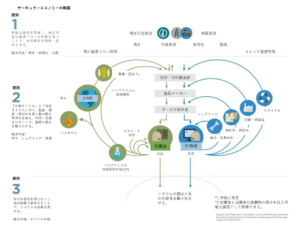
As the name suggests, the use of circular raw materials means incorporating circular materials — such as recycled materials and bio-based substances — into products. In the Butterfly Diagram proposed by the Ellen MacArthur Foundation (the UK-based organisation that champions the circular economy), product maintenance through life extension, sharing, and repair is prioritised over recycling from an environmental-impact perspective.
However, even with all of these measures in place, every product will eventually reach the end of its life. At that point, using circular raw materials eliminates the need to dispose of, incinerate, or landfill the underlying materials.
2. How to Apply the Circular Raw Materials Model
A product’s lifecycle can broadly be divided into the stages of “raw material procurement,” “design,” “manufacturing,” “distribution,” “consumption,” and “disposal/collection/recovery.” This model focuses primarily on the “raw material procurement” stage, though it also has significant implications for “design” and “disposal/collection/recovery.”
For example, when a company seeks to create a closed loop internally, “collection” naturally pairs with the use of circular raw materials. The idea is to build a system for collecting and recycling products that were previously treated as waste.
With that in mind, let us look more closely at the two main approaches to using circular raw materials:
- Sourcing circular raw materials externally (use of circular raw materials)
→ Primarily addresses the “raw material procurement” stage - Closing the loop internally or within one’s own supply chain (use of circular raw materials combined with building an in-house collection network)
→ Primarily addresses both “raw material procurement” and “disposal/collection/recovery”
Approach 1 starts simply by sourcing circular raw materials, making it relatively low-barrier to entry. However, sourcing circular materials is only a means to an end; companies still need to think carefully about how those materials will be kept in circulation throughout the rest of the product lifecycle.
Approach 2 closes the loop entirely within the company or its supply chain, making it more complex to implement than Approach 1. It also requires sufficient collection volumes, facilities, and human resources. Once established, however, this model makes raw material procurement significantly more sustainable.
Which approach is more feasible depends on the characteristics of the industry. For instance, a fashion brand attempting Approach 2 — building a closed loop solely within its own brand — may find that collection volumes are insufficient or that setting up a collection network is prohibitively expensive. Companies should assess which approach suits their industry and circumstances before deciding.
3. Benefits of Using Circular Raw Materials
This model offers a wide range of benefits. Below, we outline them from the perspectives of product providers, consumers, and the external environment.
3-1. Benefits for Product Providers
- It contributes to stable raw material procurement — in other words, it builds resilience against market price risk for raw materials. It may also reduce raw material procurement costs. (Economic benefit)
- Building a collection network creates additional touchpoints with customers. (Economic benefit)
- It creates an opportunity to optimise the business model around reverse logistics (the flow of goods from consumers back to producers). For example, digital technologies such as IoT can be used to monitor how consumers are using products, potentially opening up new business opportunities such as adopting a Product as a Service model.
- Reduced use of virgin (newly extracted) raw materials lowers the risk of resource depletion. (Environmental benefit)
- It supports sustainable marketing and branding, enabling companies to reach new customer segments. (Economic benefit)
3-2. Benefits for Consumers
- The use of circular raw materials may allow products to be offered at lower prices. (Economic benefit)
- Consumers who return end-of-life products and continue purchasing may receive economic incentives such as discounts on their next purchase. (Economic benefit)
- It expands the range of choices available to consumers who wish to live more sustainably. (Environmental benefit)
3-3. Benefits for the External Environment
- By curbing the use of new raw materials and aiming to utilise above-ground resources, the model reduces environmental impact. (Environmental benefit)
- It creates new employment opportunities. (For example, the EU projects that the transition to a circular economy could generate 700,000 jobs by 2030.) It may also drive shifts in industries and job types — such as designers who work with recycled materials, recycling operators, and digital technology specialists. (Social benefit)
While the benefits above are significant, there are also challenges to consider.
The phrase “may” was used deliberately when describing economic benefits. Taking PET bottles as an example: strong demand for recycled PET combined with falling oil prices has in some cases made recycled PET more expensive than virgin petroleum-derived PET, raising the barrier to purchasing recycled material. Improvement in this area will require policy intervention and capital investment. (In Europe, measures are underway that use market mechanisms, policy tools, and capital investment to bring down the price of recycled PET.)
Additionally, building a reverse logistics network may itself generate significant CO₂ emissions. A partial improvement in one area can sometimes lead to a worsening in another.
These challenges must be kept in mind as companies move forward with this model.
4. Key Points When Introducing the Circular Raw Materials Model
Below, we outline the key considerations for introducing this model, illustrated with case studies.
4-1. Develop a Roadmap
Achieving the use of circular raw materials is rarely straightforward. A practical approach is to set short- and long-term targets for the proportion of circular raw materials used, and to develop concrete strategies for reaching them. Disclosing these targets publicly is also effective from the standpoints of transparency, marketing, and branding. The most important thing is to signal a clear direction — both internally and externally — and to take active steps toward realising it.
[Case Study] New Plastics Economy Global Commitment
The New Plastics Economy Global Commitment, led by the Ellen MacArthur Foundation, is an initiative with six commitments, including “making 100% of plastic packaging reusable, recyclable, or compostable by 2025” and “setting ambitious 2025 targets for the use of recycled content in plastic packaging.” More than approximately 450 companies have signed on, including global giants such as Danone, Nestlé, Unilever, and Walmart. One of its stated aims is to overcome the limitations of conventional “incremental improvement” and of focusing solely on the downstream end of the product lifecycle (the stage closest to the consumer).
Another defining feature of the initiative is its commitment to continuous progress and its transparent external reporting. In 2019, it published a progress report in which 176 companies and 14 public-sector bodies including governments disclosed their individual progress with “unprecedented transparency.”
4-2. Building Reverse Logistics and Collection Networks
Establishing a collection network requires close collaboration among logistics providers, recycling operators (waste processors), and local governments. The goal of building a circular system is giving rise to partnerships that transcend conventional boundaries.
[Case Study] McDonald’s Netherlands, HAVI, and Neste’s Renewable Diesel Initiative
McDonald’s in the Netherlands partnered with HAVI — a logistics company specialising in foodservice supply chains — to collect used cooking oil from its restaurants. Finnish energy company Neste then converts this oil into renewable diesel fuel, which HAVI uses to power its delivery fleet. The key to this case study lies in the logistics and collection network, and it is also notable for the unprecedented nature of the partnership it represents.
4-3. Partnerships Built on Shared Values
As is often said in the context of the SDGs and the circular economy, partnerships built on shared values are central to realising the circular raw materials model. As noted above, the critical elements — reverse logistics, collection network construction, securing sufficient collection volumes, and collaboration with recycling operators — are difficult for any single company to achieve alone.
[Case Study] Recycled Paper Diapers (Unicharm Corporation)
In October 2019, Unicharm Corporation, a major household goods manufacturer, announced that it had established a diaper recycling technology (formally described as “the development of technology to recover materials to a level suitable for use in hygiene products” and “prototype diapers and similar products made from recovered materials”), with plans to commercialise it by 2021.
This diaper recycling initiative grew out of a collaborative agreement signed in 2016 between Unicharm, the city of Shibushi in Kagoshima Prefecture, and two local recycling centres, which had been conducting joint research ever since. The interests of both parties aligned: the municipality had long struggled with used diapers — which account for roughly 20% of its landfill waste — while Unicharm needed to secure sufficient collection volumes to advance its technology. Notably, the collaboration reportedly began with a single email sent by a Shibushi city official.
4-4. Deepening Customer Engagement
When collection is incorporated into the model, the number of touchpoints with customers increases. The key question is how to make the most of those additional interactions.
[Case Study] PET Bottle Collection Programme (Seven & i Holdings)
Seven & i Holdings’ PET bottle collection programme allows customers to bring PET bottles to stores and convert the recycling points they earn into credits on the “nanaco” electronic money service. Customers who bring bottles to the store are likely to shop there as well. By incorporating a “collection” dimension, the programme increases customer touchpoints, encourages more frequent store visits, and enhances overall customer engagement.
4-5. Design Considerations
It is essential to carefully assess whether circular raw materials can truly serve as a substitute for conventional virgin materials. For example, companies must be alert to the risk that introducing recycled materials may compromise design quality, product performance, or hygiene standards.
4-6. Accounting for Drawbacks
The final key point is to be mindful of the risk of increased disposal. The introduction of circular raw materials must not lower the psychological barrier to discarding products. In other words, if people fall into the thinking that “it’s made from sustainable materials and can be recycled indefinitely, so it’s fine to throw it away,” the original goal of keeping materials in circulation and reducing environmental impact will not be achieved — and the economic, environmental, and social costs of disposal, logistics, and labour may actually increase. This is where the “systems thinking” introduced at the outset — recognising the priorities of circulation and remaining attentive to overall environmental impact and value chain interconnections — proves invaluable.
【Reference】What Is “Product as a Service (PaaS)” — The Business Model Accelerating the Circular Economy?
【Reference】Circular Economy Hub Learning #3 (Explanation of the Butterfly Diagram from the video “Dame Ellen MacArthur: food, health and the circular economy”)
【Reference】New Plastics Economy Global Commitment
【Reference Report】THE NEW PLASTICS ECONOMY GLOBAL COMMITMENT 2019 PROGRESS REPORT
【Reference】Neste Announces Used Cooking Oil Collection Initiative with McDonald’s Netherlands; Fuel to Power HAVI Delivery Fleet
【Reference】Unicharm Targets 100% Renewable Electricity by 2030 and Launches Used Diaper Recycling Business
【Reference】Automated PET Bottle Collection Machines
※ This article is an adapted reprint from “IDEAS FOR GOOD Business Design Lab,” operated by Harch Inc. (original article).