On November 6, 2026, the Ministry of Economy, Trade and Industry (METI) held the 14th meeting of an expert panel discussing systems to expand the use of recycled plastics (the Resource Circulation Economy Subcommittee, Innovation and Environment Subdivision, Industrial Structure Council, an advisory body to METI). The secretariat noted that leaving the matter to market forces alone risks failing to adequately develop domestic demand and supply for recycled plastics, and proposed setting numerical targets for the use of recycled materials as one option. It then proposed beginning discussions on establishing a recycled plastic utilization rate, starting with PET bottles (plastic beverage bottles made of polyethylene terephthalate).
According to secretariat materials, domestic use of recycled plastic materials totals about 430,000 tonnes per year, equivalent to 4.7% of waste plastic. Meanwhile, approximately 7.09 million tonnes per year (about 80% of waste plastic) is incinerated or landfilled, and roughly 1.26 million tonnes is exported overseas. The secretariat identified challenges facing Japan’s overall recycled materials market, including insufficient collaboration across the value chain and the recycling industry, uncertainty in supply chains, and the absence of established demand and markets for recycled materials. It then raised the question of whether Japan should move a step beyond current efforts—such as setting targets and reporting obligations for recycled material use under the Act on the Promotion of Effective Utilisation of Resources—by establishing numerical targets and formalizing an integrated framework combining regulation with support for initial investment and demand creation.
The materials stated that in sectors already possessing a certain level of supply infrastructure, such a framework could be expected to generate further demand. For sectors where supply capacity remains underdeveloped, the materials outlined a three-stage process—(1) designing the system and building infrastructure, (2) creating initial demand and forming a market, and (3) launching the system and achieving self-sustaining domestic circulation—to establish a high-quality domestic recycled materials market.
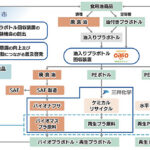
As reasons for selecting PET bottles as the lead item, the secretariat cited the fact that more than 80% are already recycled, that supply capacity of about 400,000 tonnes is sufficient relative to demand, and that sorting and collection systems are already well established. In fiscal year 2024, the effective utilization rate (combining recycling and thermal recovery) for designated PET bottles (PET bottles officially designated under Japanese law as subject to collection and recycling obligations) was 98.6%, while the bottle-to-bottle ratio (the share of recycled PET bottles reprocessed into new PET bottles, a form of closed-loop recycling) stood at 37.7%, up about 4 percentage points from the previous fiscal year. The soft drink industry has declared a target of raising the bottle-to-bottle ratio to 50% or higher by 2030.
Regarding the establishment of a recycled plastic utilization rate for PET bottles, the secretariat presented committee members with three points for discussion. First, how to proceed with detailed consideration starting from PET bottles. Second, what factors should be taken into account in designing the details of the system—examples cited in the materials included the target level, the businesses subject to the rule, calculation and verification methods, and the timing of implementation along with any transition period. Third, how to balance the effectiveness of the system with the feasibility and burden for businesses, including measures to ensure a stable supply of recycled materials, domestic circulation, and predictability for investors. In addition, the secretariat sought opinions on how to proceed going forward and on which matters should be prioritized in hearings with industry.
Underlying this discussion is the amended Act on the Promotion of Effective Utilisation of Resources, which took effect in April 2026. The amended law introduced a framework encouraging manufacturers and other businesses to use recycled plastics. Under the law, the government set out, through ministerial ordinances, standards that businesses are expected to meet for plastic containers and packaging, automobiles, and four categories of home appliances (air conditioners, televisions, refrigerators and washing machines). Among plastic containers and packaging, those used for food and pharmaceuticals are excluded, but designated PET bottles are covered. Businesses subject to the rule are required to set targets for the volume and rate of recycled plastic use and to appoint a responsible person at each business site. They must also submit utilization plans to the government by the end of September each fiscal year, starting in fiscal year 2027, and regular reports on actual performance starting in fiscal year 2028.
The Circular Economy Action Plan, adopted by a meeting of relevant cabinet ministers on April 21 of the same year, positioned strengthening the supply chain for recycled resources as one of its pillars. The plan includes consideration of phasing in mandatory recycled plastic utilization rates for products where progress is already underway, with the aim of implementation by fiscal year 2028 (Reiwa 10). Furthermore, amid concerns over the stable supply of petroleum-derived chemical products due to escalating tensions in the Middle East, the 17th meeting of the GX (Green Transformation) Executive Council—a government body coordinating Japan’s green transformation policy—on August 26 also laid out a policy of advancing, in an integrated manner, both system design and support for capital investment, in order to increase the supply of products made from recycled plastics.
The secretariat’s materials also touched on overseas trends. In the EU, mandatory use of recycled plastics is advancing through a provisional agreement on the draft End-of-Life Vehicles Regulation (reached in December 2025), as well as through the Batteries Regulation, which will mandate the use of recycled materials starting in 2031. South Korea and other countries are also moving to mandate the use of recycled materials in PET bottles. At the same time, the materials noted that in some countries and regions that have mandated the use of recycled materials, domestic recycled material supply capacity has actually shrunk. The European Commission and European recyclers’ associations have reported falling utilization rates at recycling facilities and a wave of bankruptcies among recyclers, and project that recycled material supply capacity within the EU will decline by one million tonnes by the end of 2025, attributing this in part to unfair competition from third countries.
METI presented a schedule under which it will hold hearings with both supply-side and demand-side industries at the 15th subcommittee meeting on January 25, 2027, with the aim of outlining the basic direction of the system within fiscal year 2026. The ministry also proposed coordinating detailed system design, such as certification methods, from the following fiscal year onward, and stated that it will proceed in coordination with discussions at a separately convened “Study Group on Resource Circulation for Designated PET Bottles.”
【Reference】14th meeting of the Resource Circulation Economy Subcommittee, Innovation and Environment Subdivision, Industrial Structure Council
【Related article】Government to Mobilize ¥1 Trillion in Public-Private Funding to Strengthen Recycled Resource Supply Chains, Sets Recycling Targets for Critical Minerals and More: Circular Economy Action Plan
【Related article】METI to Require Businesses to Formulate Utilization Plans for Recycled Plastics
【Related article】METI Revises Ministerial Ordinance to Expand Label-Free PET Bottles; Coca-Cola System to Roll Out Vending Machines in October