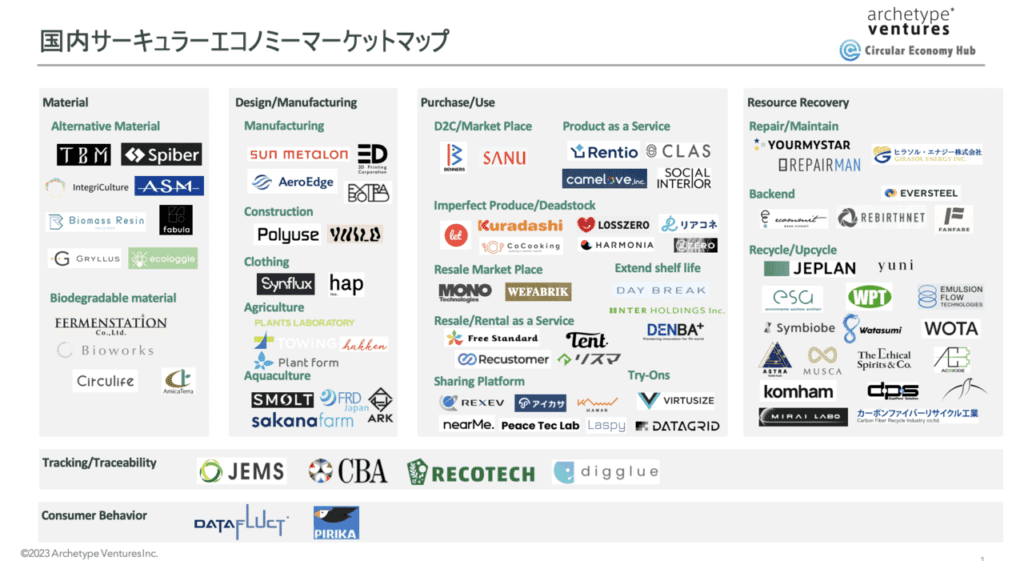
Circular Economy Hub, in collaboration with Hirokazu Kitahara, Partner at Archetype Ventures, has published a market map (see the header image) and list of domestic circular economy startups and ventures.
This article outlines trends surrounding circular economy startups and ventures, and introduces 11 companies across various sectors that Circular Economy Hub is watching. Feedback on the list is also welcome via our contact form.
The circular economy startup/venture list is available here.
Circular Economy Startup/Venture Trends
As awareness of the circular economy grows and concrete steps toward the transition accelerate both in Japan and abroad, startups and ventures placing the circular economy at the core of their business are emerging and attracting investor attention.
The following factors are driving this trend:
- Growing recognition of the circular economy as a contributor to carbon neutrality
- Progress in internalising externalities through policies, regulations and incentives
- Increasing awareness of the expanding circular economy market and growing demand for related technologies
- Advances in ESG and impact investing practices and disclosure frameworks
- Development of digital technologies
- Rising interest in the sector, following the momentum of climate tech
For example, recent developments around the circular economy have been moving quickly: at the government level, initiatives such as the “Circular Economy Vision 2020,” the “Disclosure and Dialogue Guidance for Promoting Sustainable Finance Related to the Circular Economy,” the “Act on Promotion of Resource Circulation for Plastics,” and discussions within the “Growth-Oriented Resource-Autonomous Economy Design Study Group” are accelerating; a target has been set to expand the circular economy market to more than ¥80 trillion by 2030—1.6 times its current size; and in the EU, the proposed revision of the Ecodesign Directive under the Circular Economy Action Plan has been published, alongside regulatory developments including the EU Taxonomy. These external conditions are beginning to lay the groundwork for startups and ventures to build sustainable businesses.
Naturally, circular economy startups and ventures are able to place the circular economy at their core from the moment they are founded—a stark contrast to the difficulty large, established companies face in transitioning to sustainable, circular business models.
Investor attention is also growing. Well-known examples of investment activity include BlackRock’s circular economy-focused BGF Circular Economy Fund, Intesa Sanpaolo’s €5 billion circular economy lending facility over three years, and BNP Paribas Asset Management’s ETF. According to a survey conducted by the GIIN (Global Impact Investing Network), 45% of the investors surveyed identified “responsible consumption and production”—a theme closely linked to the circular economy—as a key investment theme.
Looking at startup and venture investment trends, circular economy-specialist venture capital firms such as Circulate Capital, Closed Loop Partners, and the newer Regeneration.VC and Circular Innovation Fund are expanding their activities. Startup and innovation scouting efforts—such as Google’s accelerator programme covering reuse, refill, recycling, composting, fashion, food and circular materials—are also gaining momentum, as are investments in circular economy-related startups by global majors such as IKEA and H&M.
In light of these international trends and Japan’s domestic circular economy policy and market developments, building a foundation that enables circular economy startups to grow and flourish will be crucial to Japan’s transition to a circular economy. It was with this goal in mind—first and foremost to categorise circular economy startups—that we created this map.
About Version 1 of the Circular Economy Market Map
This map and list feature domestic startups and ventures whose activities align with the three principles of the circular economy as defined by the Ellen MacArthur Foundation, and which operate circular business models.
The Ellen MacArthur Foundation’s Three Principles of the Circular Economy
- Eliminate waste and pollution
- Circulate products and materials at their highest value
- Regenerate nature
Examples of Circular Business Models
- Circular materials
- Circular design and manufacturing
- Collection and recycling
- Sharing and Product-as-a-Service (PaaS)
- Reuse, repair and maintenance
- Circular enablers (digital and others)
This is Version 1 and is not a complete list; it will be updated on an ongoing basis. For enquiries about this map, please click here.
11 Circular Economy Startups/Ventures Highlighted by the Editorial Team
From this map, we would like to introduce 11 companies that the editorial team is watching, organised by sector.
Materials
The circulation of materials is essential to the circular economy transition. Here we have divided companies into two sub-categories: alternative materials and bio-based materials.
Featured Company ①: fabula Inc.
fabula creates new materials by drying, pulverising and thermally compressing substandard vegetables and offcuts. For example, a material made from Chinese cabbage waste boasts approximately four times the flexural strength of concrete, and the company anticipates potential future applications in construction materials and more. Because the materials are derived from discarded food, they retain the colour, aroma and texture of the original ingredients, making each piece unique. They also raise no concerns about competition with food supply, avoid greenhouse gas emissions from incineration, and lock carbon into the material itself. Applications range from small accessories to building materials. The technology is expected to contribute to the bio-based material strategies that are a key pillar of circular design.
【Official Website】https://fabulajp.com/
Featured Company ②: Fermenstation Co., Ltd.
Fermenstation is an R&D-driven startup working to build a society in which unused resources are regenerated and circulated through its proprietary fermentation technology. The company ferments and distils unused resources to produce ethanol and fermentation feedstocks, opening up a market for high-value-added, bio-derived raw materials such as cosmetic ingredients. The residual fermentation lees are used as cosmetic ingredients or as feed for chickens and cattle, while the resulting manure is used as fertiliser for fields and paddies—forming a closed-loop model. Key features include the revitalisation and use of fallow and idle rice paddies, and the addition of value to food waste such as residues from food-related factories. Its flagship product, rice ethanol, holds USDA certification and Ecocert COSMOS certification, and the company itself has obtained B Corp certification. In addition to raw material production, the company handles OEM, ODM and novelty production, and co-creates businesses with large corporations, tackling challenges both in Japan and globally. While it also falls under recycling and upcycling, it is classified here under materials.
【Official Website】https://fermenstation.co.jp/
Design/Manufacturing
Circular design is perhaps the single greatest differentiator between the circular economy and the conventional 3R (reduce, reuse, recycle) economy. Research suggests that design determines up to 80% of a product’s environmental impact, making circular design an essential element of circular manufacturing—also included in this category. Beyond the non-digital domain achieved through skills development and circular thinking, digital enablers using AI and 3D printing to support circular design are also emerging.
Featured Company ③: Synflux Inc.
Synflux is a speculative design laboratory implementing fashion for the planet. Inspired by the straight-line cutting of the traditional kimono, the company has developed Algorithmic Couture—an AI-powered system that brings fabric waste in garment manufacturing close to zero. The company first gained widespread attention when it won a special award at the 4th Global Change Award hosted by the H&M Foundation. It has been developing projects and proof-of-concept experiments with brands and research institutions, and recently announced the collaborative project “SYN-GRID” with Goldwin, marking further progress in the social implementation of the speculative design it has been developing. While the environmental impact of manufacturing processes tends to be difficult for end consumers to perceive, Synflux is expected to be a trailblazer in this space.
【Official Website】https://synflux.io/
【Collaboration with Goldwin “SYN-GRID”】https://syngrid.goldwin.co.jp/
Purchase/Use
It goes without saying that the circular economy cannot be achieved through the efforts of manufacturers alone—it requires the cooperation of all stakeholders, and consumers in particular. Various approaches exist to engage consumers, including transforming business models and strengthening circular marketing. Here we introduce three companies that have achieved, or have the potential to achieve, both enhanced circularity and a sustainable business.
Featured Company ④: Sanu Co., Ltd.
Sanu offers a second-home subscription service that gives members a home in nature. In addition to the experiential and educational value of fostering awareness of coexistence with nature, the architecture itself adheres to the principles of the circular economy. The company’s service, “SANU 2nd Home,” achieves carbon negativity while incorporating a nail-free construction method that enables the reuse of building materials, raised-floor architecture that reduces the burden on the soil, the use of domestically sourced timber, process transparency, and prefabricated, disassembly-ready design for eventual demolition—realising circularity across the entire building lifecycle wherever possible. Beyond its business model, the company demonstrates the potential of circular architecture suited to Japan’s natural environment. While classified under purchase/use on the map, it is relevant to many other categories including design, recycling and traceability.
【Official Website】https://2ndhome.sa-nu.com/
Featured Company ⑤: CLAS Co., Ltd.
CLAS provides “CLAS,” a subscription service for home appliances and furniture, and has been growing steadily in terms of membership numbers and fundraising. The company procures name-brand furniture and appliances and offers them as a subscription, aiming to improve circularity by managing product repair and maintenance. Its private-label brand, launched on the basis of know-how accumulated through product maintenance and repair, incorporates circular design that makes disassembly, cleaning and repair easy. The company also addresses the increased environmental burden from logistics and packaging materials—a common pitfall of servitisation models—through measures such as consolidated delivery and optimised inventory management.
【Official Website】https://clas.style/company.html
Featured Company ⑥: Social Interior Co., Ltd.
Like CLAS above, Social Interior’s core business is “Subsclife,” a furniture and home appliance subscription service. The furniture offered uses recycled materials and recyclable materials, products designed for long-term use, and materials from sources that contribute to forest conservation through schemes such as FSC certification. The company aims to establish a closed loop through collaboration with local businesses and through evaluation and reporting that makes the whereabouts of furniture and appliances visible. It also operates “Program CRAFT,” a mechanism that returns profits to manufacturers whose products have been used multiple times, creating a system in which reuse becomes economically beneficial for manufacturers as well. It will be worth watching whether this initiative succeeds in updating and spreading a culture of reuse.
【Official Website】https://corp.socialinterior.com/
Tracking/Traceability
Tracking plays a role in improving product circularity and rebuilding supply chain collaboration by making products and their flows visible. As demonstrated by developments such as the EU’s Digital Product Passport (DPP) and various data-sharing platforms like GAIA-X, the importance of tracking in the circular economy is growing, and companies offering solutions in this space are beginning to emerge.
Featured Company ⑦: Recotech Inc.
Recotech aims to “redesign the act of ‘discarding’ into ‘POOL—depositing as a resource.'” The company has developed “POOL,” a system for visualising the waste and recycling supply chain and centrally managing information from the point at which urban resources are generated through to their supply to manufacturers. This is said to lead to better understanding of urban resources and optimisation of factory utilisation rates and logistics. PCR (post-consumer recycled) materials traced through POOL are reborn as value-added resources under the name “POOL Resin.” The company has developed numerous joint projects, and most recently attracted attention for conducting the first circularity assessment in Japan’s domestic sports industry at the “Rakuten Japan Open Tennis Championships 2022,” which it supported—demonstrating the wide-ranging applicability of its technology.
【Official Website】https://recotech.co.jp/
Featured Company ⑧: digglue Co., Ltd.
Aiming to realise “a society in which resource circulation is digitalised,” digglue operates businesses in waste stream visualisation, CO2 calculation and resource traceability. In collaboration with major manufacturers and recyclers, the company supports the material recycling of plastic by-products generated through business activities and the construction of recycling schemes for used bottle containers. It has also launched a beta version of its own product, “MaTeRe,” which allows users to register waste information to visualise waste volumes and CO2 emissions, and to sell waste materials at value through matching with partner companies. digglue is a startup to watch for its approach of developing traceability systems in direct response to actual user needs.
【Official Website】https://digglue.com/
Purchase/Use (Sharing)
Sharing, as one of the business models contributing to the circular economy, can enhance circularity when applied appropriately. By maximising the utilisation rate per resource, it is a model that reduces the amount of virgin resources extracted. It also contributes to the creation of social connections, data utilisation and the “prosumerisation” of consumers who take on a partial production role.
Featured Company ⑨: Kaman Co., Ltd.
Kaman operates “Megloo,” a reusable container sharing service designed to reduce takeaway container waste. The service is currently deployed around Kamakura Station, in shopping streets in Sumida Ward (Tokyo), and at Suzuka Circuit, among other locations. In June 2022, it was selected for Japan’s first programme hosted by the Alliance to End Plastic Waste—the world’s largest network focused on preventing plastic pollution—aimed at “eliminating plastic waste and realising a circular economy.” The service allows stylish containers that can be used more than 100 times to be shared among restaurants, with users returning them to participating outlets, thereby reducing costs. The company also uses its official LINE account to improve user convenience. It will be worth watching whether this initiative leads to a transformation in everyday lifestyles.
【Official Website】https://kaman.co.jp/
【Megloo Official Website】https://megloo.jp/
Material Recovery
This category includes high-priority approaches that contribute to maintaining product value—such as repair and maintenance—as well as back-end enablers that support recycling, upcycling and material recovery after a product reaches the end of its life.
Featured Company ⑩: YourMystar Co., Ltd.
YourMystar operates the “YourMystar” platform, which connects customers with skilled tradespeople in highly circular businesses such as house cleaning and repair. The company contributes to reviving Japan’s value of “cherishing things” through a digital marketplace. By making repair and maintenance service providers—previously difficult to access—visible online, it charts a path toward greater circularity. Beyond this environmental value, the company also places importance on the social dimension of local employment. It operates a “local production for local consumption” model in which local partner businesses take on local jobs. According to the company’s own data, more than 200 jobs have already been created, with a target of generating 1,500 jobs by 2026.
【Official Website】https://yourmystar.jp/
Consumer Behavior
Consumer behaviour is key to creating a circular economy market. However, changing consumer behaviour is no simple task. Just as with supply chain visibility, the first step is making the environmental impact and contribution of individual actions visible. From there, it becomes possible to consider building incentive and nudge mechanisms to shift consumer behaviour—and businesses in this space are beginning to emerge.
Featured Company ⑪: DATAFLUCT Inc.
Operating under the vision of “realising a sustainable future through the sharing of algorithms,” DATAFLUCT operates “becoz,” an environmental value distribution platform designed to enable all stakeholders—including individual consumers—to participate in efforts toward carbon neutrality. The company treats environmental values such as tradeable carbon credits, recycling volumes and water usage reductions as “the value held by things and actions that underpin the sustainability of the planet,” and aims to introduce a new set of metrics into everyday life. With the Japanese government having set a target of reducing household CO2 emissions by 66% by 2030, the expectation is growing that not only energy reduction at the consumer level but also the practice of the circular economy will be required—making DATAFLUCT’s contribution to this space all the more anticipated.
【Official Website】https://datafluct.com/
Embedding a Circular Economy Vision Company-Wide
It goes without saying that the companies introduced here are leveraging their proprietary technologies, systems and expertise to drive the circular economy transition. What is even more significant is that every one of these companies has embedded, at the highest level across the entire organisation, a vision of applying these assets to contributing to the circular economy. Companies in which this kind of circular thinking has taken root have a natural ability to attract other businesses, and command high levels of attention from investors and large corporations alike. Circular economy startups and ventures with this mindset will become increasingly important and indispensable to Japan’s transition to a circular economy.
【Related Article】Ellen MacArthur Foundation Releases Beta Version of Startup Database
【Reference Report】ANNUAL SURVEY 2020 (GIIN)
【Reference Report】European Commission, Directorate-General for Energy, Directorate-General for Enterprise and Industry. (2014). Ecodesign your future: How ecodesign can help the environment by making products smarter.