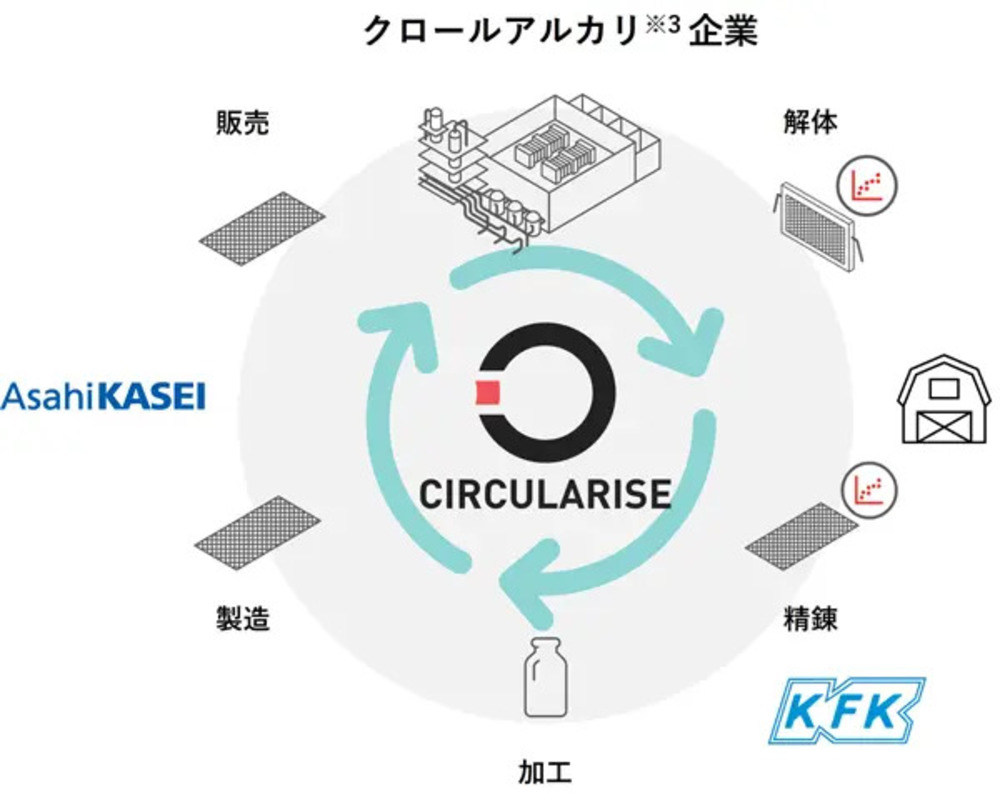
Asahi Kasei, Furuya Metal Co., Ltd. and the Netherlands’ Circularise B.V. have launched a demonstration project aimed at securing traceability of precious metals used in salt electrolysis electrodes and issuing a “Digital Product Passport (DPP).”
This demonstration builds on the “Metal Recycling Demonstration for Salt Electrolysis Cells and Electrodes” launched in 2025 by Asahi Kasei, Nobian, Furuya Metal and Mastermelt. Beyond simply recycling precious metals recovered from used electrodes, the project aims to achieve both resource circulation and greater supply chain transparency by digitally visualizing the origin and circulation history of these materials.
From February to September 2025, Asahi Kasei and Circularise conducted initial verification using hypothetical scenarios. They tested whether the amount of metal recovered from used electrodes and the amount reused in new electrodes could be managed through Circularise’s system, confirming key aspects of feasibility. This time, Furuya Metal—which has expertise in the refining, processing and recycling of iridium and ruthenium—has joined the project, and verification will proceed in two phases targeting the actual recovery and regeneration processes.
In the first phase, the project will verify methods for acquiring, recording and managing traceability information, covering the process from collection of used electrodes through extraction and refining of precious metals to the production of reusable regenerated ingots. In the second phase, covering the process from regenerated ingots to the manufacture of new electrodes, the project will build a framework for sharing information on circular resources and verify the process toward issuing a DPP. Based on the findings from each phase, the companies will consider how to implement in society a mechanism for visualizing the circulation history of recycled precious metals.
Precious metals such as iridium and ruthenium are critical minerals used in a wide range of industries, including salt electrolysis electrodes, electronic components and semiconductor materials, with demand expected to grow further in the future for hydrogen production using PEM (polymer electrolyte membrane) water electrolysis equipment. At the same time, supply sources are limited: according to estimates by the International Platinum Group Metals Association, global annual primary production of iridium is only around 7 tons, while annual supply of ruthenium is only around 30 tons. Production is also concentrated in a very small number of regions, with most of it produced as a byproduct of platinum mining. In recent years, rising demand and wider price volatility have heightened the importance of securing stable resource supplies and promoting their effective use, driving growing interest in recycling precious metals recovered from used products.
However, even when the origin of used cells and electrodes and the refining destination of recovered metals are known, it is not easy to trace the distribution channels in between or how the materials are reused after refining. To properly recycle recovered precious metals, it is essential to have a system that connects information from collection through to reuse. Managing the origin and circulation history of recycled materials is expected to help ensure quality and improve supply chain transparency, as well as support responsible mineral sourcing, promote resource recovery, and help companies meet the requirements of sustainability certifications.
Circularise is a company that has spent roughly a decade providing supply chain traceability and data-sharing solutions around the world, including in Japan. It has technology that allows companies to share only the necessary information across the supply chain while protecting their confidential information. Asahi Kasei invested in Circularise in November 2022 through its corporate venture capital (CVC) arm.
Going forward, the three companies will work to advance precious metal recycling in the field of salt electrolysis and improve supply chain transparency. Looking ahead, they also plan to expand into the field of water electrolysis for hydrogen production, aiming to build frameworks that achieve both circular use and traceability across a range of industries that rely on critical minerals.
※The image at the top of this article is taken from the press release.
【Press release】Asahi Kasei launches demonstration project with Circularise and Furuya Metal on precious metal traceability for salt electrolysis electrodes
【Press release】Furuya Metal begins joint verification with Asahi Kasei and Circularise of precious metal traceability and Digital Product Passport (DPP) issuance for salt electrolysis electrodes
【Press release】Metal recycling demonstration for salt electrolysis cells and electrodes
【Reference】IPA Fact Sheet: Iridium (May 2026)
【Reference】IPA Fact Sheet: Ruthenium (May 2026)
【Related article】“Traceability is a company’s core competency”: Circularise co-founder on the value of DPPs
【Related article】Honda and the Netherlands’ Circularise partner on digital battery passport compliance