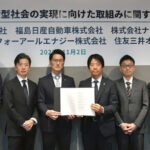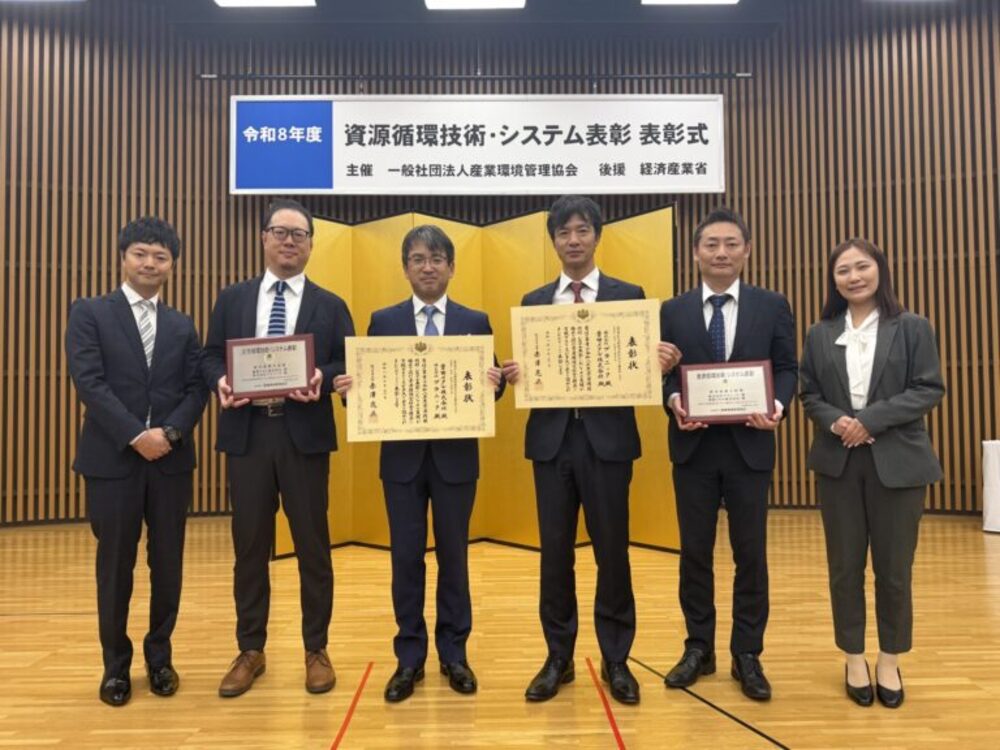
Planic Inc. and Toyota Metal Co., Ltd., both members of the Toyota Tsusho Group, announced on October 26, 2026 that they had received the top honor—the Minister of Economy, Trade and Industry Award—at the “FY2026 Resource Circulation Technology and System Awards,” an awards program hosted by the Japan Environmental Management Association for Industry (JEMAI, a general incorporated association) and supported by the Ministry of Economy, Trade and Industry (METI). The award ceremony was held on October 21.
The awards program recognizes advanced technologies and products, as well as social systems and business models, that contribute to the transition toward a circular economy through reductions in resource and energy use, and through reduce, reuse and recycle initiatives.
The winning project was titled “Car-to-Car Recycling through Resin Recovery from ASR and Pelletization.” The initiative involves recovering plastic from ASR (Automobile Shredder Residue)—the material left over after end-of-life vehicles are shredded—and processing it into recycled polypropylene (PP) pellets. The project achieved adoption in new vehicles in 2025: ASR-derived recycled PP was used in the front fender seal of Toyota’s “Crown (Sport)” and the body under cover of the “RAV4.”
The judging panel highly praised the integrated technology chain—from sorting to recycled pellet production—that made it possible to manufacture automotive-grade materials, as well as the practical implementation of Car-to-Car recycling for automotive parts.
Previously, nearly 70% of ASR in Japan was used for thermal recovery, with the material recycling rate for ASR-derived plastic remaining at only about 1–2%. This was because efficiently recovering plastic from ASR was technically difficult, and pellets made from the recovered plastic struggled to meet automotive requirements in terms of physical properties, safety, stable supply, and management of environmentally hazardous substances.
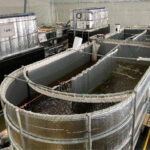
Toyota Metal recovers PP from ASR using a proprietary process that combines shredding, particle size adjustment, and removal of metal and lightweight dust, together with an in-house-developed water flow sorting system. The company has built a system capable of processing approximately 30,000 tons of ASR annually and recovering about 8,100 tons of recycled plastic feedstock—equivalent to 27% by weight. The achievement was made possible not only by the two companies’ technologies but also through technical collaboration with related companies including Toyota Motor Corporation and Kojima Press Industry Co., Ltd.
Going forward, the two companies plan to promote plastic recovery from ASR across the industry by sharing their sorting technology and providing equipment to other ASR material recovery facilities. They are also in discussions and exchanging information with all domestic automakers, and expect to expand the range of vehicle models that adopt the recycled pellets.
Planic was established in 2018 with the aim of ensuring a stable supply of recycled plastic for automotive use, and began operating a factory in Omaezaki City, Shizuoka Prefecture in 2022. The company manufactures recycled PP pellets through an integrated process spanning sorting, compounding and inspection, combining a three-stage specific gravity separation process (using heavy liquid, water and light liquid) with electrostatic separation to minimize contamination by foreign materials.
※ The feature image is quoted from the press release.
【Press release】Planic and Toyota Metal Receive METI Minister’s Award at “FY2026 Resource Circulation Technology and System Awards” — Recognized for Achieving Car-to-Car Recycling Using ASR-Derived Recycled Plastic
【Reference】Announcement of Winners of the “FY2026 Resource Circulation Technology and System Awards (52nd Edition)”
【Related article】ASR, a Hard-to-Recycle Material, Becomes Auto Parts: Toyota Tsusho Group Achieves Japan’s First Adoption through Advanced Sorting Technology