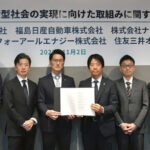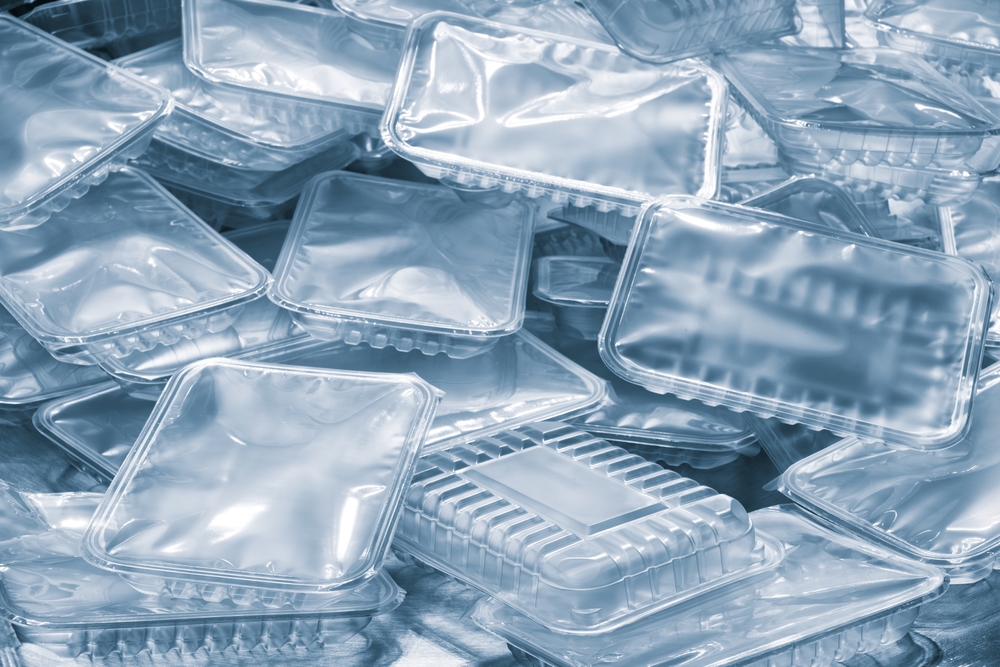
Veolia Generets K.K. and Sumitomo Chemical Co., Ltd. announced on October 28, 2026 that they have been selected to participate in the Ministry of the Environment’s “Fiscal Year 2026 Model Project on Plastic Resource Circulation” (令和8年度プラスチックの資源循環等に係るモデル事業). By combining material recycling (a process that reprocesses waste plastic back into plastic products) with chemical recycling (a process that breaks down waste plastic into chemical feedstocks), the two companies aim to raise both the resource utilization rate and the chemical conversion rate in the recommercialization of plastic containers and packaging (hereafter, “PCP”).
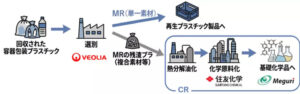
Until now, PCP collected separately under the Containers and Packaging Recycling Act (容器包装リサイクル法, a law requiring the separate collection and recycling of containers and packaging) has been recommercialized by recycling operators using either material recycling or chemical recycling, but not both. Starting in fiscal year 2027, a new Joint Group Registration Scheme (ジョイントグループ登録制度) for container and packaging recycling will allow material recycling operators and chemical recycling operators to form joint groups and combine different recommercialization methods. This model project is intended to promote the use of that new scheme.
Some PCP is difficult to effectively utilize because of differences in material composition, contamination, or the use of composite materials, and as a result, conventional material recycling has achieved a recommercialization rate of only around 50%. Under this model project, waste plastic residue generated during the material recycling process will be recommercialized through chemical recycling, with the aim of raising the resource utilization rate for PCP to around 80%. The project is also expected to expand the use of this residue—previously used mainly for thermal recovery (i.e., burned for energy)—as a feedstock for chemical products of a quality comparable to virgin, fossil-derived materials, thereby broadening its potential applications.
Under the division of roles, Veolia will draw on its expertise in waste management, sorting, and material recovery to promote the effective use of resources suited to material recycling, while also examining sorting and supply schemes that channel plastics unsuitable for material recycling into chemical recycling. Sumitomo Chemical will work on applying its chemical recycling technology, which uses a proprietary catalyst currently under development to efficiently convert pyrolysis oil—derived from the plastics that Veolia sorts and supplies for chemical recycling—into basic chemicals such as ethylene and propylene.
Veolia and Sumitomo Chemical stated that they will leverage the findings and verification results from this model project to deepen collaboration with a range of stakeholders, including local governments, recycling operators, product manufacturers, and end users, with the aim of achieving social implementation of the resource circulation scheme and the chemical recycling technology.
【Press release】Veolia and Sumitomo Chemical selected to participate in the Ministry of the Environment’s “Fiscal Year 2026 Model Project on Plastic Resource Circulation” (Veolia)
【Press release】Veolia and Sumitomo Chemical selected to participate in the Ministry of the Environment’s “Fiscal Year 2026 Model Project on Plastic Resource Circulation” (Sumitomo Chemical)
【Related article】Chemical Recycling of Plastics Can Cost Up to 3.7 Times More Than Virgin Materials, EU Joint Research Centre Estimates