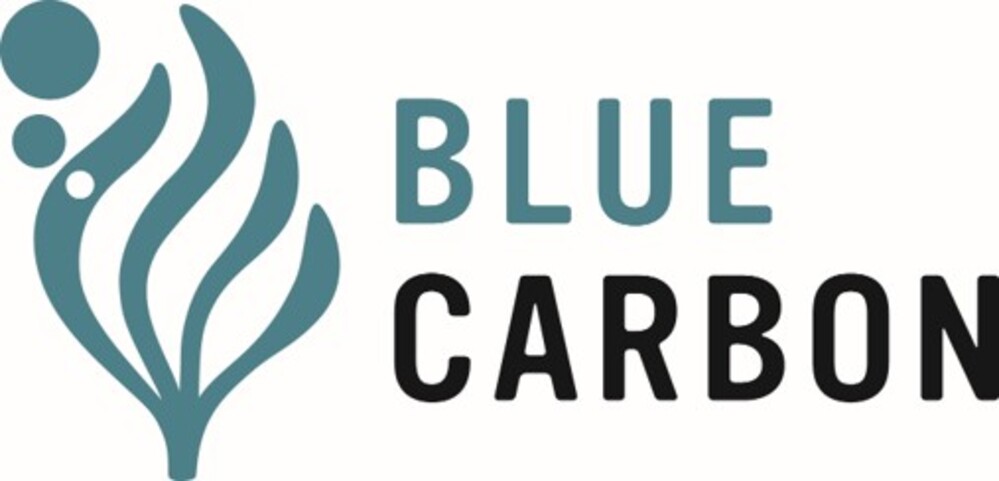
The Ports and Harbours Bureau of the Ministry of Land, Infrastructure, Transport and Tourism (MLIT) announced on September 9 that it has finalized a new logo mark to raise public awareness of “blue carbon” initiatives, referring to CO₂ absorbed and stored by marine plants. Going forward, the logo will be used at events, on social media, and in public relations materials to help promote activities related to blue carbon.
Blue carbon refers to carbon absorbed and stored by marine ecosystems such as seagrass meadows, tidal flats, and mangrove forests. Like forests on land, these ecosystems absorb CO₂, which has drawn attention as a measure against global warming. Blue carbon ecosystems are said to have a high capacity for carbon absorption and storage per unit area, and research and utilization of this capacity as a climate change mitigation measure are advancing worldwide.
The logo mark was designed with motifs based on eelgrass, a representative blue carbon ecosystem. The three surrounding circles represent the absorption of CO₂, while the design—in which the interior of the leaves gradually turns white—depicts the process of carbon absorption through photosynthesis.
According to the usage guidelines that took effect the same day, the logo mark comes in four variations:
- Basic design: Available to those who register through the designated online application to the Ports and Harbours Bureau. Intended for use on social media and other communication tools, signage, banners, and similar materials
- For J-Blue Credit issuers: Intended for use by local governments, companies, and organizations that have issued J-Blue Credits. In addition to business cards and social media, it can also be used on products and public relations materials related to credit issuance
- For J-Blue Credit purchasers: Intended for use by companies and organizations that have purchased J-Blue Credits. In addition to business cards and social media, it can also be used on products and public relations materials related to the purchase
- For blue carbon supporters: Available to those who register through the designated online application to the Ports and Harbours Bureau. Intended for use on business cards and social media
For all versions of the logo mark, no permission or approval from the Ports and Harbours Bureau is required for use, and there is no usage fee.
At the same time, the guidelines stipulate that in the event of accidents, complaints, or disputes with third parties arising from use of the logo mark, the user bears sole responsibility and cost for addressing them, and the Ports and Harbours Bureau assumes no liability for damages or other legal responsibility. It should be noted that permitting use of the logo does not mean the government guarantees the quality of the products or activities to which it is affixed.
Regarding blue carbon, J-Blue Credits—certified and issued by the Japan Blue Economy Association (JBE)—are already in operation, with an increasing number of local governments and companies issuing and purchasing credits. This new logo mark initiative can also be seen as a move to support greater recognition of such schemes and to provide companies with a means of publicly demonstrating their efforts toward decarbonization and marine conservation.
Those wishing to use the logo mark must register through a dedicated form. The usage guidelines and related documentation are posted on the website of MLIT’s Ports and Harbours Bureau.
【Press release】Blue Carbon Logo Mark Finalized – Bringing “Blue Carbon,” the CO₂ Absorbed and Stored by Marine Plants, Closer to Everyday Life
【Related article】MLIT Selects First 29 Ports Working on Resource Circulation as “Circular Economy Ports”
【Related article】MLIT Begins Discussions on New System to Reduce Lifecycle Carbon in Buildings