Ricoh Company, Ltd. and Etria Co., Ltd. announced on October 5, 2026 that they will launch initiatives based on “Circular New,” a manufacturing concept that collects products used in the market and uses their resources and parts to build the newest generation of products. As a first step, the companies will apply this concept to Ricoh’s A3 monochrome multifunction printers, lowering the virgin resource usage rate from the conventional approximately 76% to as low as about 21% for products manufactured at locations close to where they are consumed.
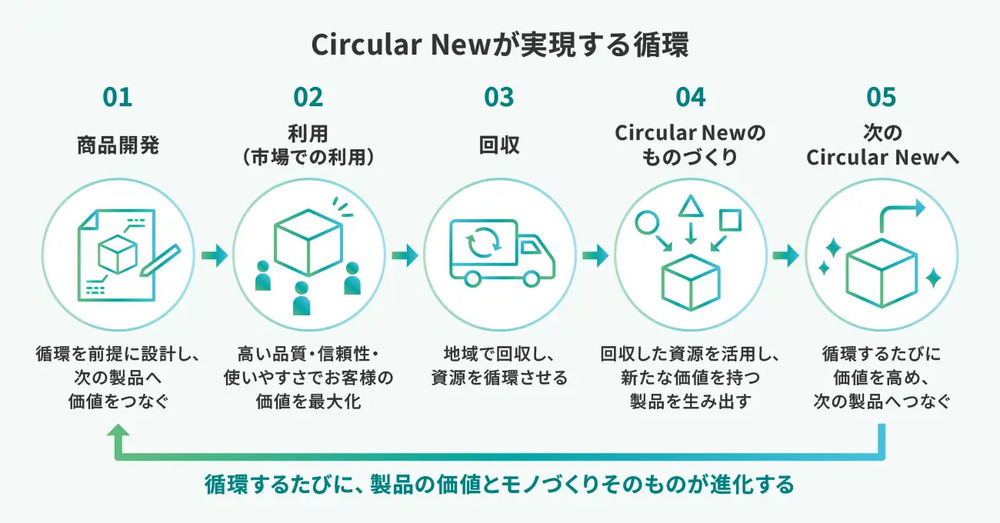
The Circular New concept treats a product’s planning, design, production, use, collection and reuse as a single continuous loop. Unlike conventional remanufactured or refurbished machines, in which the collected product itself is repaired and serviced before being resold, the distinguishing feature of this approach is that collected products are used as resources and parts to newly manufacture currently sold models.
The foundation for this approach is product design built around circularity from the outset. Etria, which was formed by combining the technology and experience of Ricoh, Toshiba Tec and OKI and handles the development and production of imaging equipment such as multifunction printers and printers, has incorporated into its planning and design stages such features as shared chassis frames and parts across generations and models, longer-lasting parts, and structures that are easy to disassemble and replace. This design approach has been combined with technology that digitally tracks the condition of products and parts, selects usable parts, and guarantees their quality. As a result, in addition to conventional recycled materials such as recycled resin and recycled iron, the companies can now use the parts and resources of collected products themselves in the newest generation of products.
On the production side, in addition to the conventional consolidated production model centered on core factories in Thailand, China and elsewhere, the companies are establishing a system for production near consumption areas, in which resources are collected locally and circulated into new products. This will begin at Etria Manufacturing Japan Co., Ltd.’s Gotemba Plant and at ETRIA MANUFACTURING FRANCE S.A. in France, where production of newly built machines will start. By creating a regional loop of “collection → use of resources and parts → production → use → re-collection,” the companies aim to reduce virgin resource use and long-distance transport, lowering environmental impact while also making the supply chain more resilient to risks from resource procurement, geopolitics and logistics disruptions, thereby supporting stable supply.
The first products under this initiative are Ricoh’s A3 monochrome multifunction printers, the “RICOH IM 6010/4510/3510/2510” series. In addition to products continuing to be manufactured at core factories in Asia, shipments of products manufactured at the Japan and France sites are scheduled to begin in the first half of 2027. For products made in Japan and France, the virgin resource usage rate by weight will be as low as about 21%, with the figure varying depending on factors such as the availability of collected parts. According to the two companies, this is the first time in the industry that a newly built machine has achieved such a reduction in virgin resource use through the use of collected parts (based on a survey of publicly available information from major companies in the office equipment industry, as of September 2026). Here, “newly built machine” refers to a product manufactured for the first time through an industrial process, as distinct from a remanufactured or refurbished machine. For the “RICOH IM 6010,” the carbon footprint of units made in Japan and France is expected to be reduced by up to approximately 25% compared with units made in Asia. Products manufactured at either site meet the same global standards for quality, functionality and warranty, meaning users can contribute to resource circulation without sacrificing performance or quality.
The Ricoh Group has set targets of reducing the virgin resource usage rate of its products to 60% by 2030 and 12% by 2050. In addition, under its “Mid-Term Management Strategy ’26,” the company has set a goal of achieving a 30% share of Etria-made engines by fiscal year 2030, and Circular New is positioned as one of the initiatives supporting this growth strategy. Going forward, Ricoh will be responsible for building circular systems that involve customers, while Etria will handle product design and development built around circularity as well as the establishment of production infrastructure located close to consumption areas.
Amid climate change, resource constraints, geopolitical risk and logistics disruptions, manufacturers are being called upon to shift toward manufacturing that reduces environmental impact while ensuring stable supply. Through Circular New, the two companies aim to establish a new manufacturing standard that turns resource circulation into a driver of business growth.
*Images in this article are taken from the press release.
【Press release】Ricoh and Etria Launch Industry-First “Circular New” Manufacturing Concept That Turns Resource Circulation into Competitiveness