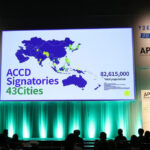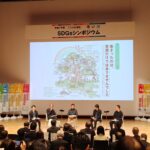
On November 26, 2025, at the Asia Smart City Conference 2025 (ASCC), held at Pacifico Yokohama North, a session was held presenting the current state of resource circulation in Yokohama.
The session was titled “Business Collaboration and the Potential of Circulation Connected by the Yokohama City Resource Circulation Promotion Platform.” Two member companies of the Yokohama City Resource Circulation Promotion Platform (YRC Platform)—established in October 2024 through a partnership agreement between the City of Yokohama and seven resource circulation businesses operating within the city—took the stage. Using concrete examples of initiatives being implemented in the city, the session explored the possibilities of public-private and business-to-business collaboration in realising the circular economy.
Yokohama’s Waste Sorting and Resource Circulation Model: Evolving Through Citizen Participation
Over the years, Yokohama has built a citizen-participatory resource circulation model by progressively reviewing household waste sorting methods and collection systems.
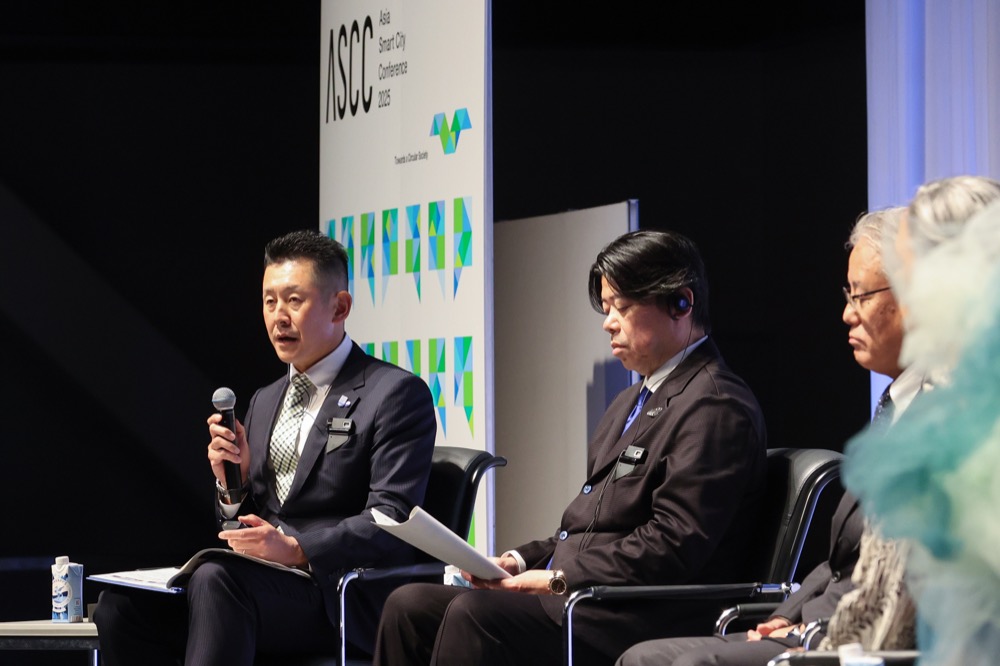
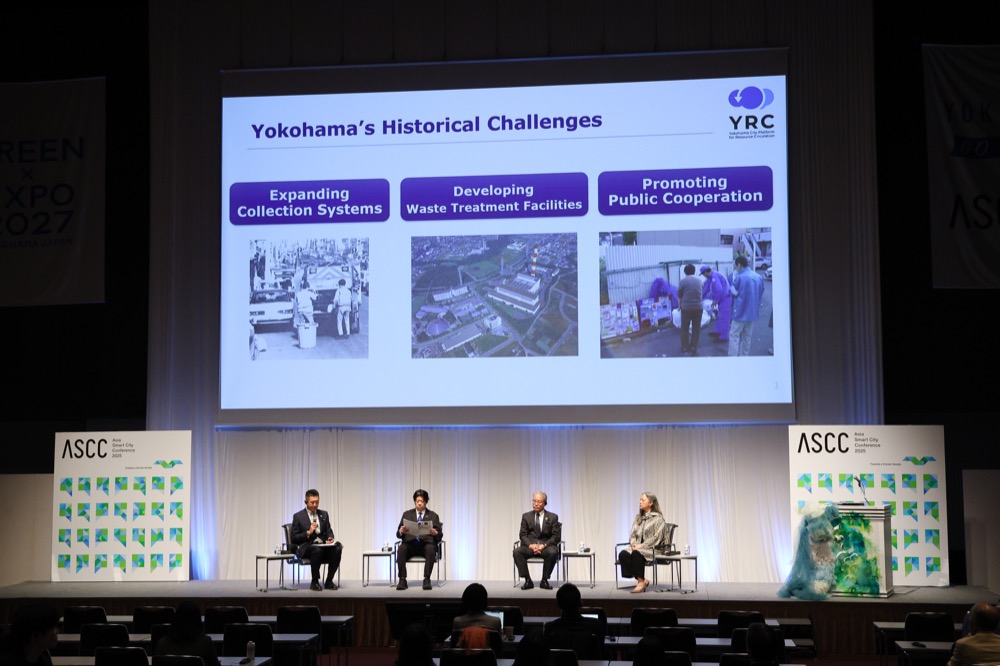
At the opening of the session, Takashi Oshima of the Yokohama City Resource Circulation Bureau presented the evolution of the city’s resource circulation policies since 1970, illustrated with photographs and graphs.
He also referred to the G30 Plan (the former Yokohama City General Waste Management Master Plan), implemented from fiscal year 2002 through fiscal year 2010, explaining how finer waste-sorting categories increased recoverable resources and reduced the volume of waste (※) generated. He noted that the city has placed great emphasis on “citizen power” in operating these systems, evolving its resource circulation framework on the basis of public understanding and action.
※ The volume of materials disposed of as waste, excluding those separated out as recyclable resources.
What distinguishes Yokohama’s approach is not merely the design of policies, but the city’s commitment to engaging directly with local communities, fostering open dialogue, and continuously improving its systems. A key message shared throughout the session was that resource circulation is both a public service and an urban activity in which every resident has a personal stake.
Expanding to Partner Cities Abroad: Taking the Yokohama Model International
Yokohama has shared its knowledge and technology on waste sorting and recycling with cities such as Da Nang in Vietnam, various African nations, and Cebu City in the Philippines. What sets this apart is that it goes beyond one-way technology transfer: the city provides hands-on support that includes on-site lectures, public awareness activities, and assistance with implementing resource circulation projects.
On the topic of international cooperation, the city does not act alone but also uses these opportunities to help Yokohama-based companies with relevant expertise expand overseas. Shinji Fujieda, Chairman and President of Goon Co., Ltd., commented:
“Yokohama has a city-to-city agreement with Cebu Province and Cebu City. I understand that the partner city makes various requests for assistance, and in most cases waste management is the top priority. As a company with the relevant know-how, we were eager to contribute and put our hand up.”
In the case of Cebu City, support has extended to facility design, human resource development, and even the establishment of local business operations. Guided by the belief that “technology should be passed on to local companies,” the company has also set up a joint venture with a local partner.
These efforts demonstrate that city-to-city partnerships can go beyond one-off assistance to generate sustainable circular industries.
Collaboration Is the Key to Realising the Circular Economy
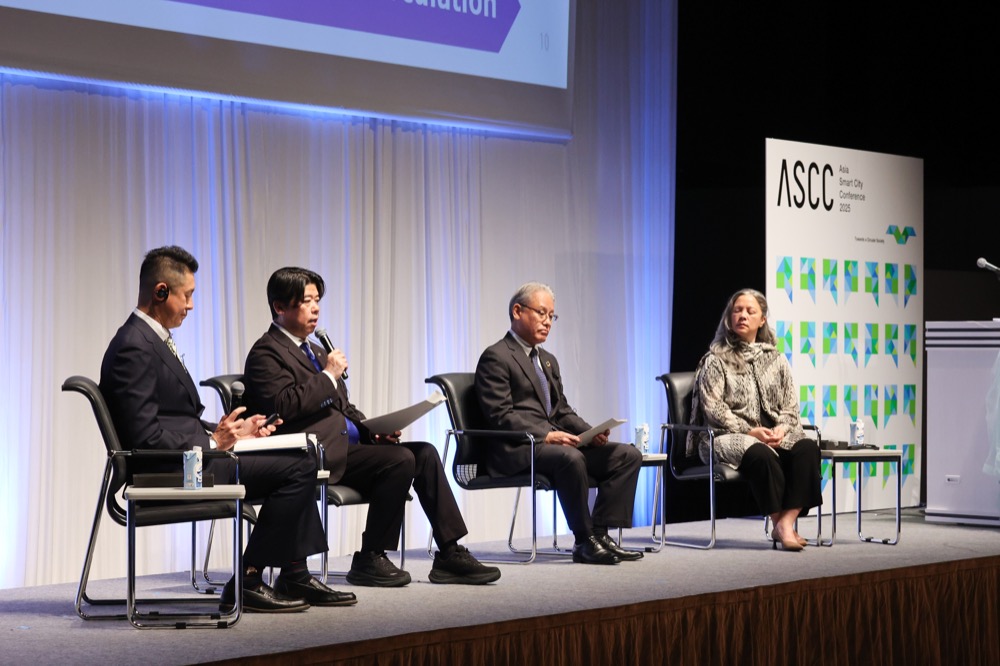
The discussion then turned to the challenges and opportunities involved in establishing resource circulation as a viable industry. From the perspective of waste generators, lower-cost processors tend to be chosen as a matter of course. Because recycling involves additional costs, it is often at a competitive disadvantage, and as a result waste tends to flow toward cheaper linear-economy options such as incineration or landfill.
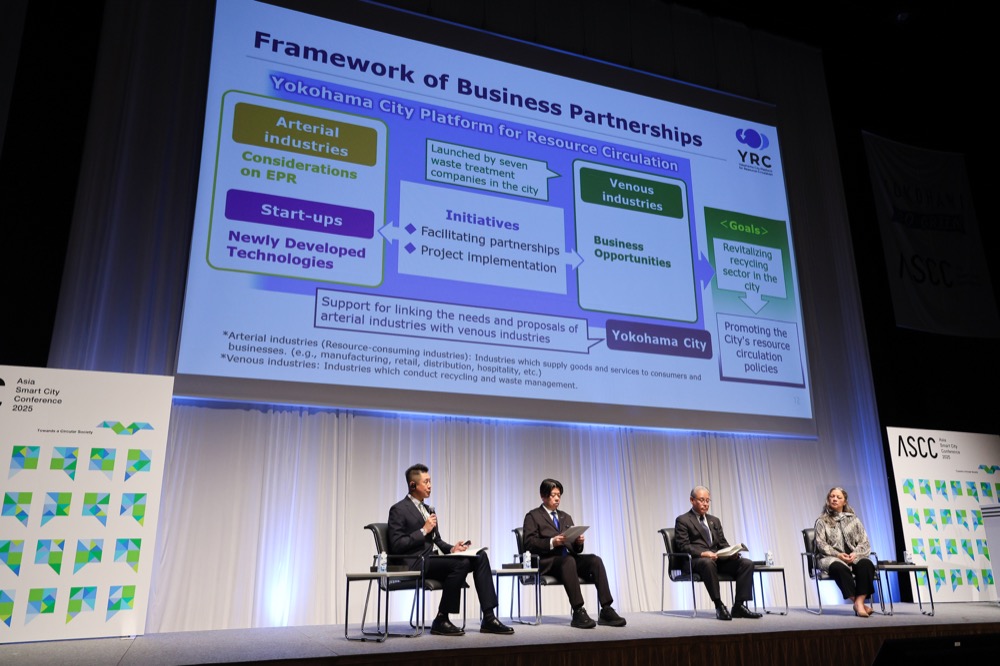
Achieving decarbonisation and the circular economy requires not only improving the circulation of household waste, but also advancing the recycling of commercial and industrial waste. At the same time, there are limits to how far any single company can push this agenda on its own. This is where the YRC Platform—a public-private forum established to enable cross-sector discussion and action—becomes critical.
Fujieda, who serves as the platform’s executive coordinator, outlined four objectives behind its establishment:
“First, for the waste and recycling industry to play a role in realising a decarbonised society. Second, to develop local waste management businesses into a new growth industry. Third, to build collaboration with companies involved in manufacturing and sales. And fourth, to work with the City of Yokohama to advance locally rooted, locally consumed resource circulation.”
Another distinctive feature of the platform is that operators handling commercial waste and those handling household waste sit at the same table to discuss issues and build results through pilot projects. Fujieda expressed his vision for the future: by steadily accumulating these efforts, he hopes to create new circular industries and expand the “Made in Yokohama” resource circulation model across Japan.
Concrete Examples of “Co-Creation” Through Business Collaboration
In Japan, by analogy with the circulatory system, companies involved in manufacturing and selling products are referred to as the “arterial industry” (upstream producers), while those involved in recycling and disposing of products once they become waste are called the “venous industry” (the waste and recycling industry).
According to Oshima, in recent years, driven by the concept of extended producer responsibility (EPR), upstream producers have been increasingly approaching the city with enquiries about making effective use of waste and recovering materials from their own end-of-life products. Meanwhile, companies in the waste and recycling industry are also seizing on these social trends as business opportunities, actively promoting the use of recycled materials and proposing new business models.
The YRC Platform has been established as a space for upstream producers and the waste and recycling industry to communicate and connect with each other. The City of Yokohama plays the role of drawing in the needs of upstream companies, facilitating matchmaking and collaboration with recycling businesses, and supporting technology development through public-private partnerships.
The session highlighted two concrete examples: a collaboration between The Kahala Hotel & Resort Yokohama in the Minato Mirai district and Yokohama Zoological Gardens Zoorasia in Asahi Ward.
Surplus food (fruit) left over from the hotel’s buffet was used as animal snacks during “Night Zoorasia,” a special evening event at the zoo. As a one-off event, the actual reduction in food loss was limited, but the initiative was seen as highly effective in terms of local resource circulation and public awareness. The parties are now exploring the possibility of making it an ongoing programme.
From Waste to Renewable Energy and Fertiliser: J&T Kankyou’s Vision of a “Circular Loop”
In the second half of the session, Hiroyuki Haseba, President and Representative Director of J&T Kankyou Co., Ltd. (a YRC Platform member), took the stage. The company operates a wide range of resource circulation businesses in Yokohama, including PET bottle and plastic waste recycling and food waste recycling.
At Pacifico Yokohama, the venue for ASCC itself, J&T Kankyou has managed waste operations arising from exhibitions and events since 2010. Combustible waste is processed at a waste-to-energy incineration plant, while food waste is handled through methane fermentation for biogas power generation. The session also introduced a scheme in which the electricity generated is sold back to the facility as “renewable energy derived from the waste it produced.”
As an example of collaboration within Yokohama, Haseba mentioned closed-loop (bottle-to-bottle style) recycling of PET bottles in the Minato Mirai 21 district. He also touched on food recycling initiatives that prioritise local production for local consumption, noting that in recent years the company has been working toward a “double recycling loop”—not only generating electricity but also supplying the by-products as fertiliser to farmers, whose produce is then used by local restaurants, thereby creating two interlocking circular flows.
He further noted that following the enforcement of the Plastic Resource Circulation Act (a law enacted in 2022 to promote the sorting, collection, and recycling of a broader range of plastic products) in 2022, the range of plastics subject to collection has expanded. As municipalities across Japan increasingly shift from incineration to recycling, J&T Kankyou opened a new facility in Kawasaki City in April 2025 capable of processing and recycling plastics from multiple municipalities in an integrated manner, responding to the demands of the times.
Towards an Era of “Keeping Resources Circulating at High Value”
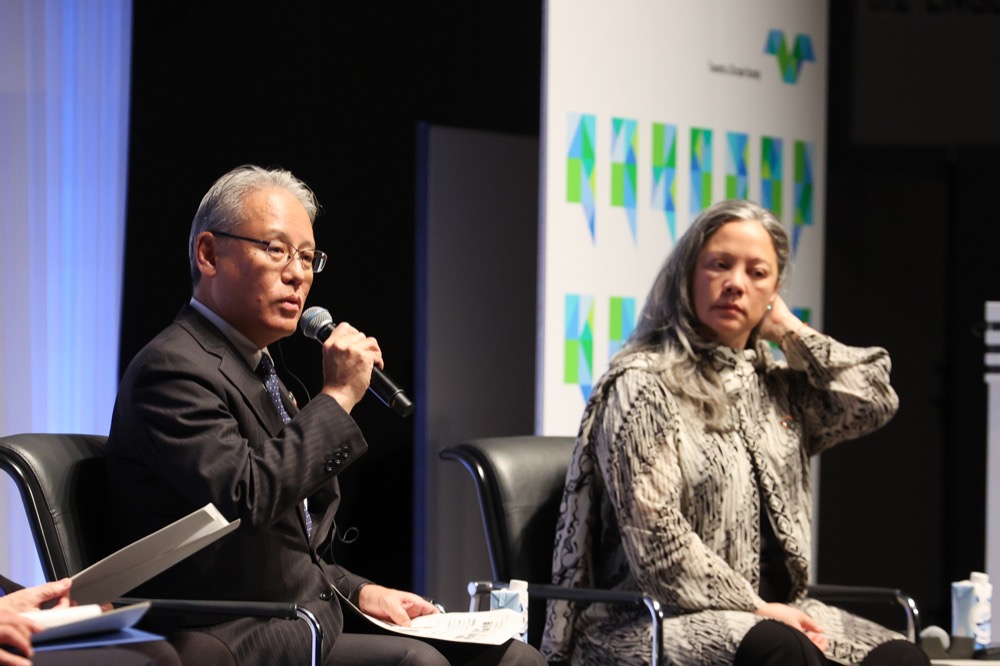
To close the session, each speaker shared their vision for the future of resource circulation and the direction Yokohama should aspire to.
Fujieda began by emphasising the importance of “economic viability” and “style” that go beyond simple recycling.
“Upstream producers must make the effort to use recycled materials, and the waste and recycling industry must make the effort to make those materials worth using. In public-private partnerships too, substantive cooperation—including financial support—is essential. Above all, pursuing economic advantage is what keeps activities going. I want to bring in creative thinking and build a style that makes resource circulation genuinely cool.”
Haseba then spoke about the need for a realistic approach with an eye on achieving carbon neutrality by 2050.
“There are many approaches available, but I believe the realisation of the circular economy is built on the steady accumulation of grounded, practical efforts. To achieve that, governments, local authorities, citizens, and a diverse range of businesses must work together more closely than ever before.”
Finally, Oshima reflected on the role expected of local government:
“What the city is called upon to do is to act as a bridge. By continuing to build connections, I hope to see new business opportunities emerge for local companies and start-ups, and for a virtuous cycle of environmental and economic benefit to take hold.”
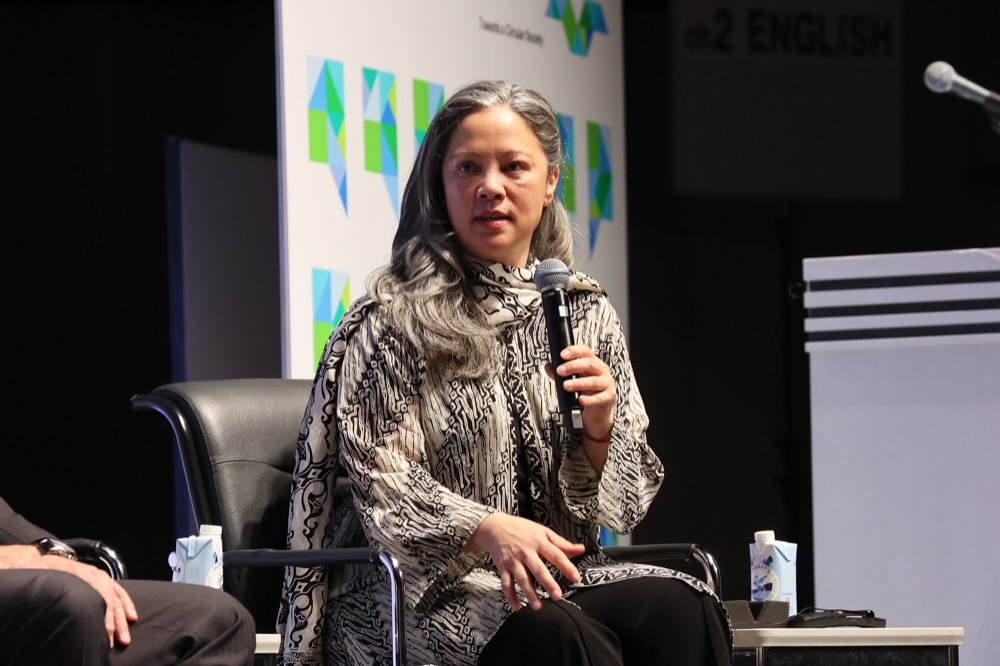
As a closing message to the session, Ivonne Bojoh, CEO of the Circle Economy Foundation—a leading international voice on the circular economy—offered the following words:
“The next 25 years leading to 2050 will be defined by how well society as a whole can build systems and designs that prevent products from losing their value.”
In the conventional linear economy, products are made from resources, lose their value after use, and ultimately become waste. The circular economy, by contrast, aims to keep products circulating at high value before they ever become waste.
Of particular importance is creating systems in which globally distributed products can be reused and have their materials recovered at high value even after use. Bojoh noted that going forward, in addition to advancing recycling technologies, there is a growing need for circulation to begin at the product design stage—designing for repair and reuse from the outset.
What the YRC Platform is connecting is not only resources. The aspirations of people who believe in a sustainable future intersect with the technical capabilities to make that future real, and new forms of circulation are being born in this city every day.
Companies that had never previously crossed paths are now connecting; through dialogue with local government and citizens, they are imagining and continuously refining a better future. It is precisely this spirit that hints at the next chapter for Yokohama’s resource circulation model. The challenge of “questioning value”—pursued by a diverse range of actors from large corporations to local players—is set to become the very core of resource circulation in the years ahead.