※ This article is reprinted from “Ideas for Good“.
【Kyoto Circular Economy Special Feature】
This special feature is a collaborative project between IDEAS FOR GOOD and the City of Kyoto, exploring the present and future of the circular economy in Kyoto. How can the spirit of “shimatsu no kokoro” (the Kyoto tradition of mindful frugality and waste-free living), the circular lifestyles, and the craftsmanship culture that have been passed down through a thousand years of history in this ancient capital be developed into innovations that will shape the Kyoto of tomorrow — and give rise to circular businesses that endure for the next thousand years? Together with the City of Kyoto, local businesses, and Akihiro Yasui, a policy advisory consultant to the City of Kyoto, we explore the value and potential of Kyoto through the lens of the circular economy. (Kyoto Circular Economy Special Feature Top Page)
The circular economy is not simply about reusing things over and over again. Underlying it are inherited skills and culture, and the wisdom and relationships cultivated over long stretches of time.
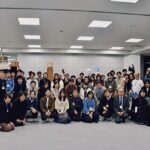
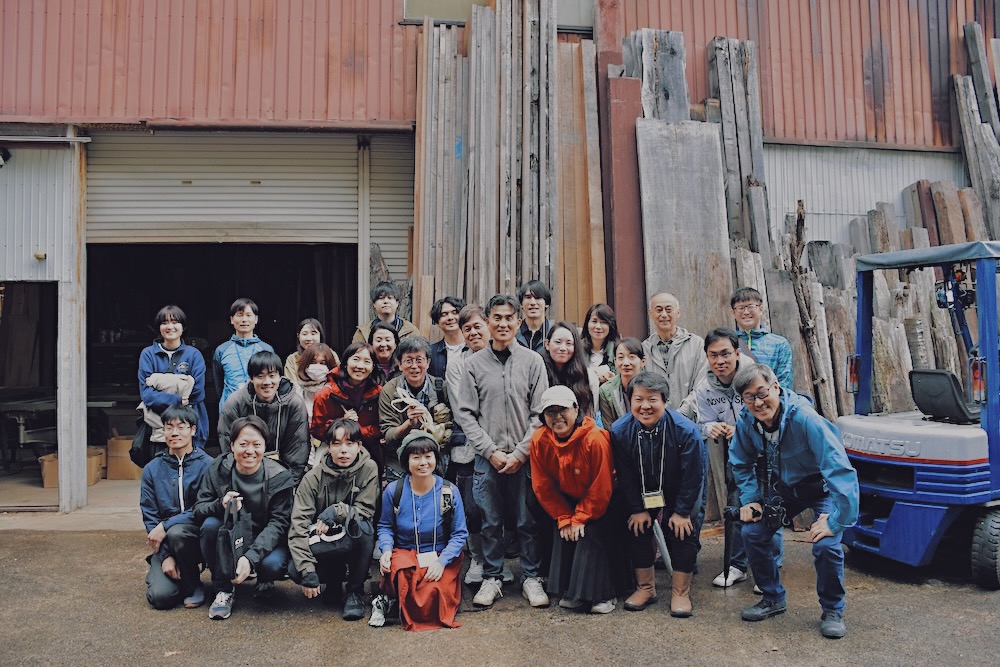
Seeking to absorb exactly that kind of learning, participants in “Circular Business Design School Kyoto (hereafter CBDS Kyoto)” — a hands-on circular economy business development programme organised by the City of Kyoto and operated by Harch Inc. — set out into the streets of Kyoto on a rainy autumn day.
The fieldwork took participants through the heart of the city: Kitayama cedar forests that have been cultivated since the Muromachi period (14th–16th centuries); a sukiya (traditional Japanese-style) carpenter who challenges himself to co-create with his clients; an aburi-mochi (grilled rice-cake) shop that has existed alongside its shrine for centuries; and a park where urban nature restoration is underway. By visiting these sites where circularity is both inherited and newly born, participants witnessed the many faces of “circulation” stretching from past to future. This article shares the learnings from that one-day journey.
To the Source of Kitayama Cedar: Learning an Attitude of Coexistence with Nature from a 600-Year-Old Technique
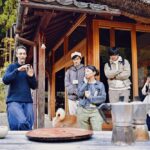
A thirty-minute bus ride north from central Kyoto brings you to Nakagawa Hachimangu Shrine in the Nakagawa district of Kyoto, home to the “parent cedar” (oya-sugi) of the Kitayama cedar, and to the workshop of Kunimitsu Hata, a sukiya carpenter who works with these cedars. Kitabayashi, the day’s guide from COS KYOTO, opened with a teaser: “To give away the punchline first — all Kitayama cedars are clones.”
Those clones are produced through a cutting technique said to have been devised during the Muromachi period. It is so rare in global terms that researchers holding doctorates from Harvard and MIT have reportedly contacted the community asking to come and see “humanity’s first cloning technology” for themselves.
Kitabayashi: “Unless we think about how to apply technology in order to live alongside nature, we simply cannot generate circularity. I believe the starting point for that thinking can be found right here in the Kitayama cedar.”
Arriving at Nakagawa Hachimangu Shrine and walking inside, visitors are suddenly confronted by a single enormous cedar standing quietly among the trees.
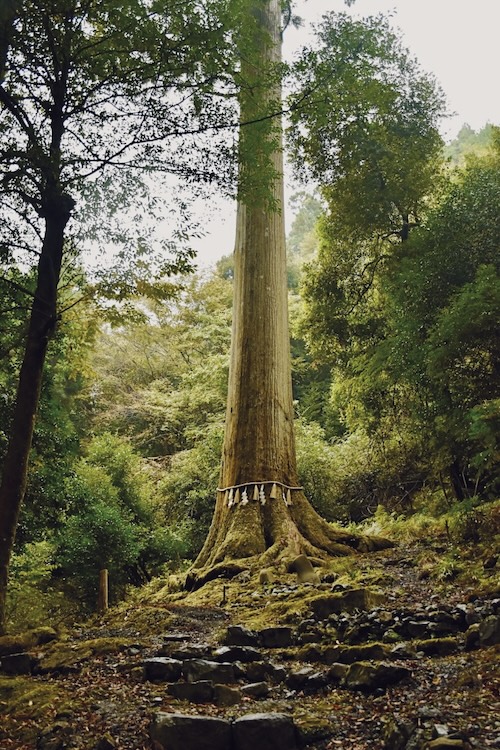
Hata: “This is said to be the origin of the Kitayama cedar, and it is about 600 years old. Kitayama cedars have long been propagated by a method called sashiki (cutting), in which a branch is cut off and pushed directly into the ground to produce an identical clone.”
This production method was established in order to mass-produce timber with special characteristics — such as the smooth-surfaced polished round logs (migaki-maruta) and the distinctively textured “natural twist-grain” (tennen shibori) logs often used for decorative pillars. It arose from a deep understanding of the forces of nature, at a time when the very concept of DNA did not exist. The people of this community have adorned this parent tree with a shimenawa (sacred rope) as an offering of gratitude, and have practised forestry on this land ever since.
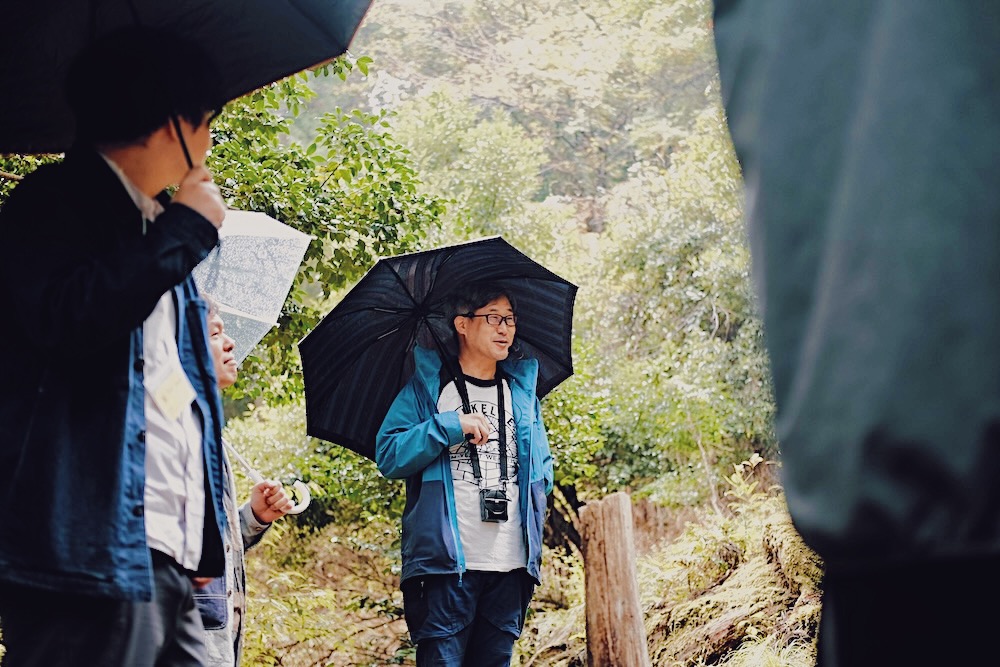
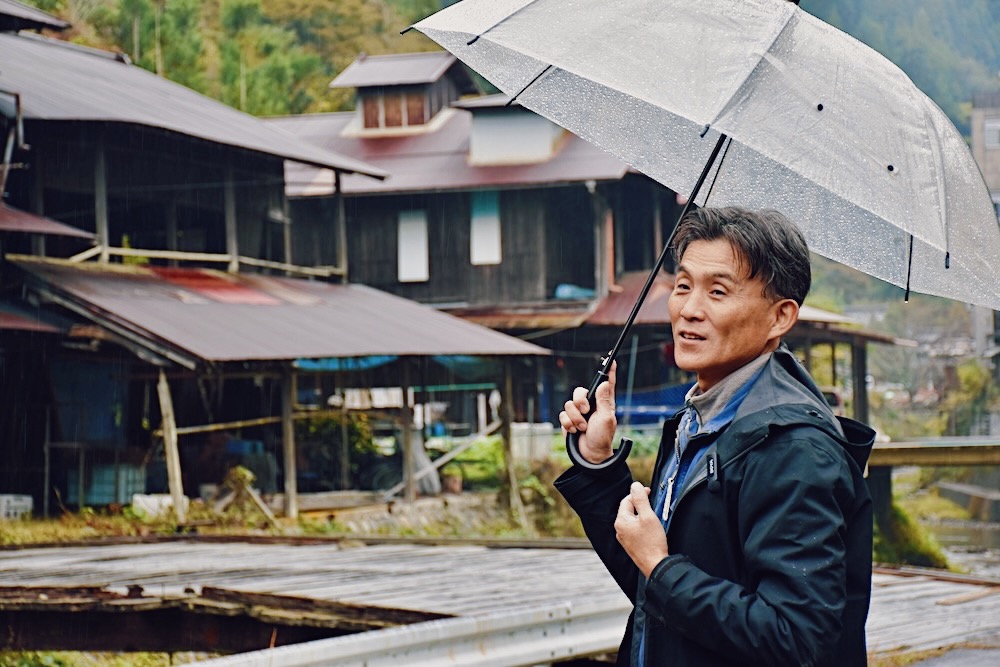
Yet this accumulated wisdom and technique cannot be maintained without the continued involvement of human hands. While carefully tended Kitayama cedars spread across the mountain slopes, cedar groves left unmanaged — with branches unpruned — are also reportedly visible here and there. When cedar forests cleared for forestry are abandoned, they do not revert to their original ecosystem; instead they become dark, species-poor woodland that can drive wildlife into urban areas.
Japan’s forestry industry as a whole was squeezed for years by cheap imported timber, and as a result the industrial system that once felled trees in the mountains, processed them, and delivered them to cities has been severed. Hata laments this situation.
Hata: “Japan has an abundance of trees, yet we import timber from overseas. I think something has gone very wrong. I genuinely wonder why we can’t keep that circulation within Japan.”
At the same time, Kitayama cedar faces a distinct set of problems. As Japan’s economy has stagnated, the shift away from traditional Japanese-style rooms (washitsu) has accelerated, and the population practising the tea ceremony has declined. As a result, architecture that uses Kitayama cedar has fallen sharply, and the very survival of the material itself is now in question.
The techniques that our predecessors learned from nature, and the contemporary challenges that arise when those connections are severed — the Kitayama cedar lays bare both the light and the shadow of circularity: what flourishes when humans and trees are intertwined, and what withers when they are not.
Tradition Means Protecting the Essence While Weaving New Value
Leaving the Kitayama cedar forest behind, the group visited Hata’s workshop. Hata is a sukiya daiku — a carpenter specialising in sukiya architecture, the refined, understated style exemplified by the tea room. Yet his work extends well beyond tea rooms. He fuses techniques handed down from earlier generations with contemporary architecture, capturing people’s hearts in the process.
For example, in the interior of one sushi restaurant he placed a single symbolic pillar made from an old chestnut beam called an inagi — the type of post traditionally used to hang harvested rice stalks for drying.
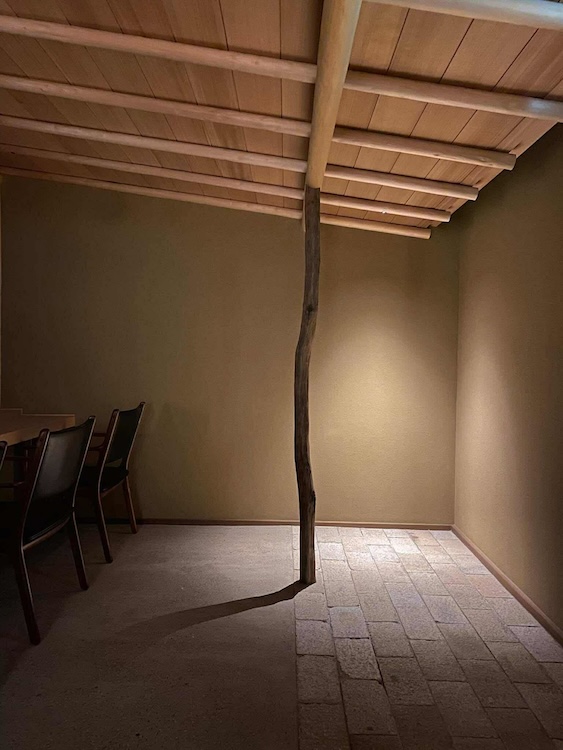
Hata: “Rice is everything to a sushi restaurant, so I absolutely wanted to use this one post — something that had supported rice. This is not about being eccentric; it is my own playful spirit as someone who loves (suki) giving meaning to weathered materials shaped by human life. In my work I generally aim for ‘architecture that does not assert itself too strongly.’ Architecture that coexists with nature, preserves the sculptural beauty of natural materials, makes you feel as though you are in a forest or on a mountain, and yet is filled with aesthetic sensibility. I work with a sense of seeking harmony with nature while protecting what is central to the space. The representative timber used in sukiya and tea-room architecture — architecture that does not assert itself — is the Kitayama cedar polished round log.”
Listening to the voice of the material and considering the harmony of the entire space — that sense of balance is surely the essence of the sukiya carpenter’s craft.
In recent years, Hata rescued from demolition a replica of the Taian (待庵) — a National Treasure tea room — that had been built for vibration experiments following the lessons of the Great Hanshin-Awaji Earthquake (which struck the Kobe-Osaka region in January 1995). He renamed it “T-an (the Dancing Tea Room).” There were even discussions about bringing it to the Venice Biennale. He has also been involved in a project to scientifically demonstrate the earthquake resistance of traditional architecture. The “base-isolation structure” in which pillars simply rest on stones — with no fixed connection — is an example of ancestral wisdom designed to absorb and deflect the energy of earthquakes.
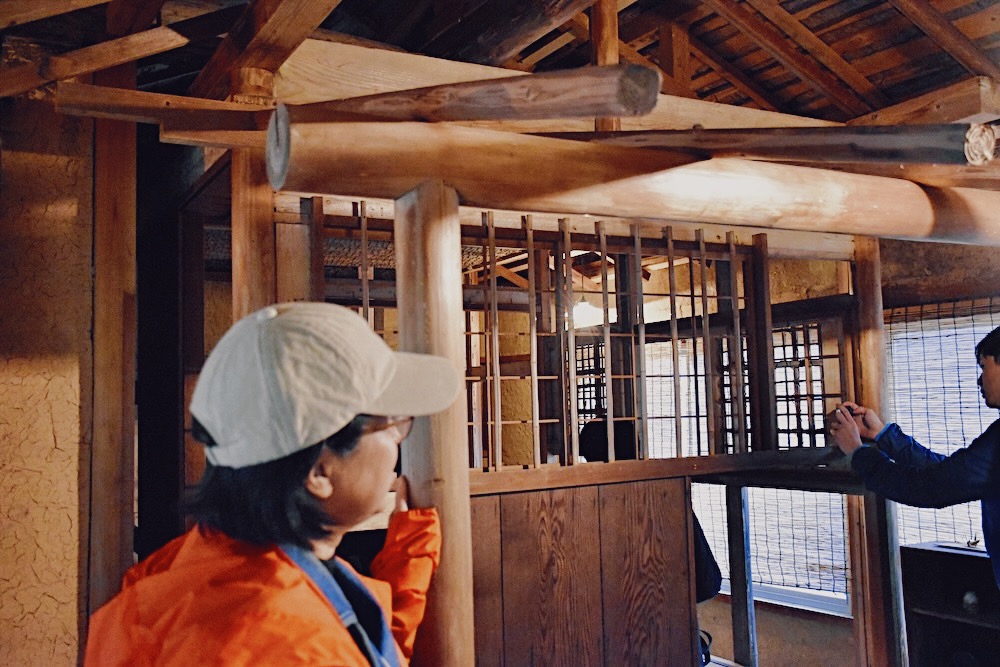
Preserving tradition does not mean stubbornly adhering to a single fixed method. It may mean understanding and maintaining the essence, fusing it with contemporary technology and sensibility, and continuing to create new value.
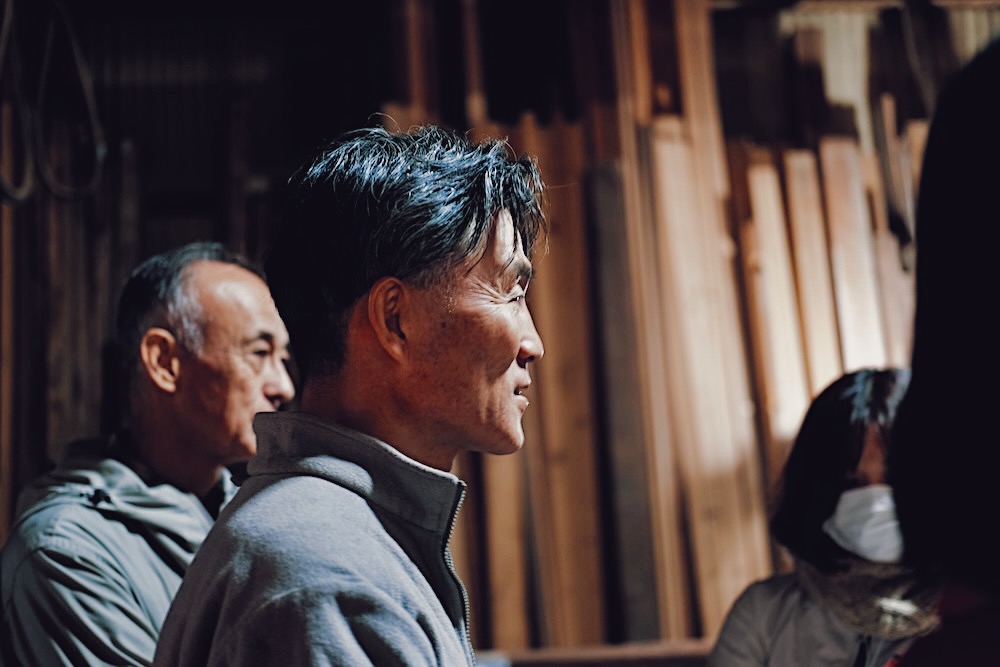
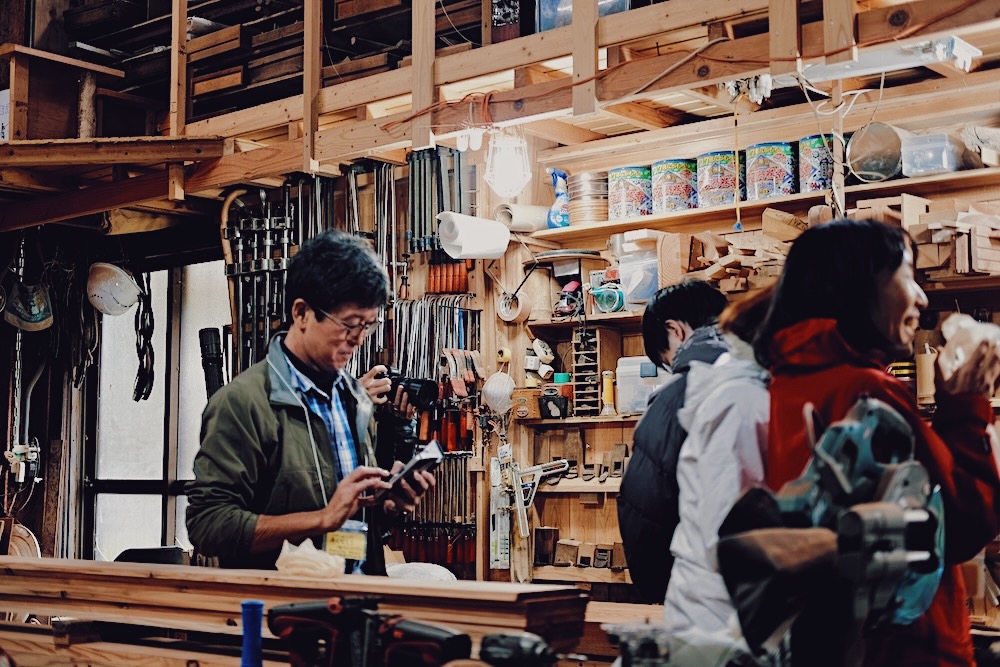
Once human hands have shaped a natural environment, continued human involvement is what keeps it circulating and in a healthy state. The presence of craftspeople like Hata, who keep their hands on the timber, points to one way of responding to the environmental challenges that Kitayama cedar faces as humans and nature grow more distant from each other. Drawing on that attitude, how might we carry forward into contemporary society the “circulation in coexistence with nature” that is in danger of being lost? And how might we express that value in order to pass it on to the future?
It seemed as though each participant was absorbing, through all five senses, questions that could not yet easily be put into words.
Rooted in the Community: Unpacking a Thousand-Year-Old Economic Ecosystem
The next stop was Imamiya Shrine in the Murasakino area of Kita Ward. Passing through the shrine precincts, visitors find two aburi-mochi (grilled rice-cake) shops standing facing each other. One of them is Ichimonjiya Wasuke, founded in the second year of the Chōhō era of the Heian period (the year 1000 CE), and affectionately known by its short name “Ichiwa.”
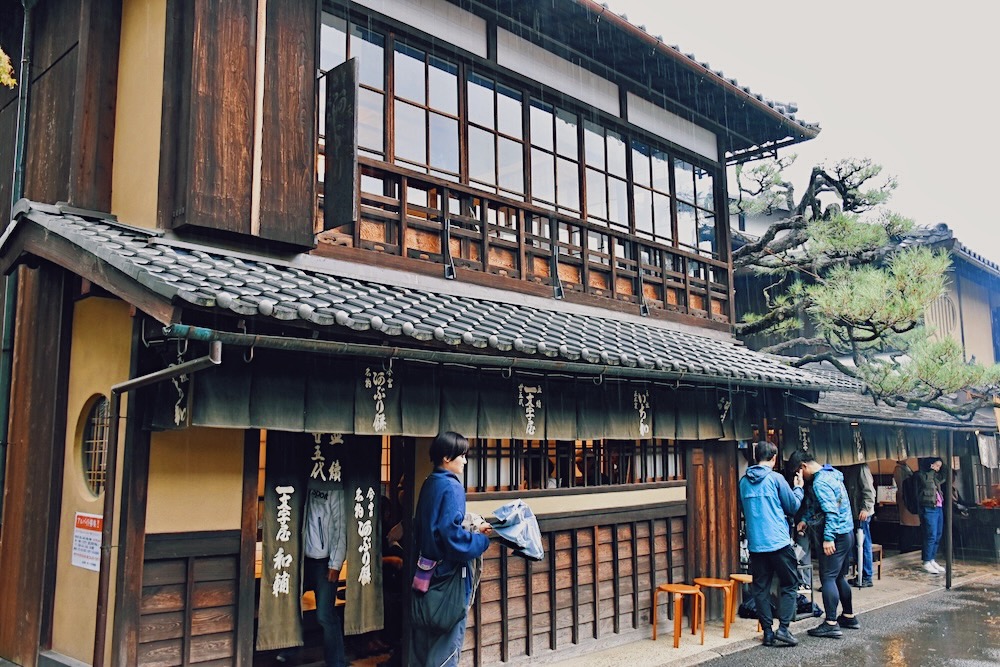
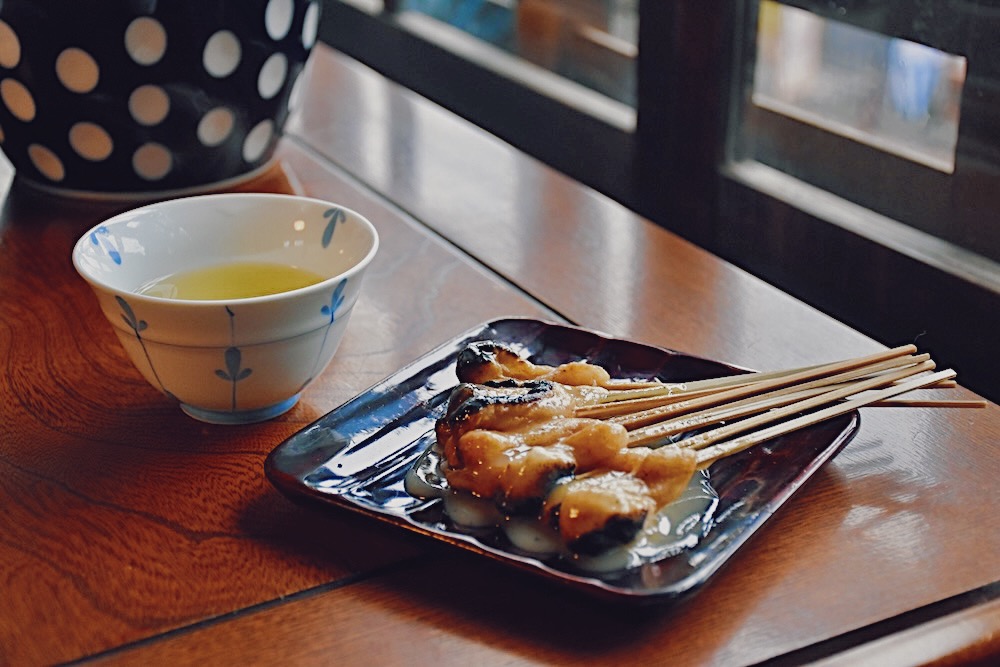
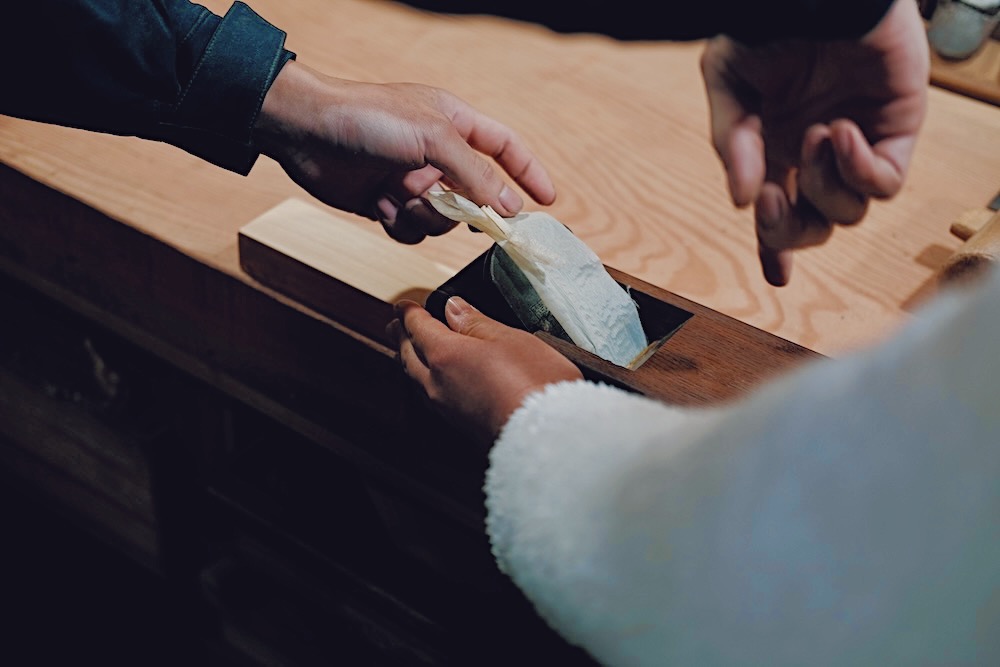
The shop’s origins lie in the practice of sharing with worshippers the sacred rice cakes (o-sagari) that had been offered to the deity during festivals. The business was born, in other words, from an act of service.
The group was welcomed by Nao Hasegawa, the 25th-generation proprietress.
Hasegawa: “We offer the sacred food (shinsен) to the deity and then receive it back as a blessing. Because the rice cakes were hard, we would first pound them into small pieces and grill them. In those days sugar was not available to ordinary people, so they were eaten with only the sweetness of white miso — and it is said that doing so brought an epidemic to an end. That is how it all began.
Even now, every year at the festival we get up early in the morning and bring the sacred offerings. If we don’t move, the mikoshi (portable shrine) doesn’t move. The fact that this has continued from generation to generation — that is something I am truly grateful for.”
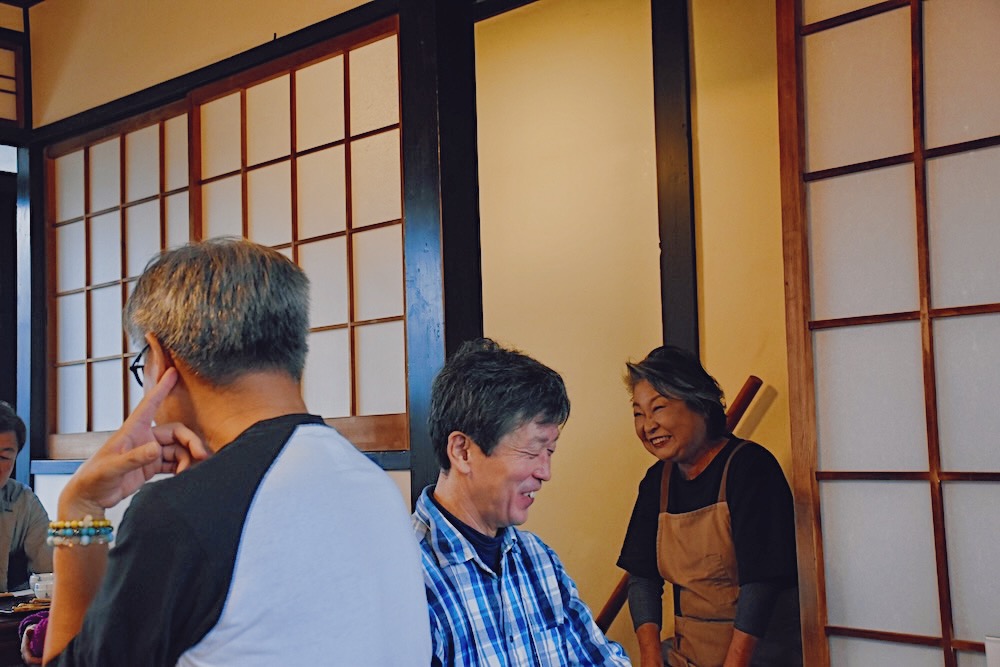
Over more than a thousand years of history, the shop has faced existential crises on multiple occasions. It has survived them by dividing roles: some family members went out to work and support the household financially, while others stayed home to fulfil the shop’s duties of service to the shrine.
The shop also received guidance from the public health authorities regarding hygiene standards for making mochi at the front of the shop. “In a thousand years, not one person has had an upset stomach from our mochi. We’ve been here longer than the health department,” Hasegawa said with a smile — and the shop has since moved production indoors. Flexibility in adapting to the times is necessary, yet what must not change is preserved.
Hasegawa: “Keep the foundation in place and simply align yourself with whatever era you are in. Just make sure there is one unbroken thread running through it all. Without that, a business will snap.”
The goal was never simply to keep the business going. Ichiwa has lasted a thousand years because it was needed by the local community and because it protected what was worth protecting. The history of Ichiwa may be a reflection of the harmony between economy, culture, and community.
Reclaiming a “Forest of Life” from Scratch: Thirty Years of Experimentation at Umekoji Park
The final stop of the fieldwork was Umekoji Park. Once the site of a vast railway marshalling yard, this space has been transformed over thirty years into a nature-rich park.
With Kitabayashi’s words — “The conclusion is: yes, nature can be reclaimed” — ringing in their ears, the group made their way through the park and into the inner area known as the “Forest of Life” (Inochi no Mori). Here, various experiments are underway to restore the land’s original ecosystem while keeping human management to a minimum.
Thirty years ago this was a concrete-covered site. Today, more than 600 plant species, 80 bird species, and 380 fungal species have been recorded here. Biodiversity is steadily reviving in the middle of the city.
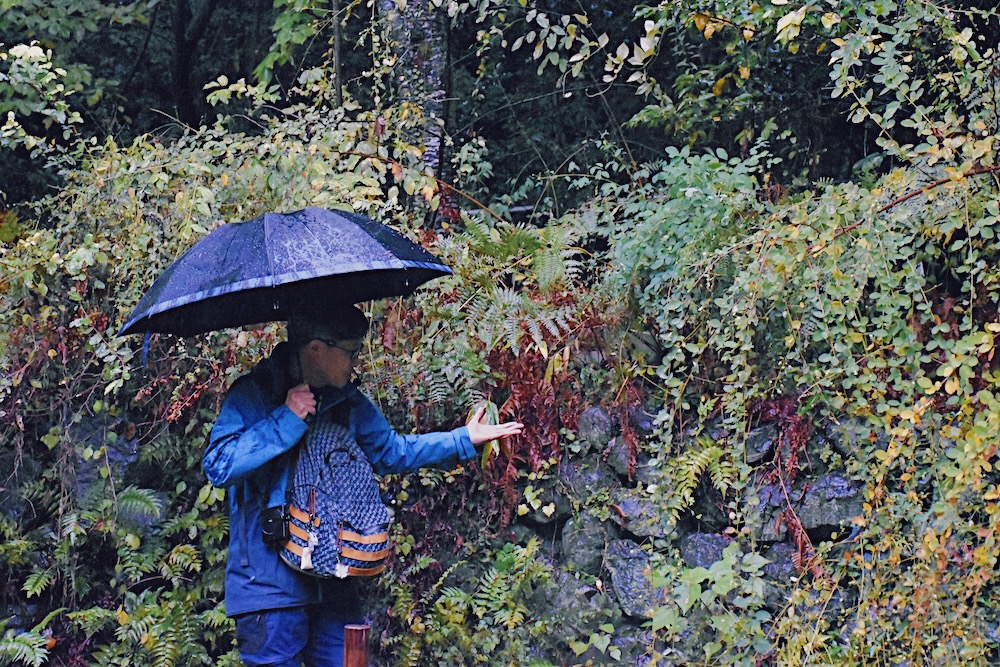
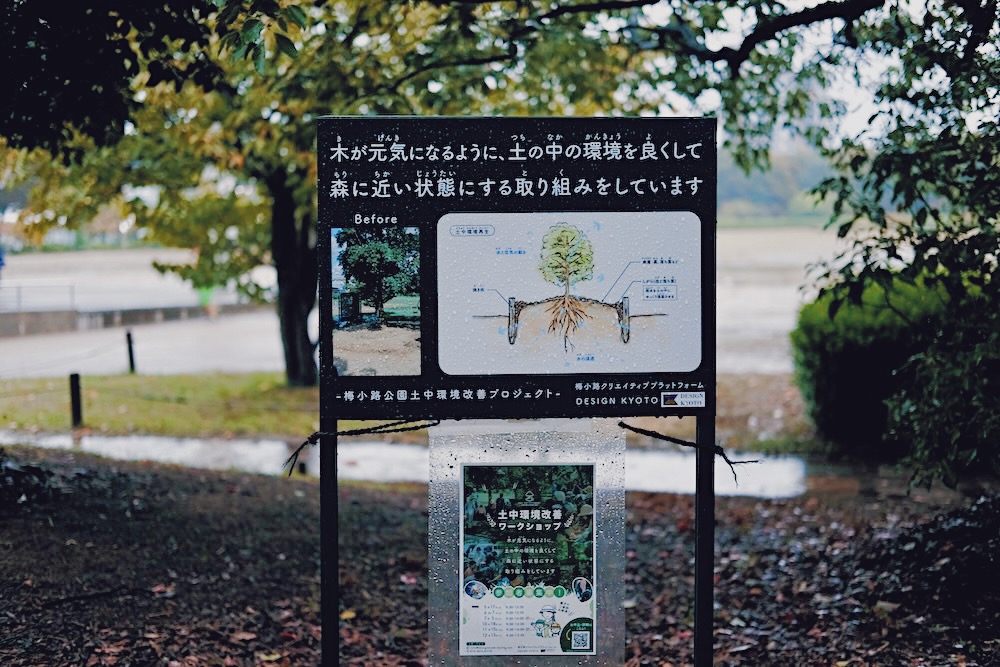
In another area of the park, however, the soil is compacted and hard, and no vegetation grows. Kitabayashi and his colleagues are addressing this through citizen-participation workshops on improving the underground soil environment.
The process begins by driving stakes around a tree to create channels for water and air to move through the soil. Pruned branches are then woven in a lattice pattern around the stakes (a technique called shigарami), and fallen leaves are packed inside. Microorganisms break down the leaves, enriching the nutrients in the soil. In this way, soil that had been compacted and impermeable to rainwater gradually loosens, and green shoots begin to emerge once more.
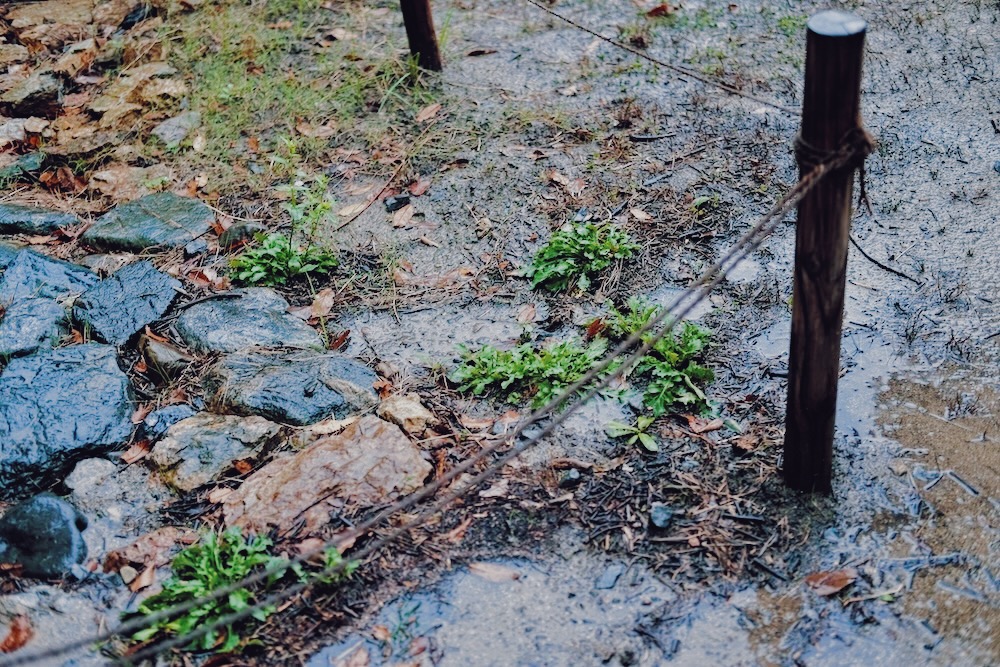
Kitabayashi: “When humans step in and create conditions in which living things can truly live, plants and animals will always respond. If you prepare an environment where life is possible, everything can live — and it’s the same for people too. It’s very hard to make plants grow exactly where you want them to; what matters is preparing the right environment.”
Another challenge the park faces is food waste from events held on the grounds. A project called “Shigen ga Kururi” (Resources Going Round) is under way, aiming to compost that food waste and reuse it in the park’s flower beds and the satoyama (traditional rural landscape) area of the Kyoto Aquarium — creating an on-site resource circulation loop. However, some vendors began over-ordering food on the assumption that any surplus would simply be composted. A system designed to eliminate waste was, paradoxically, at risk of encouraging more food waste.
Kitabayashi: “The original intention was to compost whatever waste inevitably arose and reuse it, so as to bring waste to zero. But if you neglect the effort of communicating that intention, people quickly drift toward the easier option.
That undermines the motivation of everyone who is working hard on the composting. So it’s not enough just to set up a system or to be doing something good — you have to create an enjoyable format that keeps people’s commitment alive. That’s the challenge we’re working on right now.”
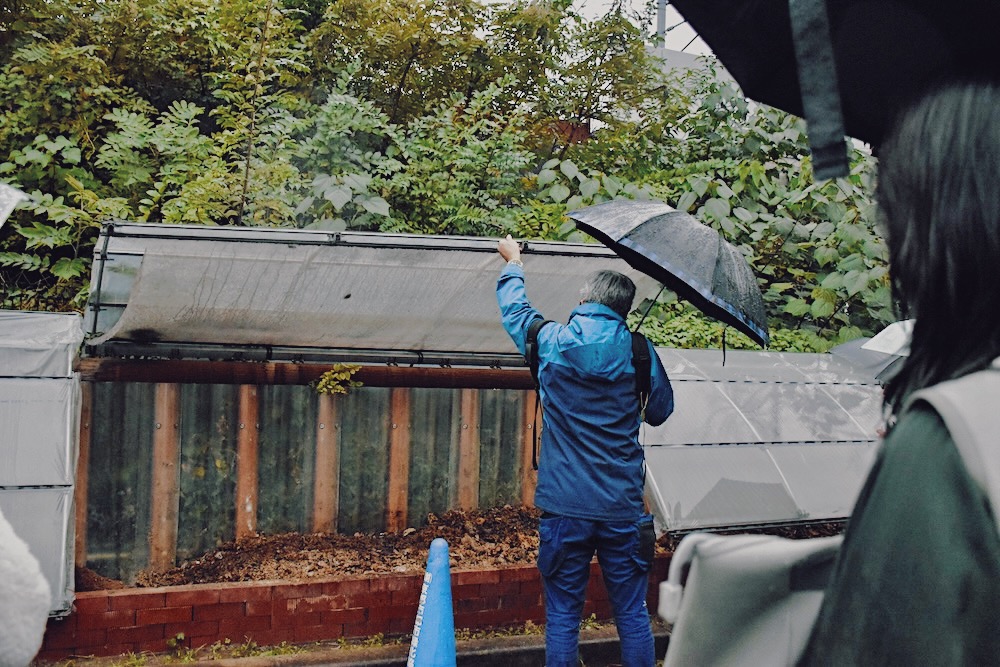
The work at Umekoji Park offers a vision of hope for nature restoration. At the same time, it brought into sharp relief a challenge that systems and technology alone cannot solve: the need to change human awareness and behaviour — one of the key hurdles on the path to implementing the circular economy.
What Will We Pass On to Future Generations?
At the end of the day, participants reflected on what they had learned. The keywords that emerged as insights included “flexibility that circulates even while swaying,” “reconnection with daily life and culture,” and “division of roles and the right material in the right place” — a wide range of perspectives filled the air. Then one question was put to the group:
“Do we really need to last a thousand years? What struck me as more important is the idea that something lasted a thousand years as a result — because it had meaning and was needed.”
The Kitayama cedar, the skills of sukiya carpenter Hata, the aburi-mochi of Ichiwa — none of them made “continuing” their primary purpose. They have endured to the present as the result of facing nature honestly, responding to human needs, and serving their communities. The activities at Umekoji Park may be standing at the very entrance to that same journey.
What seems, in retrospect, to have been one element of the tool for building those relationships was something that connects to circulation itself. Rather than viewing a business purely as an individual entity, one’s role becomes to understand the web of relationships that sustains you and to act in ways that pass that web on to the next generation — and it is that behaviour which constitutes the business. The totality of those connections is, perhaps, what allows things to circulate — as a business, and as a community.
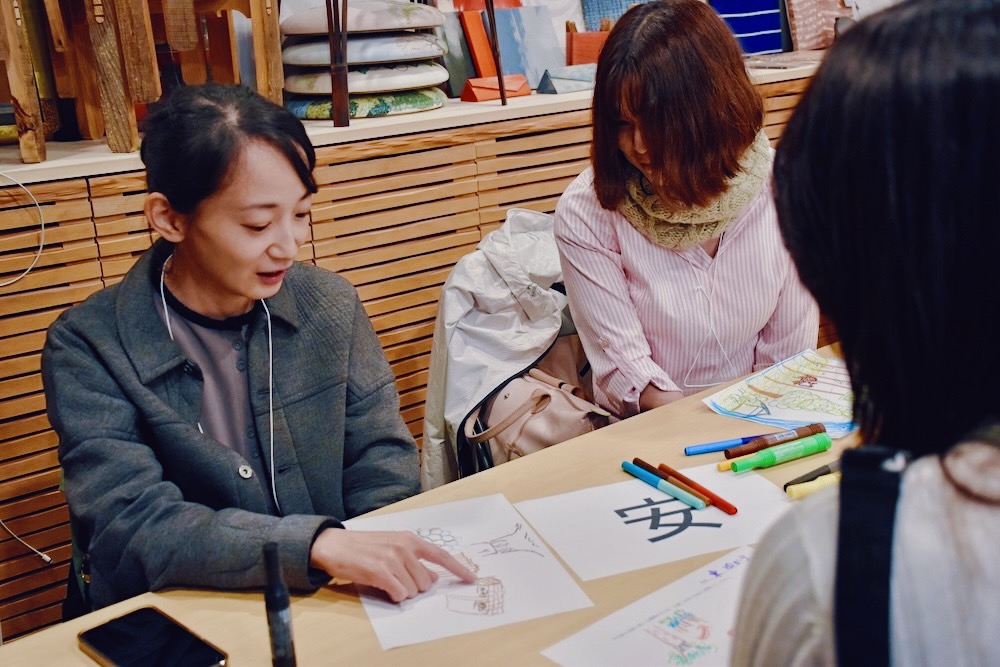
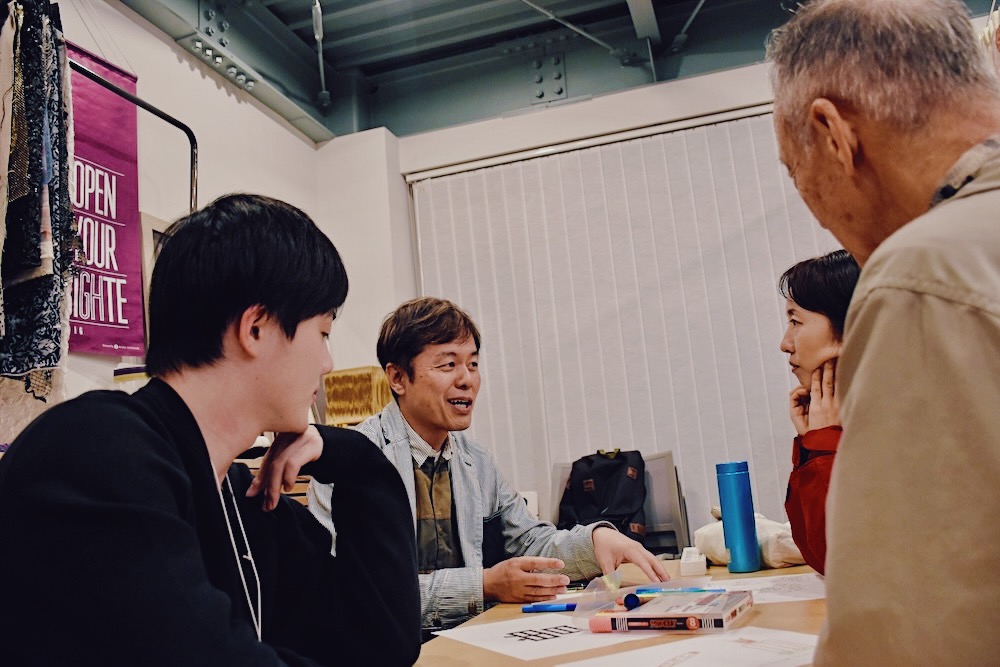
Rather than pursuing economic rationality alone, within what kind of ecosystem should one position the circulation of one’s own business so that it can also be sustained economically as a result? — Carrying with them the questions gained in the streets of Kyoto, the exploration of CBDS Kyoto continues.
The next session will take participants to Keihoku (a mountainous district in the northern part of Kyoto City) for the second fieldwork. What interactions between nature and human life lie at the quietly rooted sources of circulation in that living landscape? We will continue to report through future articles.
About Circular Business Design School Kyoto
Kyoto holds assets that shine across the ages — the spirit of “shimatsu no kokoro” (mindful frugality), circular lifestyles, and a culture of craftsmanship, all nurtured over 1,200 years of history. Realising the circular future demanded by deepening global challenges such as climate change and biodiversity loss requires the creativity to draw on this accumulated wisdom and carry it forward. With that in mind, Harch Inc. — the operator of IDEAS FOR GOOD — launched a learning programme in October 2025 that combines the circular wisdom rooted in Kyoto with a forward-looking perspective grounded in cutting-edge circular economy knowledge, so that participants can together envision and realise the future they want. “Decode Culture, Design Future” — a circular future that extends beyond tradition, from Kyoto to the world.
Website: https://cbdskyoto.jp/