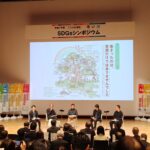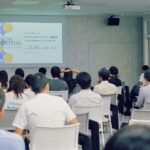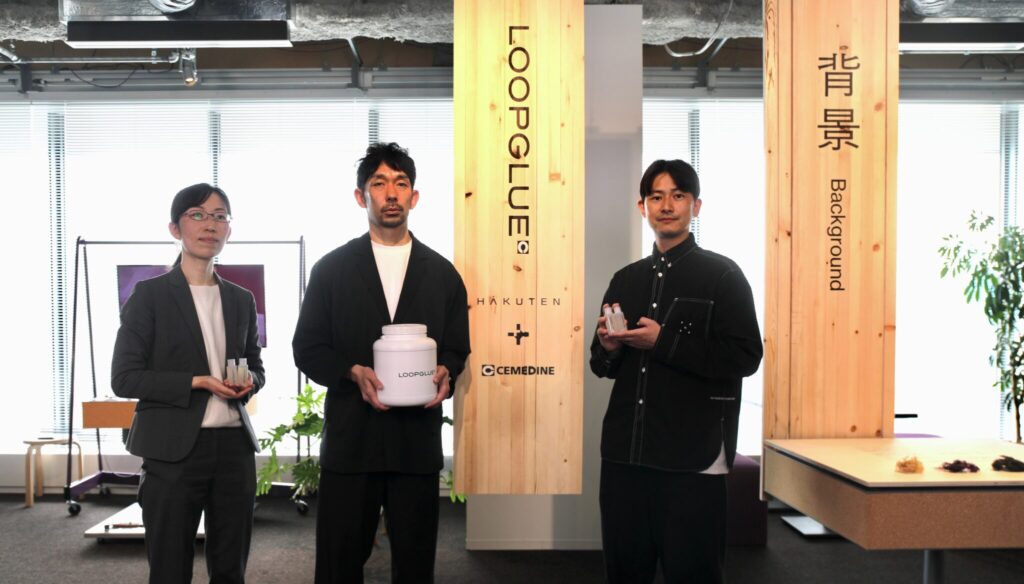
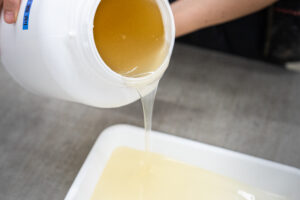
Hakuten Co., Ltd., design studio we+, and Cemedine Co., Ltd. have jointly developed LOOPGLUE, a seaweed-derived sodium alginate adhesive that can be removed with water, and recently held a live demonstration event.
When setting up temporary spaces for trade shows, pop-up events and similar occasions, surface-finishing work (known in Japan as hyogu work) involves adhering wallpaper and other coverings to walls and wooden panels using adhesive. However, removing these coverings cleanly after an event is notoriously difficult: residual glue and surface damage mean that wooden panels can typically be reused only around seven times before they must be discarded. LOOPGLUE, by contrast, bonds firmly under normal conditions yet becomes easy to peel away simply by adding water, and does so without damaging the substrate.
The project originated in research by we+ into underutilised marine resources. The team focused on the adhesive properties of sodium alginate — the viscous component found in seaweeds such as kelp and mozuku (a type of edible brown algae). At a networking reception following the 2023 International Marine Environmental Design Conference, the question arose of whether this slimy substance could be made into an adhesive, and a small collaborative project between we+ and Hakuten was born. After a period of DIY-style prototyping, Cemedine joined the effort with an eye toward commercialisation, contributing expertise in formulation optimisation and strength improvement to produce a product capable of real-world use.
Combining Adhesive Strength and Easy Disassembly to Accelerate Circular Design
LOOPGLUE has two defining characteristics. The first is that it is naturally derived. It contains no harmful chemical solvents, making it safe to handle. From the perspective of improving circularity in the events industry, this quality is itself a significant asset. Hokuto Ando (centre in the lead photograph), co-director of we+ and associate professor at Musashino Art University, notes: “We do mix in ingredients beyond sodium alginate, but our top priority was to use only naturally derived components.”
The second characteristic is that it achieves both strong adhesion under normal conditions and easy disassembly at the point of removal — properties that are typically in tension with each other. Kana Nishimura (left in the lead photograph), of the Standards Management Team in the Product Division at Cemedine Co., Ltd., explains: “Generally speaking, something that bonds firmly is hard to remove, and something that is easy to remove does not bond well. Adhesion and release are inherently a trade-off — but LOOPGLUE is designed to satisfy both requirements simultaneously.”
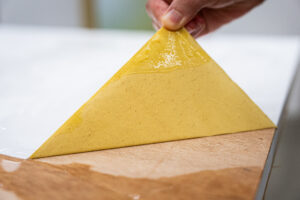
The removal process is remarkably straightforward. The adhesive is intended for use between porous materials such as wooden panels and paper: simply spray water onto the surface and wait a few minutes for the bond strength to drop sharply, at which point the wallpaper peels away cleanly. Cemedine has confirmed that LOOPGLUE releases faster than conventional starch-based pastes. At the live demonstration, the surface covering was peeled away in its weakened state without causing any damage whatsoever to the underlying wooden panel.
According to Nishimura, some adhesives can be removed by applying heat, but this approach is time-consuming and energy-intensive. LOOPGLUE, being water-releasable, reduces both the labour and the energy required for removal.
Hakuten estimates that the combination of significantly extended panel lifespans — from the current average of around seven uses to between ten and twenty — and the reduction in removal labour will cut both materials procurement costs and production labour costs by approximately 15% each.
Opening the Technology to the Entire Industry
Hakuten has set a medium-term goal of “creating all experiences and spaces through resource circulation by 2030.” The environmental burden of the events industry is a structural challenge, and the company has positioned itself as an industry frontrunner committed to addressing it as a core part of its mission. Ryosuke Suzuki (right in the lead photograph), General Manager of the Sustainability Promotion Division at Hakuten Co., Ltd., explains: “Temporary spaces consume enormous quantities of resources for an average of just two to three days — sometimes only a few hours. Of course, many decorative elements can be reused, but even so, a huge volume of waste is generated.” The company has established an internal Circular Design Room to pursue its stated goal across the full lifecycle of its event operations, and the development of LOOPGLUE is one element of that effort.
The immediate target is to use LOOPGLUE in 30% of the surface-finishing work Hakuten undertakes. However, exclusive use by Hakuten alone would not drive industry-wide change. The company therefore intends to make LOOPGLUE openly available across the industry rather than keeping it proprietary, once intellectual property matters such as patents have been resolved. According to Suzuki, there are already customers who have expressed interest in using it. Work is currently under way to establish mass-production capacity and set pricing, with the aim of making the product generally available within fiscal year 2026.
The Significance of LOOPGLUE for the Circular Economy: Three Perspectives
This development invites deeper examination from a circular economy standpoint across three dimensions.
1. Use of Bio-Based Resources with Ecosystem Considerations
Development of bio-based adhesives is advancing rapidly, with researchers exploring formulations based on lignin (a by-product of wood pulp production) and hemicellulose, among other materials. As with bio-based materials generally, sourcing must be conducted with careful regard for the ecosystems of the regions where raw materials are obtained.
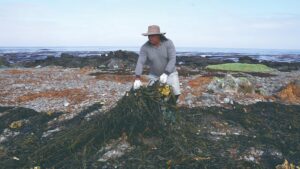
The seaweed used as the raw material for LOOPGLUE originates in Chile, South America. In Chile, an established industry collects only seaweed that has already completed its natural lifecycle and washed ashore (beach-cast seaweed), meaning that ecosystems are not disturbed and competition with food production is considered minimal. The three companies also note that the development and wider adoption of LOOPGLUE has the potential to create employment in Chile. Ideally, such a supply chain would be built closer to home — within Asia, or even within Japan — but the ecosystems, food cultures and industrial structures surrounding seaweed differ considerably by region. Sourcing through Chile, where the relevant industry already exists, is therefore the practical solution for now.
Relevant here is the way we+, which led the underlying research, describes itself: as “a contemporary design studio that explores alternative design approaches, cherishing diverse values and seeking an intimate coexistence with natural and social environments.” The process behind this project was guided by that philosophy. Accordingly, this development can be understood not merely as a material substitution — replacing conventional adhesive ingredients with bio-based alternatives — but as an extension of a broader pursuit of coexistence between nature and social ecosystems. As it becomes ever more important for circular material development to consider not only business factors but also environmental trade-offs and social dimensions such as inclusivity, a multi-perspective research process of this kind offers insights across a wide range of fields.
2. Easy Disassembly and Non-Destructive Removal as Enablers of Circular Design
The importance of easy disassembly in the circular economy continues to grow. Alongside adhesive-free approaches, on-demand debonding — where separation is triggered by specific stimuli such as heat, electricity or chemical agents — is gaining traction. Adhesives that facilitate easy disassembly and removal are being developed across a wide range of sectors and products, including apparel, medical devices, batteries and CFRP (carbon fibre-reinforced plastic). One notable example is the Adidas NIMBUS MIRAI, a recyclable shoe that attracted considerable attention: it uses a proprietary adhesive that releases under heat, enabling the shoe to be recycled. In this way, adhesives with “easy-release” functionality are becoming indispensable enablers of the transition to a circular economy.
Non-destructive removal — leaving the substrate undamaged — is equally important from the perspective of promoting reuse and similar strategies. On-demand debonding also makes it possible to avoid defaulting entirely to adhesive-free approaches in the pursuit of non-destructive outcomes.
This development has the potential to serve not only as a change in adhesive but as a starting point for transforming design itself into a circular practice. Ando reflects: “I think this opens up new possibilities for design.”
3. Using Material Innovation as a Starting Point to Transform Supply Chains and Business Models
A defining feature of LOOPGLUE is its potential to drive change not only in circular design but across entire processes and supply chains. It is frequently observed that developing circular materials and products necessitates creating corresponding processes, supply chains and business models — and this case appears to be a prime example.
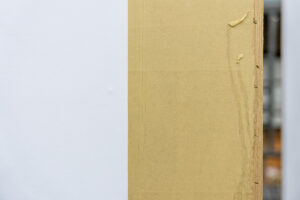
LOOPGLUE, for instance, has the potential to dramatically — one might even say revolutionarily — shorten the surface-covering removal process. With conventional adhesives, removal requires physical effort using scrapers and similar tools, leading to lengthy removal times, residue left behind and surface irregularities on the substrate.
LOOPGLUE holds significant promise for addressing these issues, but a key question is how to integrate it into existing workflows. Suzuki notes that how to incorporate the wetting and drying steps into operations will be a subject for future verification. The plan is first to conduct large-scale trials and validation within Hakuten itself, then to roll out the system — including the revised processes — more broadly.
The adhesive also opens up a range of possibilities at the business model level. In asset arrangements where ownership does not transfer — such as panels owned by the event company — each additional cycle of reuse directly reduces costs for the owner. In other words, when a company retains ownership of its assets and uses an adhesive that releases easily without damaging the substrate, the economic benefits are maximised and new models such as reuse and repair become viable. The ability to improve circularity while simultaneously strengthening the business case is the greatest commercial attraction when looking ahead to full commercialisation. “It is possible to enhance not only environmental value but economic value as well,” says Suzuki. It will be worth watching how LOOPGLUE — a product with wide-ranging potential — takes root both within and beyond the events industry.
【References】
- Hakuten, we+ and Cemedine Jointly Develop LOOPGLUE, a Water-Releasable Seaweed-Derived Adhesive — Harnessing Underutilised Marine Resources to Promote Resource Circulation in Exhibition Surface-Finishing Work (Hakuten Co., Ltd.)
- Joint Development with we+ and Hakuten of LOOPGLUE, a Water-Releasable Seaweed-Derived Sodium Alginate Adhesive (Cemedine Co., Ltd.)