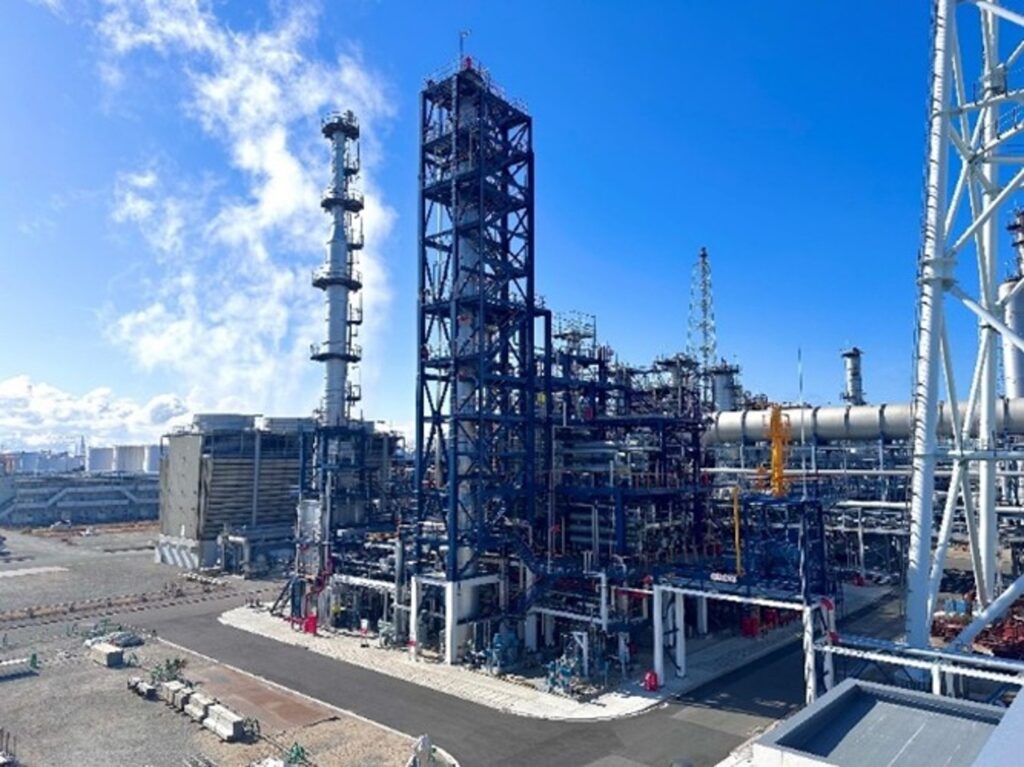
Cosmo Oil, Maruzen Petrochemical, Ube-Maruzen Polyethylene and SAFFAIRE SKY ENERGY LLC announced on September 17, 2026 that they will begin utilizing the naphtha co-produced during the SAF (Sustainable Aviation Fuel) manufacturing process at Cosmo Oil’s Sakai Refinery.
Naphtha is a feedstock for basic chemical products that underpin a wide range of chemical goods, and the four companies say that reducing its carbon footprint is essential to lowering the environmental impact of the entire supply chain. Naphtha produced from biomass feedstock offers higher environmental value than naphtha derived from fossil fuels, and is expected to become an important sustainable resource.
This initiative builds on a project selected in 2021 for a subsidy program run by NEDO (the New Energy and Industrial Technology Development Organization, a Japanese public R&D agency), titled “Building a Supply Chain Model for Biojet Fuel Production Using Domestically Sourced Waste Cooking Oil.” The SAF production facility at the Sakai Refinery, the first large-scale facility of its kind in Japan, was completed in December 2024 and began production in fiscal year 2025. The waste-cooking-oil-derived naphtha obtained from this facility is a co-product of the SAF produced by SAFFAIRE SKY ENERGY, and has obtained ISCC certification, an international certification system for sustainable products.
Under the arrangement, SAFFAIRE SKY ENERGY produces the waste-cooking-oil-derived naphtha, Cosmo Oil supplies it using the mass balance method, Maruzen Petrochemical manufactures basic chemical products from it, and Ube-Maruzen Polyethylene handles polyethylene production and its use in plastic products. The transfer of naphtha is carried out using the mass balance method under ISCC PLUS certification. The mass balance method is an approach used when sustainable feedstock—such as biomass-derived material—is mixed with fossil-derived feedstock, whereby the quantity of sustainable feedstock is allocated to part or all of the resulting products in proportion to the input ratio. Cosmo Oil, Maruzen Petrochemical and Ube-Maruzen Polyethylene have each obtained ISCC PLUS certification.
Because waste-cooking-oil-derived naphtha primarily uses domestic resources, it can reduce the environmental burden associated with transportation. It can also be used in the same manufacturing processes as conventional naphtha, contributing to CO2 emission reductions across the entire life cycle.
As an example of using biomass naphtha as a chemical feedstock, Mitsui Chemicals began in December 2021 to feed biomass naphtha—produced by Neste from waste vegetable oils and residual oils—into the ethylene cracker at its Osaka Plant, allocating it to plastics and chemical products via the mass balance method under ISCC PLUS certification. What distinguishes the current initiative is that it uses domestic waste cooking oil as the primary feedstock and utilizes naphtha co-produced within the same domestic SAF manufacturing process.
Featured image: Cosmo Oil press release
【Press release】On the Start of Utilization of Naphtha Co-Produced in the SAF Manufacturing Process
【Related release】Mitsui Chemicals to Begin Producing Plastics and Chemical Products from Biomass Naphtha at Its Osaka Plant
【Related article】Cosmo Energy Group Ramps Up Domestic SAF Supply, Expands Collection of Household Waste Cooking Oil in Partnership with Tokyo Metropolitan Government