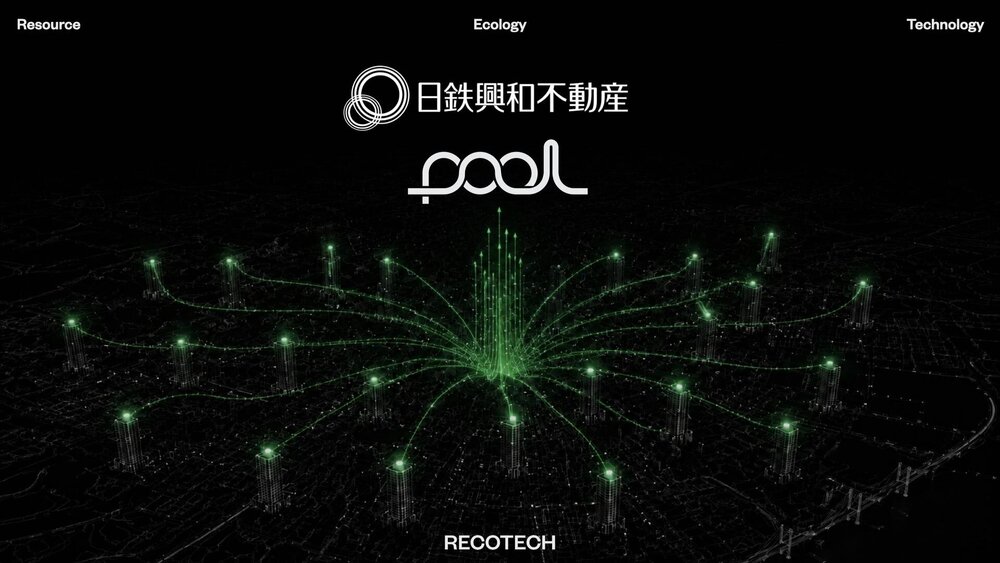
RECOTECH Inc. (hereinafter “RECOTECH”) and Nippon Steel Kowa Real Estate Co., Ltd. (hereinafter “Nippon Steel Kowa Real Estate”) have introduced RECOTECH’s resource circulation data infrastructure “pool” into office buildings owned and managed by Nippon Steel Kowa Real Estate, with operations commencing in August 2026. The initiative consolidates waste data that had previously been scattered across individual properties, with the aim of advancing resource circulation and strengthening ESG information disclosure.
In the real estate industry, accurately tracking and continuously improving the volume of waste generated by office buildings, recycling rates, and waste-derived CO2 emissions has become increasingly important in driving decarbonisation and resource circulation. Accurate, property-level waste data is also indispensable for preparing industrial waste management plans required under the Waste Management and Public Cleansing Act and resource reuse plans required under municipal ordinances, making waste data management an increasingly critical operational foundation for real estate businesses. At the same time, a persistent challenge has been the difficulty of assessing an entire property portfolio against a single standard, given that collection, transport, and processing contractors—as well as management and reporting methods—differ from property to property. Nippon Steel Kowa Real Estate decided to adopt pool in order to address this challenge.
pool is a next-generation resource circulation data infrastructure delivered via the cloud. It digitally connects information relating to the discharge, weighing, collection, material recovery, and procurement of waste and recyclable materials, and uses AI technology to aggregate and standardise that information, thereby enabling efficient circulation of waste-stream resources. In this initiative, the consolidated data will serve as a foundation for visualising resources across property boundaries and promoting resource circulation, while also automating the administrative work associated with ESG data disclosure.
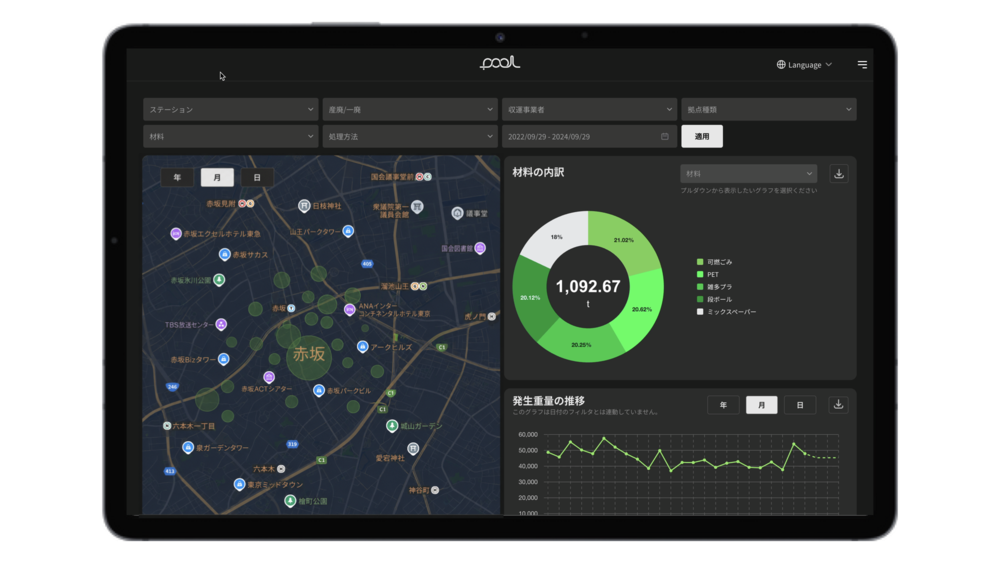
The introduction of pool is said to deliver the following three outcomes.
- Centralised management and standardisation of waste data, enabling the entire property portfolio to be assessed against a single standard.
- Advanced resource circulation: building on the consolidated data, the initiative will promote area-level visualisation of resources across individual properties, including resources that cannot be aggregated in sufficient volumes at a single property, with the goal of reducing overall waste generation.
- Streamlined ESG disclosure: the entire workflow—from acquiring and standardising waste data, to calculating recycling rates and emissions volumes, to organising the data required for regulatory submissions such as reuse plans filed with authorities and for international benchmarking frameworks used in real estate ESG assessment such as GRESB—will be consolidated within a single system.
Because pool can be adopted without changing existing management and reporting practices, no operational changes are required of collection and transport contractors or on-site building management staff.
Across the real estate industry, other companies are also advancing the infrastructure needed to standardise waste data. In April 2025, Ecos Co., Ltd. introduced its waste management cloud service “Ecologinet Plus” at BLUE FRONT SHIBAURA TOWER S, a mixed-use development promoted by Nomura Real Estate and East Japan Railway Company. Under this system, when tenants weigh waste at shared waste storage areas, the data is automatically imported into the system; for industrial waste, registration is also automated through integration with the electronic manifest system (Japan’s legally mandated digital tracking system for industrial waste). This enables the digitalisation of waste information for the entire facility and the automatic calculation of recycling rates and GHG emissions (Scope 3). The approach differs from pool’s in that it focuses primarily on tenant-level visualisation within a single facility, whereas pool aims to consolidate data across multiple properties.
Nippon Steel Kowa Real Estate and RECOTECH are positioning this deployment as a model case for waste data standardisation and advanced resource circulation in the real estate sector. Starting with the visualisation of data across all properties as a first step, they intend to translate the insights into improvement actions targeting higher recycling rates and lower CO2 emissions, while also pursuing the implementation of a circular economy at the area level through collaboration with neighbouring buildings and local communities. Both companies have stated that they will continue to deepen their partnership and accelerate the social implementation of data infrastructure, thereby contributing to the realisation of a sustainable, resource-circulating society.
【Press Release】Resource Circulation Data Infrastructure “pool” Introduced in Office Buildings Owned and Managed by Nippon Steel Kowa Real Estate — Consolidating Waste Data and Leveraging AI to Advance Resource Circulation and ESG Disclosure
【Press Release】Resource Circulation Data Infrastructure “pool” Introduced in Office Buildings Owned and Managed by Nippon Steel Kowa Real Estate
【Related Article】RECOTECH and the City of Yokohama Partner on Digital Waste Management via “pool”
【Related Article】Visualising Urban “Resource Distribution” to Accelerate a Circular Society: An Interview with RECOTECH Inc. Representative Nozaki
※ Images sourced from the press release