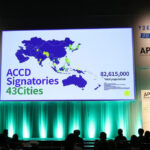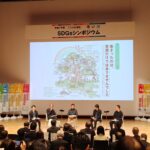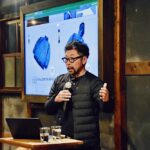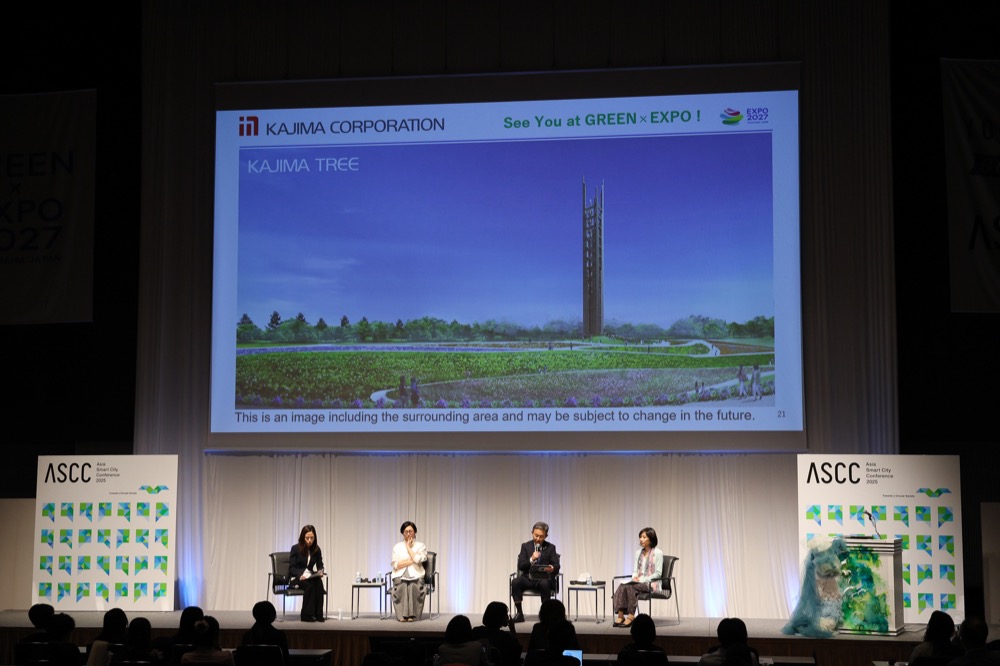
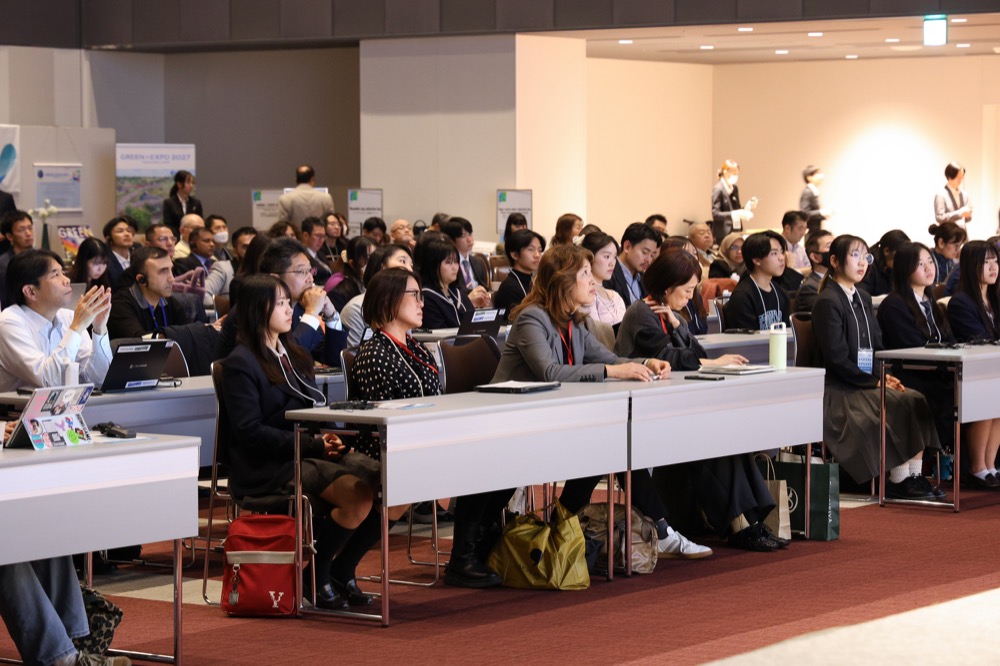
On November 26, 2025, at Pacifico Yokohama North, the Asia Smart City Conference 2025 (ASCC) hosted a talk session titled “Communicating a Circular Society through GREEN×EXPO 2027.”
The 2027 International Horticultural Exposition (commonly known as GREEN×EXPO 2027) aims to engage citizens in envisioning a “green society that coexists with the environment” and to share that vision with the world. On November 4 of the same year, the exposition marked the milestone of 500 days until opening. The session brought together speakers from the GREEN×EXPO Association and companies planning to participate, and explored how GREEN×EXPO 2027 can communicate the idea of a circular society both domestically and internationally.
Making Social Challenges Personal — A Venue That Educates and Excites
The session opened with an overview of GREEN×EXPO 2027 presented by Misa Kenmiya, Director of the Sustainability Promotion Division at the GREEN×EXPO Association. While the exposition takes flowers and horticulture as its central theme, she explained that it is conceived as an initiative that also addresses planetary-scale challenges — including climate change, biodiversity loss, and resource circulation — in recognition of the fact that modern society is pushing up against planetary boundaries.
The venue will feature a pavilion themed around “the power of nature.” The Japanese government’s exhibition is planned to include a Japanese garden drawing on the Izumigawa River as a water source, alongside indoor displays presenting possibilities for addressing challenges such as biodiversity loss and climate change. She also noted that, building on the momentum of the Osaka-Kansai Expo, which closed in October 2025, the organisation is actively stepping up its public outreach.
Kenmiya emphasised that the exposition is designed not merely to present exhibits, but to give visitors a reason to connect what they see with their own daily lives. The guiding design philosophy — “a venue where visitors can both learn and feel a sense of excitement” — was presented as a foundational premise for GREEN×EXPO 2027 as a whole.
Aiming to Give Visitors the Ability to “See the Invisible” — Just as in the Soil
During the session, Noriko Ishizaka, President and Representative Director of Ishizaka Sangyo Co., Ltd. — one of the companies planning to participate — highlighted “soil” as a symbol of the circular society.
Ishizaka Sangyo, based in Miyoshi Town, Saitama Prefecture, is engaged in industrial waste material recovery and environmental education. Ishizaka said, “I really want everyone to see this,” and displayed a single illustration on the screen.

“What I want to share with you today is the story of what lies beneath the soil. The roots of a plant are, in human terms, equivalent to the brain. It is through those roots connecting with the various nutrients, fungal networks, and ecological systems in the soil that beautiful flowers bloom. We live within a miraculous balance on this planet. The value of the earth itself has an enormous influence on our future. I hope GREEN×EXPO 2027 can be an opportunity for us all to think together about how to develop the ability to see what is invisible.”
Ishizaka spoke about the essence of resource circulation, drawing on examples from her company’s own operations.
“We transport waste from urban areas — waste that would ordinarily end up in landfill — and sort it down to the millimetre. A great deal of what we receive actually contains living soil, teeming with microorganisms. And yet we bury that soil in landfill and treat it as though it no longer exists. What have we actually been producing through our economic activity? It is while confronting that question that I want to keep resources circulating within a circular society.”
A circular society, she argued, is not simply about raising recycling rates; it is also about questioning the assumptions society makes regarding what counts as valuable. Ishizaka underscored this point and said that GREEN×EXPO 2027 holds great significance as a place where visitors can directly experience these “invisible cycles.”
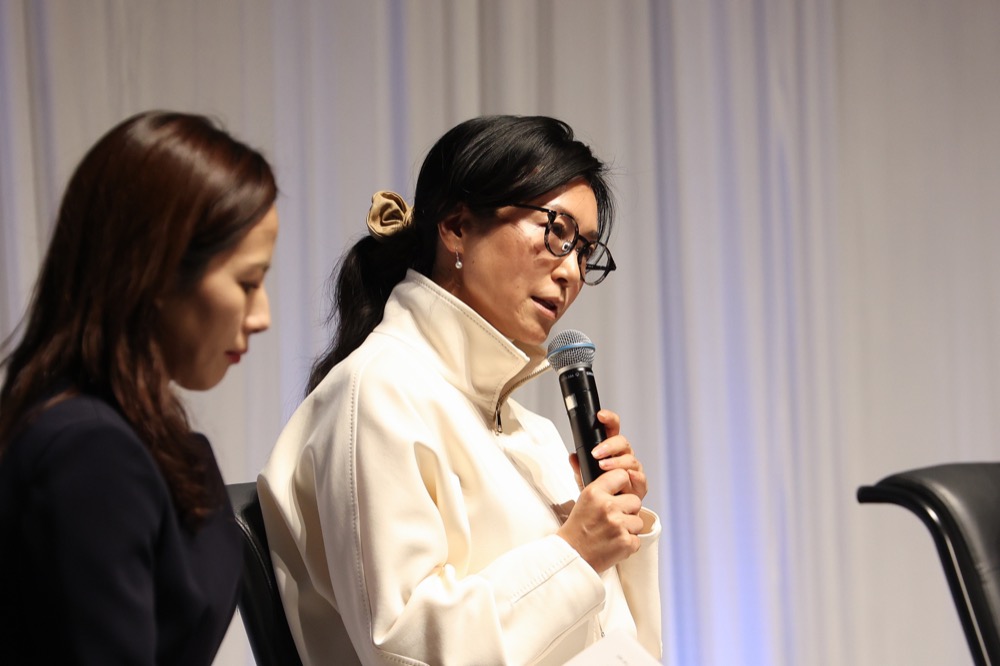
Connecting “Intentions” and “Resources” Through the EXPO Venue
The session then turned to how a green society would be communicated at the GREEN×EXPO venue, and what specific content was planned. Kenmiya cited “the intentions of the people and organisations involved” as one example of the “invisible things” Ishizaka had mentioned, and said that a key challenge for the venue was how to express and carry those intentions forward.
Multiple companies have already confirmed their participation in GREEN×EXPO 2027, and the concept for the Village Exhibition to be held within the venue is gradually taking shape.
“I hope it will become a place that conveys the connection between the power of green and industrial activity, and carries those intentions forward,” said Kenmiya. She also introduced the diverse range of content being planned: not only large corporations, but more than 370 organisations will participate through floral and horticultural displays; a “Satoyama Village” (a zone showcasing traditional Japanese rural landscapes and community activities) and an “Agriculture and Food Village” themed around food are also in the works.
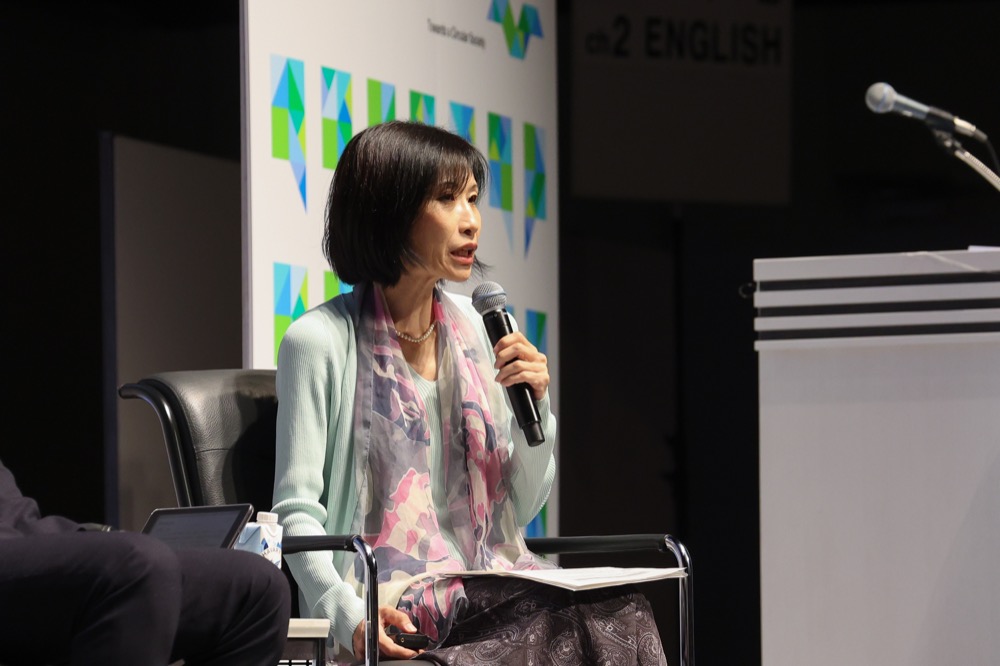
Hiroshi Noguchi, Deputy General Manager of the Environmental Division at Kajima Corporation — another participating company — introduced “KAJIMA TREE,” an approximately 60-metre timber tower that Kajima plans to exhibit at GREEN×EXPO 2027.
Intended to become a landmark of the venue, KAJIMA TREE will incorporate timber reused from the Grand Roof Ring of the Osaka-Kansai Expo. Advanced technology will be applied to give the wood new value, and the structure is planned to be reborn as a symbol of GREEN×EXPO 2027.
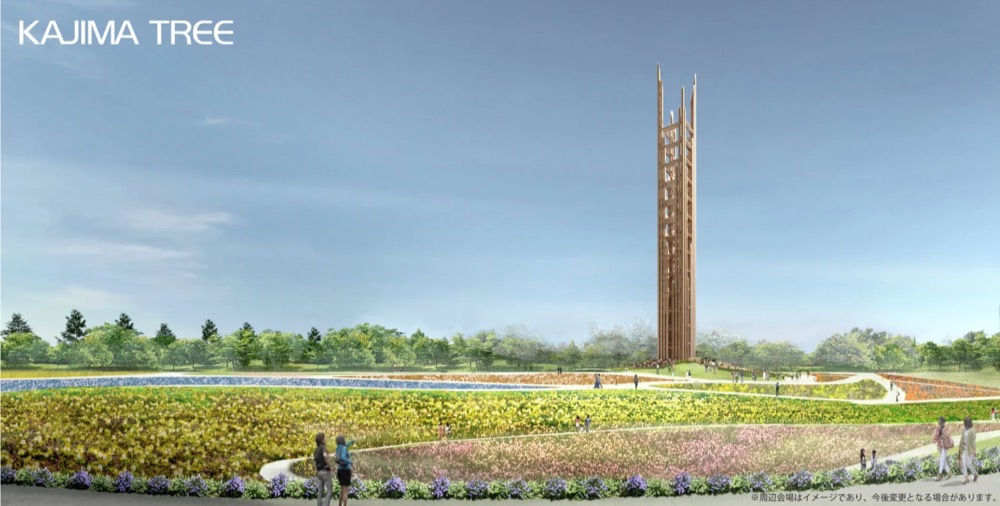
“The main theme of GREEN×EXPO 2027 is ‘Tomorrow’s Landscape, Creating Happiness.’ We proposed KAJIMA TREE as a symbol of a new landscape pointing toward the cities of the future. As a frontrunner in environmental technology and urban development, we want to give concrete form to green circular architecture. By presenting a landscape that can only be seen here and moving visitors emotionally, we hope to spark a change in behaviour.”
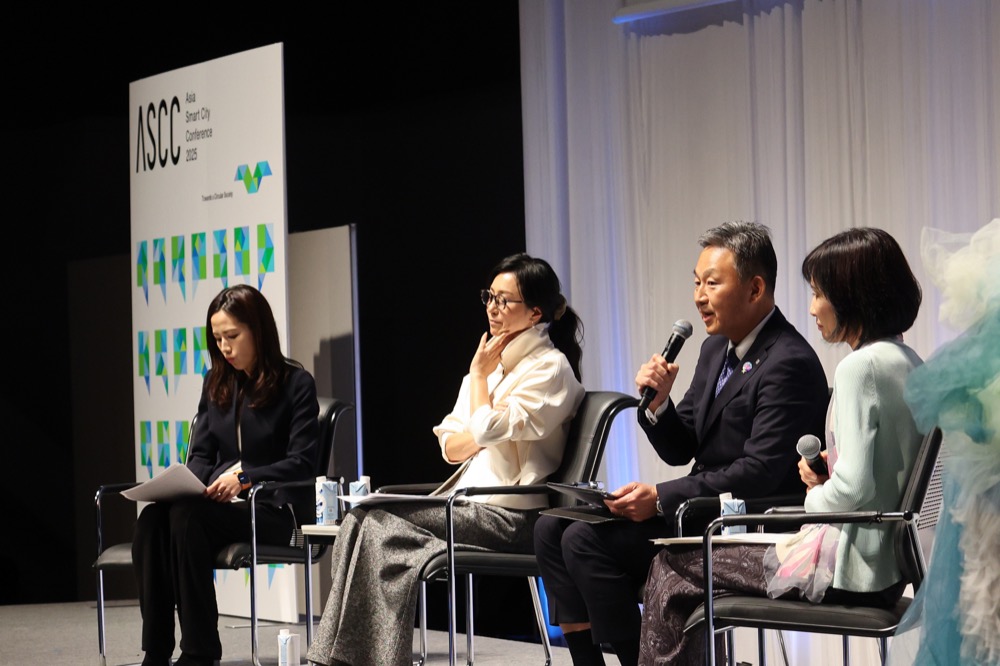
In 2024, Kajima Corporation formulated its “Kajima Environmental Vision 2050plus,” which seeks to generate synergies across three pillars: decarbonisation, resource circulation, and nature restoration.
As one example, Noguchi introduced an initiative in which waste plastic generated at construction sites is finely shredded and recovered as a material, then used to manufacture the safety barriers deployed on those same sites. This cycle, he said, has not only enabled effective use of materials but has also changed the mindset of workers on site.
“When people understand that the waste they sorted themselves comes back to the site in a new form, the accuracy of their sorting naturally improves,” he said, making the point that alongside the system itself, a sense of personal conviction is essential to making circular practices work.
Responding to this, Ishizaka introduced the case of Ishizaka Sangyo, which over approximately 20 years has transformed a satoyama (traditional Japanese rural woodland) that had once been used for illegal waste dumping into a biodiverse landscape. Of the company’s roughly 180,000-square-metre site, approximately 90 percent is satoyama, which is open to the public as an immersive environmental education field. The initiative has attracted considerable attention, drawing visitors from Japan and abroad.
“I am thinking about whether we can propose ways for citizens to engage continuously with the satoyama in Seya — the field that will become the EXPO venue. What does daily life connected to the satoyama actually look like? I hope we can provide an environment where people can have experiences that connect them with one another.”
She also mentioned that, although Ishizaka Sangyo did not exhibit at the Osaka-Kansai Expo, the company contributed the concept behind the “Expo Circular Market Myaku-ichi!” — an initiative that ultimately led to the material reuse now incorporated into KAJIMA TREE.
“I hope GREEN×EXPO 2027 can become an opportunity to adorn the venue with re-material — materials created from waste. It would make me very happy if an EXPO venue built from recycled materials were to become, in some form, a representative symbol of Japan and its commitment to resource circulation.”
Toward an “EXPO for Everyone” That Sparks Innovation Through a Shift in Consciousness
Toward the end of the session, the speakers were asked: “What kind of relationship do you hope to build with visitors?”
Noguchi said he hopes KAJIMA TREE will be a place that deliberately steps back from the digital world, allowing visitors to experience the local environment — wind, light, and more — through all five senses. He also mentioned that the company is considering activities that would let primary school children in the city experience how timber grows and is transformed into products.
Ishizaka observed, “Japan has many satoyama landscapes, but I feel that people are once again asking what the value of satoyama really is.” Like Kajima Corporation, she placed great importance on creating experiential opportunities for children, and announced that Ishizaka Sangyo would co-host the “Green Blue Education Forum” — a presentation competition supporting the perspectives and ideas young people need to build a sustainable society — together with the Ministry of the Environment. She also extended an invitation to the students in the session audience to take part.
Kenmiya pointed out that “the innovations that change society do not necessarily emerge from the latest technology — they begin with a shift in people’s consciousness.” She called for citizens to get involved, framing GREEN×EXPO 2027 as an opportunity to learn about and enjoy all things green in the lead-up to the exposition, and emphasising that the EXPO is “something we build together.”
The speakers closed the session by reaffirming the importance of embedding resource circulation in society as something people can genuinely experience. The hope is that the exposition will serve as a catalyst for thinking about what human wellbeing means in a future where people and nature coexist for generations to come. Anticipation for the opening of GREEN×EXPO 2027 — a place where visitors can experience a future of new cycles — is quietly but surely building.
【Reference】Asia Smart City Conference 2025 | ASCC
【Reference】GREEN EXPO 2027
【Reference】Expo Circular Market Myaku-ichi!