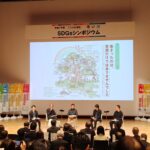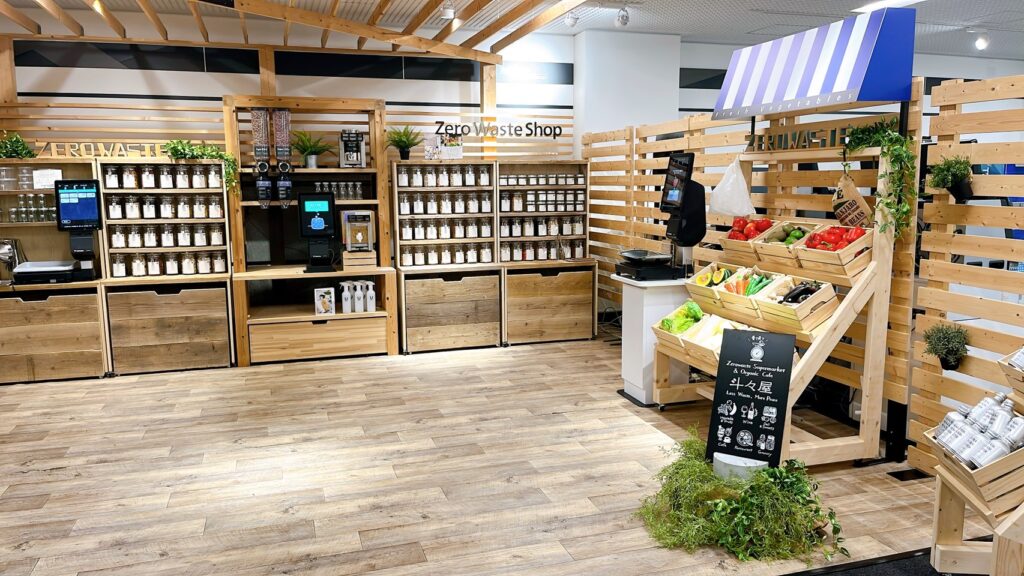
Totoya Inc., a Kyoto-based company operating a zero-waste retail model, has launched a franchise (FC) model to expand its business nationwide. This report covers the unveiling event held for the new model.
Weigh-and-pay retail — where customers buy exactly the quantity they need, without packaging — is widely seen as a promising way to put the circular economy into practice at the everyday consumer level. Small-scale shops and networks are beginning to emerge in Japan, but significant barriers remain to large-scale adoption: the effort required of consumers, the operational burden on retailers, hygiene management, and cost. The policy environment to support such models has yet to mature.
What Totoya is building is a “system” that does not depend on consumer awareness. Atsuko Umeda, the company’s Representative Director, is emphatic: “We will not compromise on convenience.” Through its physical store in Kyoto, the company has systematised its weighing technology and established operations that minimise food loss. The foundation is a zero-waste distribution model — including the use of reusable delivery crates (known as kayoibako) — and sourcing from optimally located local suppliers. As a pioneer in zero-waste retail, Totoya has been rebuilding existing retail systems along circular lines. The new franchise model is a package designed to roll out all of this accumulated know-how across Japan.
Reduction First
There is a clear rationale behind this initiative. The company aims to break the spiral of economic growth and environmental burden in order to realise a lifestyle that fits within “one planet.” The zero-waste retail model is one means to that end — but it needs to be adopted at scale. The franchise format was chosen as the vehicle: building on the know-how accumulated in the physical store, the goal is to embed zero-waste practices across Japan in forms suited to each local community.
Umeda is unequivocal: “Recycling has its limits — reduction is the true essence of the circular economy.” Citing examples from global corporations, she noted that a growing number of companies recognise they cannot survive without making the transition, and stressed that “the circular economy is an investment, not a cost.”
“Reducing Food Loss from Farm to Retail” and “Spreading Sustainable Agriculture”

Totoya actively purchases non-standard-grade vegetables and fruit that inevitably arise from organic and pesticide-free growers. These are sold as-is or converted into processed products such as purées.
“The taste is exactly the same. We tell customers: ‘These have such charming shapes — please do buy them.’ It’s also an education for consumers. If perfectly straight cucumbers ever appeared on Totoya’s shelves, customers might actually start wondering if something was wrong,” Umeda says with a laugh.
In the store, ingredients approaching their sell-by date, along with offcuts and trimmings, are immediately prepared in an on-site kitchen as ready-made dishes or soups. Any remaining surplus is bottled. In this way, the store uses up all of its approximately 700 product lines without discarding anything — a time-honoured wisdom realised within the modern framework of zero-waste retail.
Underpinning this is Umeda’s conviction: “Without efforts to protect the livelihoods of organic farmers, add value to their produce, and return that value to the producers, sustainable agriculture cannot spread.”
The goal is not only to achieve zero food loss, but to add value through processing and convert that into revenue — with the development of sustainable agriculture as the ultimate aim.
“Regenerating nature” is one of the core principles of the circular economy. Totoya puts this principle into clear practice from its position as a retailer.
Taken together, these efforts represent a challenge not merely of individual behaviour change, but of “cultural transformation” — reshaping the entire food supply chain into a circular one.
Technology to Standardise Weigh-and-Pay Retail: Partnership with Teraoka Seiko
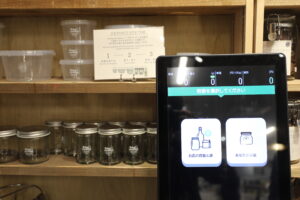
One of the barriers to wider adoption of weigh-and-pay retail is inconvenience. Umeda recognises that a model that places a burden on consumers will not spread, and cites the elimination of inconvenience as a prerequisite. Consumer awareness matters in overcoming the effort and cost involved, but the circular economy cannot be achieved by relying on awareness alone.
To address this, Totoya has partnered with Teraoka Seiko Co., Ltd., a leading manufacturer of weighing equipment, to tackle the challenge from a technological angle. Satoshi Kameyama of Teraoka Seiko acknowledges that “weigh-and-pay had an image of being troublesome,” and the company has developed the following technologies to change that perception:
- Automatic tare deduction via RFID: An RFID tag attached to the customer’s container is read automatically to determine the container’s weight (tare), and the net weight of the contents is calculated instantly. This enables self-service weighing at a speed comparable to conventional supermarket shopping.
- AI camera-based product identification: An AI system immediately identifies produce placed on the scale, eliminating the need for customers to search through a list.
- Customer management via POS system: Japan’s first weigh-and-pay POS system capable of managing deposit containers and the customer information associated with their use.
Early Deployment in the Closed Environment of the Office
In addition to standalone retail stores, the rollout of “Office Totoya” — bringing zero-waste retail into the workplace — is also accelerating. The service allows employees to experience zero-waste practices first-hand.
For companies, it offers the ability to reduce packaging volumes within a controlled, closed environment. Quantitative and qualitative data — including the volume of waste reduced and CO₂ emissions saved through the use of reusable bottles, as well as employee satisfaction — are shared with participating organisations.
The benefits go beyond direct reductions in environmental impact. By giving employees a lived experience of zero-waste practices, the service also supports the development of circular business thinking in their day-to-day work. “After using packaging-free products for a year, people start noticing how much packaging is wasted. Developing that kind of sensibility naturally leads to behaviour change and shifts in mindset,” says Umeda.
Scaling Zero-Waste Retail Across Stores and Offices Through the Franchise Model
The franchise model announced reflects the company’s intention to package all of the initiatives described above and accelerate the spread of the zero-waste model. The model targets three formats: integration into existing retail stores; community hub locations (retail shops, mini-cafés, etc.); and office deployments (corporate welfare benefits). The package will not be uniform nationwide — it will be tailored to suit each local community. The relationship between the franchisor and franchisees is envisioned as one of equal partners.
An abrupt switch to full weigh-and-pay is difficult for existing stores. To lower the barrier to entry, the model allows businesses to start with as little as “two shelves.” For participating stores, the benefits extend beyond waste reduction — there is also the potential to attract new customers.
For large corporations, a franchise version of Office Totoya — as an expanded offering — is also envisaged. This carries the added benefit of providing material for external communications with investors and other stakeholders.
A Model Case for Building a Zero-Waste Retail Environment in Japan
In Europe, policy support for weigh-and-pay retail models is advancing. France, at the forefront, has enacted the Climate and Resilience Act, which requires supermarkets of 400 square metres or more to dedicate at least 20% of their floor space to weigh-and-pay sales by 2030.
The environment in Japan remains immature — existing laws and regulations were not designed with weigh-and-pay retail in mind, among other challenges. Japan also has its own distinct conditions that differ from Europe: high standards for quality and hygiene, concepts of producer responsibility, and climatic factors, to name a few.
Even so, Totoya is working to identify the optimal solutions — the right products, conditions, and approaches — suited to Japan. The company may well become a model case for building the zero-waste retail environment that Japan will need going forward.
Building Systems That Don’t Rely on Awareness: A Pathway to System Change
Totoya’s franchise model is a challenge to achieve “system change” through zero-waste retail — in other words, to build structures that do not depend on individual awareness. Improved weighing technology reduces operating costs; processing turns loss into profit; and compliance with regulations is made easier. Indeed, Totoya’s gross profit margin already exceeds 40%.
As the model scales, direct economic benefits for consumers also come into view. Research in the United Kingdom has reported cases where refill products are priced on average 10–15% lower than their conventionally packaged equivalents. UK retailer Waitrose has placed its weigh-and-pay area along the main customer flow through the store, boosting both visibility and convenience. At a time of rising prices, the greater the scale of the model, the more accessible it becomes.
At Totoya, direct price comparisons are difficult due to the limited number of equivalent packaged products, but the company says that by eliminating packaging-related costs through weigh-and-pay, some products can be priced lower than their conventional counterparts. Furthermore, because consumers can buy exactly the quantity they need, purchasing only what is required appears to give shoppers a sense of better value for money.
Umeda closes with these words: “What we do is support companies across every sector in making the transition to the circular economy. We want to bring together a diverse range of services and create a movement that everyone can join. We hope to move forward together, starting with whatever each of us can do.”
【References】
- Totoya Franchise Model Website
- Totoya Official Website
- Realising Japan’s First Zero-Waste Retail with Zero Waste and Zero Food Loss (Teraoka Seiko)
- Refillable groceries to be made available to every UK shopper (The Guardian)
※ The lead image is provided by Totoya. All other images were taken by the author unless otherwise noted.