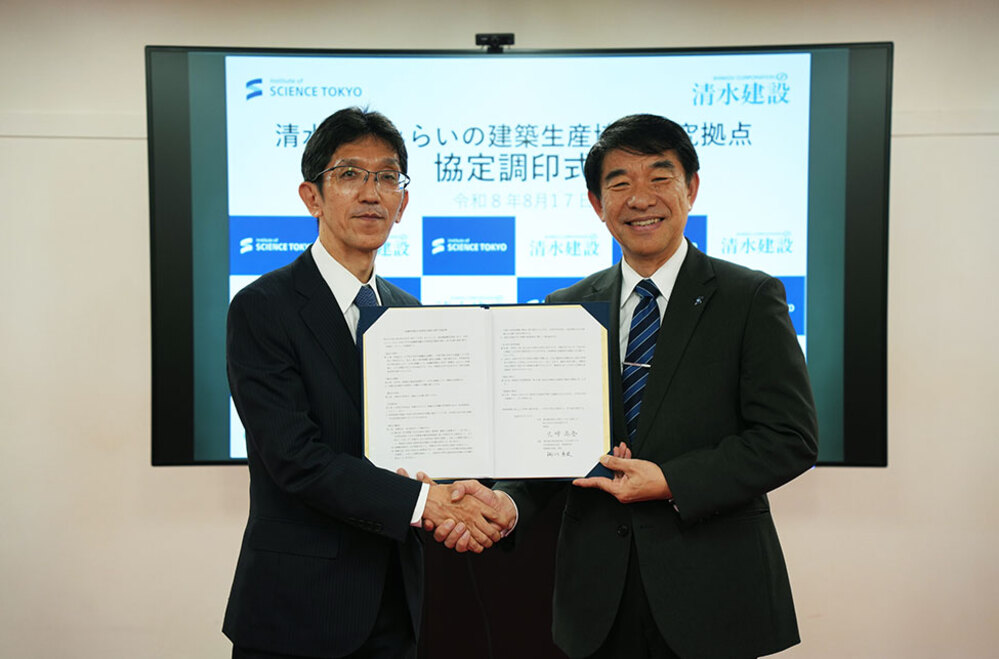
Shimizu Corporation and Tokyo University of Science and Technology established a joint industry-academia research hub on August 17 aimed at developing “building upcycling technology” that maximises the value of existing structures. The collaboration will advance research and technology development for building upcycling as a new alternative to demolition-and-rebuild or conventional renovation.
The newly established “Shimizu Corporation Collaborative Research Hub for the Future of Architectural Production,” located on the Tokyo University of Science and Technology campus, focuses on the reuse of structural frames and façade renovation in existing buildings. Operating for three years through July 31, 2029, the hub will lead technological innovation in structural-frame reuse and façade renovation—two areas that have yet to be fully established in practice.
The joint research aims to build a new architectural production model. By combining advanced techniques for reusing primary structural elements—columns, beams, and floor slabs—with façade renovation technology, the initiative seeks to upgrade and regenerate existing buildings to structural, environmental, and aesthetic performance levels comparable to new construction, at lower cost and in shorter construction periods.
The initiative is driven by growing demands for building decarbonisation and broader environmental compliance, as well as surging material prices and labour costs. Both parties consider the reuse of primary structural frames to carry significant environmental value from a circular economy perspective. Major general contractors have been setting numerical targets for building-material reuse and resource circulation in quick succession, and this initiative sits squarely within that trend.
While there are already precedents for constructing new buildings by reusing some primary structural elements, methods for assessing the soundness of existing structures slated for reuse—and for predicting service life and establishing decision criteria based on those assessments—have not yet been established. Regarding façade renovation, existing techniques such as over-cladding and double-glazing systems do exist, but they are largely limited to adding functions and performance on top of existing exterior materials, making it difficult to achieve freely designed, dramatically altered aesthetics.
Going forward, the partners plan to encourage participation by building-materials manufacturers and other industry players to drive new technology development, while also applying the research findings and developed technologies to real projects at the earliest opportunity.
【Press Release】Shimizu Corporation × Tokyo University of Science and Technology: Opening of a Joint Industry-Academia Architectural Production Research Hub
【Related Article】Shimizu Corporation Sorts Construction Waste Plastics On-Site, Selling Recovered Materials for Value
【Related Article】Tokyo Metropolitan Government Releases Training Videos for Construction Professionals to Promote Circular Economy, Encouraging Use of Recycled Materials
※The image at the top of this article is sourced from the press release.