※ This article is reprinted from “Ideas for Good“.
【Kyoto Circular Economy Special Feature】
This special feature is a collaborative project between IDEAS FOR GOOD and the City of Kyoto, exploring the present and future of the circular economy in Kyoto. The city has nurtured, over a thousand years, a spirit known as “shimatsu no kokoro” (a mindset of using things carefully and without waste), a circular way of life, and a culture of craftsmanship. How can these traditions be developed into the innovations that will shape Kyoto’s future, and how can circular businesses be created to carry the city forward into the next thousand years? Together with the City of Kyoto, local businesses, and Akihiro Yasui — a policy advisory consultant to the City of Kyoto — this feature explores the value and potential of Kyoto as seen through the lens of the circular economy. (Kyoto Circular Economy Special Feature Top Page)
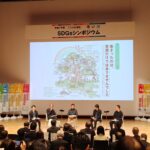
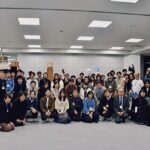
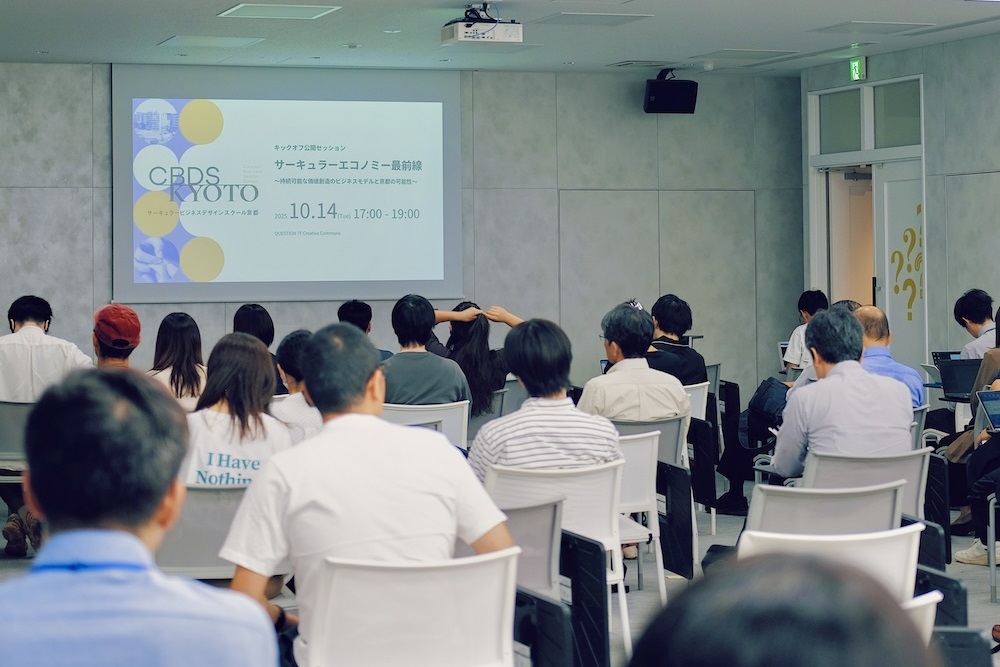
On Tuesday, October 14, 2025, the kick-off event for “Circular Business Design School Kyoto” (hereafter CBDS Kyoto) was held at QUESTION, a co-creation facility in Kyoto.
CBDS Kyoto is a learning programme through which participants study the circular economy and apply their learning to developing circular business models for their own companies or as individuals. In fiscal year 2025, the programme runs for three months, with the goal of producing prototypes that can serve as starting points for dialogue.
▶︎ For more about CBDS Kyoto: https://cbdskyoto.jp/
This article reports on the kick-off event. Attendees included not only participants enrolled in the learning programme but also others who share an interest in the topic. Why is the circular economy important right now? Where does Kyoto currently stand on the circular economy? Read on for a full report of the day.
Contents
- The Circular Economy as a Gateway to Imagining the Future
- Why Is the Circular Economy Important Right Now?
- Redesigning “Relationships” by Following the Principles of Ecosystems
- Reconnecting Four Types of Value: What We Can Learn from the Edo Period Today
- Taking the First Step Toward a Distinctly Kyoto Circular Economy
The Circular Economy as a Gateway to Imagining the Future
The opening remarks were delivered by Kiminori Kimura of the Environmental General Affairs Division, Environmental Policy Bureau, City of Kyoto, who is one of the organisers of CBDS Kyoto.
“The City of Kyoto has positioned the promotion of the transition to a circular economy as one of the leading projects in the ‘Kyoto New Strategy,’ and CBDS Kyoto is the central programme driving that effort.
We have heard from many businesses that they are ‘interested in the circular economy but don’t know how to get started,’ or that ‘collaborating with other companies is difficult.’ In response to those concerns, we launched this co-creation programme to support the development of new business models through knowledge sharing, prototype creation, and networking.”
Kimura closed by saying: “I sincerely hope that circular economy and circular business initiatives will spread outward from this programme — and from Kyoto.”
Why Is the Circular Economy Important Right Now?
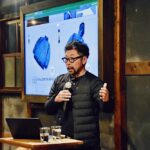
Next, a keynote address on the theme of “Why the circular economy is necessary” was delivered by the representative of Harch Inc. (the company responsible for planning and running the programme), Kato.
According to the “Planetary Boundaries” framework — an indicator of the limits within which the Earth can recover on its own, updated in September 2025 — the planet has already exceeded seven of nine boundaries (※). In this “abnormal” world, mass production and mass consumption of resources continue unabated, and resource consumption is projected to double by 2060. In other words, we face a growing risk of conflict over finite resources and economic crisis.
The circular economy is attracting attention as a means of overcoming this situation. It represents a shift from the one-way “linear” model — extract resources, make things, use them, discard them — to a “circular” approach in which products and social systems are designed from the outset on the premise that waste will not be generated.
At the same time, the question of whether circular products and projects are “genuinely reducing environmental impact” is also critical. Separating economic growth from resource use and environmental impact is known as decoupling, and whether this can be achieved is key to realising genuine circularity. The importance of asking whether that circularity “contributes to societal well-being” was also emphasised.
Last year, the ISO (International Organization for Standardization) 59000 series established definitions and standards for the circular economy, and the world — not only Europe but also Asia and Africa — is aligning on a shared direction as the circular economy moves forward. Engaging diverse actors and advancing the transition at a systems level are the keys to achieving genuine circularity.
Kato posed a question to the audience:
“What is the most important value your company should be providing?”
For the aviation industry, for example, the most important value to provide is “safety.” Yet as climate change intensifies, increasing turbulence is beginning to threaten that very “safety.” Commitment to sustainability is indispensable if companies are to keep delivering the value they exist to provide. This shift in perspective becomes a driving force for advancing the circular economy.
Countries around the world are rolling out circular economy policies one after another, and in Japan the Fifth Basic Plan for Establishing a Sound Material-Cycle Society (a national framework for promoting resource circulation and waste reduction) has been approved by the Cabinet, making this a national policy priority. What form of “circulation” can Kyoto bring into being?
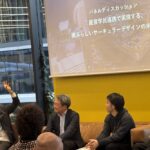
Two guests — Takahide Suetsugu of Amita Holdings Co., Ltd. and Isao Kitabayashi of COS KYOTO Co., Ltd. — joined the discussion to explore this question together.
Speaker Profile: Takahide Suetsugu
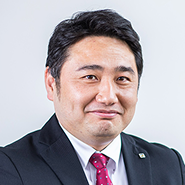 After joining the Amita Group, Suetsugu was involved in establishing and managing material recovery facilities, building regional resource circulation models, and providing comprehensive solutions including waste recycling. He became a Director and Executive Officer of Amita Co., Ltd. in 2019, Representative Director of the same company in 2020, and a Director of Amita Holdings Co., Ltd. before being appointed Representative Director and President in 2024. He currently serves as CIOO (Chief Integrated Operations Officer), overseeing dialogue with stakeholders in line with the medium- to long-term growth strategy and managing the execution of operations across the Group. He also serves as Representative Director of the General Incorporated Association Ecosystem Society Agency (ESA), established in January 2024, working to co-create an “ecosystem society” driven by “circulation” and “symbiosis” through industry-academia-government collaboration.
Speaker Profile: Isao Kitabayashi
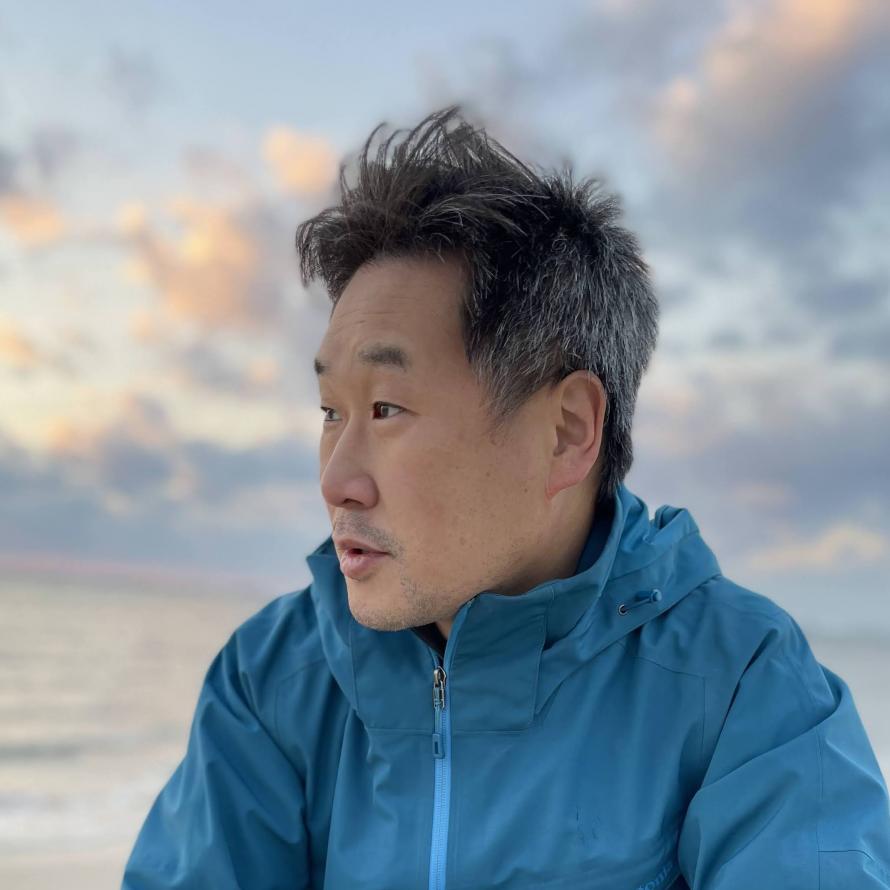 Representative Director of COS KYOTO Co., Ltd. / Representative Director of the General Incorporated Association DESIGN KYOTO. Born in Nara Prefecture. From an early age, Kitabayashi set his life’s theme as “building a society where people can live with smiles amid beautiful natural surroundings.” During his university years, he studied public policy and participated in a Cabinet Office international youth exchange programme to Finland. After working in energy facility sales at Osaka Gas (Kyoto) and as a human resource development consultant at Globis (Tokyo), he researched “cultural business” at the Graduate School of Business, Doshisha University. In 2013, he founded COS KYOTO Co., Ltd. and has since developed businesses in regional revitalisation, human resource development, and cultural exchange, centred on “cultural business coordination” — decoding the wisdom cultivated by local climate and history, and updating and applying it to contemporary society through input and experience. Since 2016, he has organised DESIGN WEEK KYOTO. [https://cos-kyoto.com/edonomy]
Redesigning “Relationships” by Following the Principles of Ecosystems
“When we think about sustainability, I believe it is extremely important to follow nature — in other words, to follow the principles of ecosystems.”
These words come from Takahide Suetsugu, CIOO of Amita Holdings. He explained that the foundation of Amita’s business is a way of operating as a company that follows the principles of ecosystems.
Those principles are threefold: “metabolism” — a mechanism for exchanging matter and energy; “relationship” — a state of mutual interdependence rather than isolation; and “continuity” — passing the baton to the future as a result of these principles functioning over time.
Suetsugu was emphatic on one point: the goal is not the continuity of the economy. He explained that the purpose is the enrichment of social relationships and natural capital — the sustainability of society and the environment — and that “circulation” is the means by which that purpose is achieved.
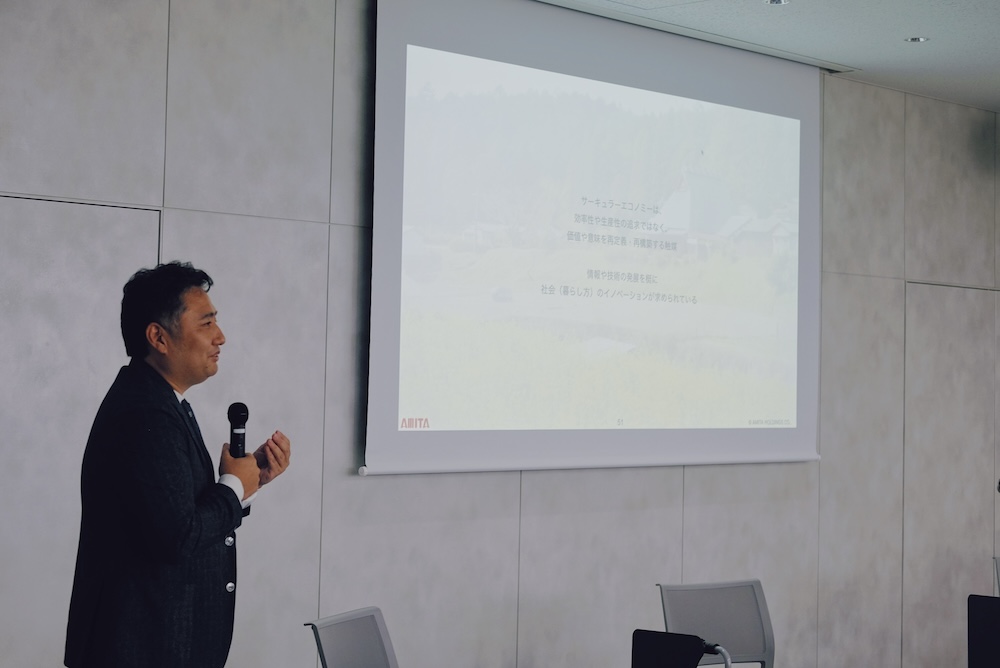 “Take eggshells, for example. Most people think of them as kitchen waste, but if you focus on the fact that they are 95% calcium carbonate, they can serve as a natural substitute for limestone. Nothing in this world is truly useless — calling something ‘waste’ is simply a matter of our own subjective perception. A change in perspective is all it takes to create new value.”
Everyone receives the gift of life and releases something into their immediate environment. At Amita, this everyday activity is positioned as an opportunity for mutual support within the community, and the company is also working to create spaces that generate new value.
“Rather than simply leaving household waste at the foot of a utility pole, people bring it as a resource to a local collection station. Conversations start there; people gather. The relationships that form enrich daily life and connect to disaster preparedness and community safety. We are designing a system of living in which that kind of circulation emerges.”
Suetsugu concluded by touching on the distinctive potential of Kyoto.
“When I ask myself, ‘What is the value of Kyoto?’, I think it lies not only in economic rationality but in the aesthetic sensibility and values that have been cultivated through history and taken root here. When we think about circulation, I believe it is important to discover a ‘circulation of time’ that is uniquely Kyoto’s — connecting the past, the future, and the present. I think this is something no other region can do.”
Reconnecting Four Types of Value: What We Can Learn from the Edo Period Today
“The river in front of my house was encased in concrete, and the crayfish and crucian carp disappeared. The pain I felt at that change in scenery is where I began.”
So says Isao Kitabayashi of COS KYOTO. Quoting Masako Sakata — an instructor in soil environment improvement who works in Kyoto city parks — who said “the moment people stopped drinking from the river in front of them, they started littering without a second thought,” Kitabayashi pointed out that the severing of our connection with nature lies at the root of environmental problems.
Kitabayashi, who has long worked to bring the lessons of Japan’s local industries and culture to a wide audience, proposes drawing on the Italian concept of “territorio” (territory). Rather than dividing cities and rural areas by administrative boundaries, this approach treats spaces that share a cultural identity as a single coherent unit and reads the historical context of each place.
“If you want to think about the industries of Tango (a region in northern Kyoto Prefecture), for instance, you start by looking at the tectonic shifts that occurred 15 million years ago. It is important to grasp things on that kind of timescale.”
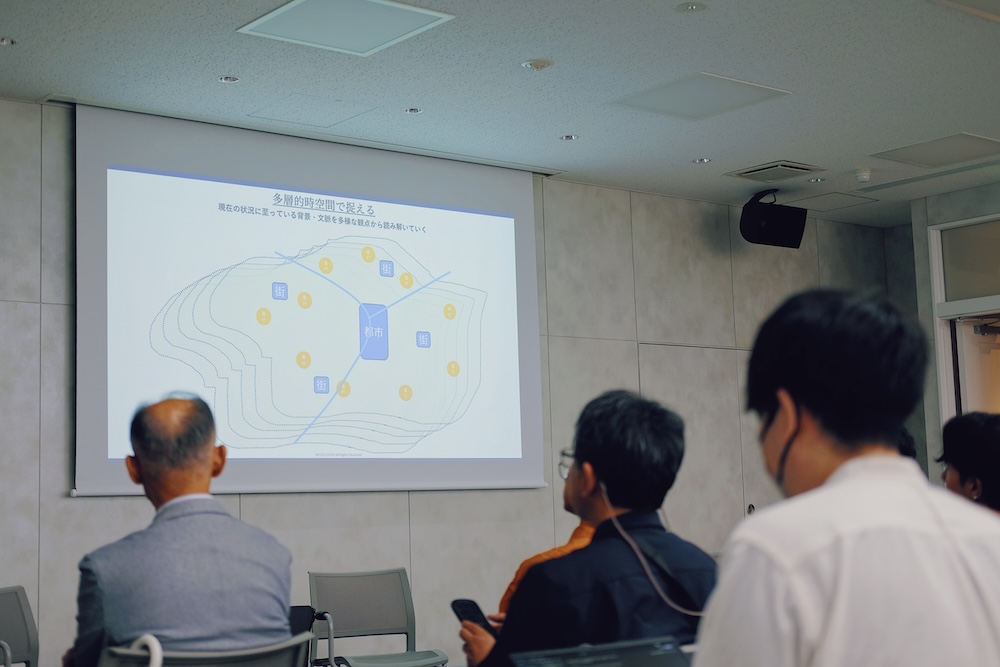
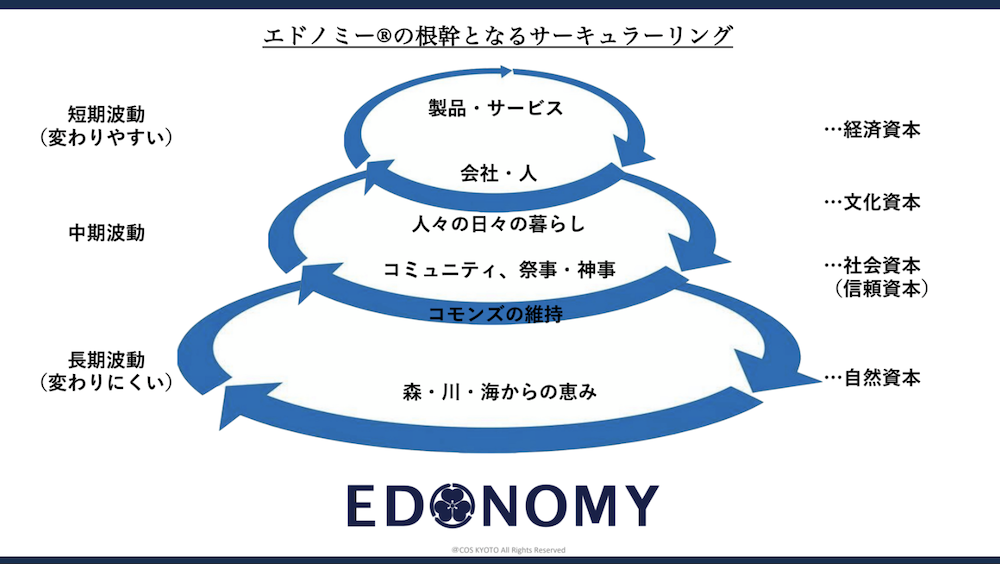
Building on this perspective, Kitabayashi advocates a concept he calls “Edonomy” — a model rooted in Edo-period (1603–1868) society. Its core idea, “circularing,” describes a model in which the circulation of nature’s bounty gives rise to a commons (a community that stewards those resources), within which daily life, culture, and festivals flourish, and from which the economy and society in turn revolve. The aim is to reconnect elements that have become fragmented in the modern era.
“Right now, the four capitals of ‘economy, culture, society, and nature’ have become disconnected. In reality, they are all interdependent — separate them and the whole system breaks down. The conversation tends to get stuck on ‘but will it make money?’, yet everything is interconnected, and I think it is vitally important to reconnect and think about them together.”
Kitabayashi conveys these ideas through experiences set in Kyoto. One example is a tour in which designers from Milan were invited to the weaving district of Tango. Rather than simply showcasing weaving techniques, the tour placed great emphasis on giving participants time to deeply understand the natural environment and living culture that form the backdrop to those techniques.
The designers were profoundly moved, and went on to independently plan how to present the work at Milan Design Week and other venues. It was precisely because they had encountered the story of that place that they produced outputs capable of touching so many people’s hearts.
“In other words, it is not just about function — what matters is where you place value. I believe the hints for that lie in the Edo period, when people sought to live richly within limited resources. But the people of the Edo period were not all highly conscious individuals. What matters is the transformation of values and the ‘systematisation’ that makes those values the norm.”
Taking the First Step Toward a Distinctly Kyoto Circular Economy
The final cross-talk session centred on the theme of “a circular economy that is distinctly Kyoto.”
Suetsugu drew on the tea ceremony to propose incorporating three perspectives — “etiquette (temae, the prescribed procedure),” “setting (shitsurai, the arrangement of the space),” and “tools” — into business as corporate culture, spatial design, and products and services respectively. Kitabayashi touched on the etymology of the word “kudaranai” (meaning “worthless” or “trivial” in modern Japanese): goods that spread from Kyoto throughout Japan were once called “kudari-mono” (things that have come down from Kyoto), while inferior goods were dismissed as “not worth coming down” — “kudaranai.” “I want to once again create things that radiate outward from Kyoto to the world,” he said.
Value resides in the “in-between” — between people, and between people and nature. Richly reweaving those relationships; deeply reading the context of a place’s history, culture, and natural environment; and “re-editing” that context together with contemporary technology and global trends: cultivating this kind of flexible, cross-disciplinary perspective will be indispensable as we move toward the circular society ahead.
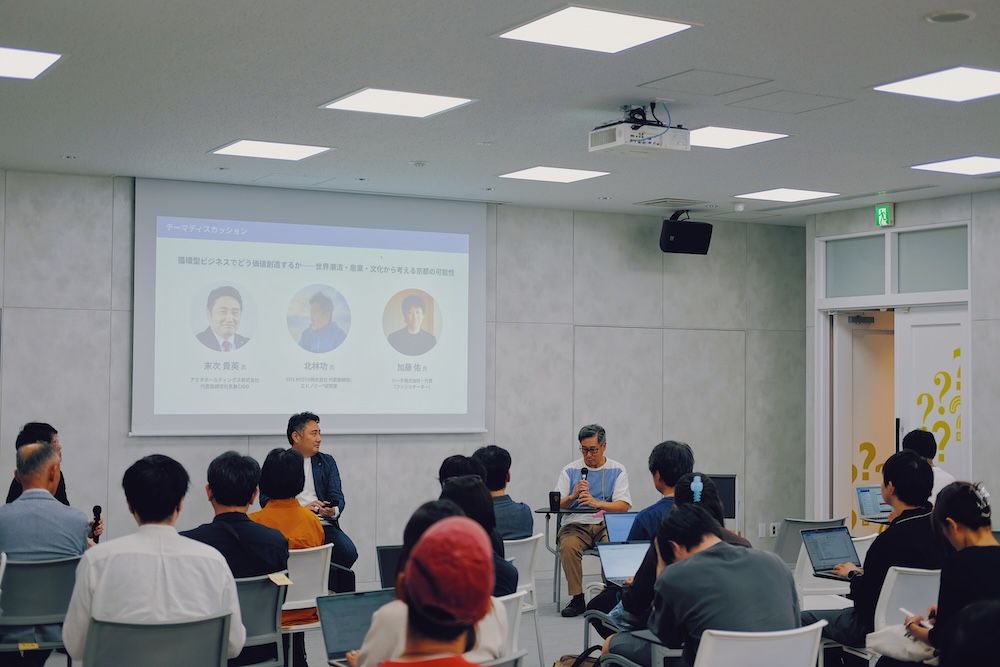
“I think that successful examples in the circular economy are ones where people from different positions and fields come together and form strong bonds. Whether the connections made in a place like this become good ones or bad ones depends on our own awareness and actions,” said Suetsugu.
“I want to take the first step toward a society we can be proud of a thousand years from now,” Kitabayashi responded.
This was a day on which questions were raised about the future shape of Kyoto’s circular economy — one that goes far beyond the circulation of physical materials and holds a wealth of diverse possibilities. It was a time that left participants with high expectations for the distinctly Kyoto form of circular economy that CBDS Kyoto will bring forth.
Three Months of Learning Begins Here
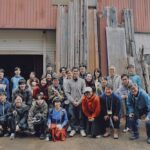
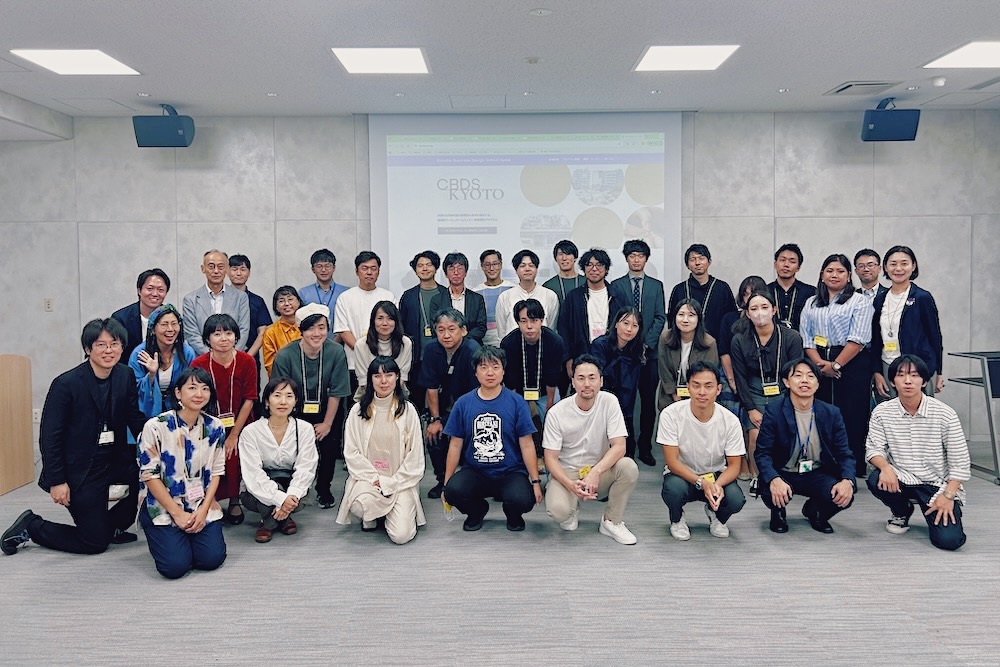
After the public event concluded, a networking session was held with the participants enrolled in the three-month learning programme. After confirming the schedule of learning ahead, participants introduced themselves and met their mentors, marking the start of the learning journey leading to the final showcase in January 2026.
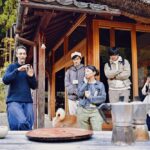
Sessions two and three will begin with fieldwork centred on the Kyoto city area, and will also take participants to Keihoku (a rural district in the northern part of Kyoto City). These sessions are expected to be opportunities to revisit the question of “why a circular economy and circular businesses are necessary” through the culture and practices rooted in each place.

About Circular Business Design School Kyoto
Kyoto possesses assets that shine across the ages — the “shimatsu no kokoro” spirit of careful, waste-free living, a circular way of life, and a culture of craftsmanship, all cultivated over 1,200 years of history. Realising the circular future demanded as global challenges such as climate change and biodiversity loss grow more severe requires the creativity to draw on this wisdom and carry it forward. With this in mind, Harch Inc. — the company that operates IDEAS FOR GOOD — launched a learning programme in October 2025 that combines the circular wisdom rooted in the city of Kyoto with a forward-looking perspective grounded in cutting-edge circular economy knowledge, enabling participants to together envision and realise the future they want. “Decode Culture, Design Future” — a circular future that continues beyond tradition, from Kyoto to the world.
Website: https://cbdskyoto.jp/
※ Seven of nine planetary boundaries now breached|Stockholm Resilience Centre