※ This article is reprinted from “Circular Yokohama,” operated by Harch Inc.
In Yokohama, efforts toward decarbonisation and the realisation of a circular society are accelerating in anticipation of “GREEN×EXPO 2027,” to be held in 2027. In November 2025, the city signed on as the first municipality under the “Asian Circular City Declaration Scheme,” signalling the beginning of its international leadership role.
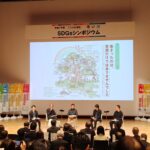
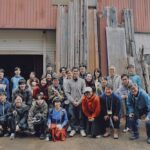
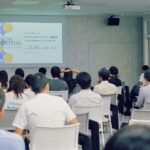
Against this backdrop, on January 30, 2026, the event “The Future of Yokohama-Style Circular Design Realised through Government–Industry–Academia–Community Collaboration: Minato Mirai Circular Economy Conference 2026” was held at chilink WORKSITE MINATOMIRAI.
Now in its fifth year, the conference featured four speakers: Yuta Murao, Section Chief of the Circular Society Promotion Division, Decarbonisation and GREEN×EXPO Promotion Bureau, City of Yokohama; Shoichi Fukui, Senior Chief Expert, Sustainability Promotion Department, Corporate Planning Office, Takenaka Corporation; Takaki Matsusaka, Representative Director of kitafuku Co., Ltd.; and Daisuke Doyo, Professor, Faculty of Business Administration, Kanagawa University.
On the day, participants from government, large corporations, startups, and academia shared the latest circular design case studies from Yokohama, followed by a panel discussion on the theme of “The Future of Yokohama-Style Circular Design Realised through Government–Industry–Academia–Community Collaboration.” This article reports on the proceedings.
Circular Design and Economy Practices in Yokohama
To begin, each of the four speakers shared their respective perspectives on circular economy and circular design initiatives.
▽Speakers:
Yuta Murao (Section Chief, Circular Society Promotion Division, Decarbonisation and GREEN×EXPO Promotion Bureau, City of Yokohama)
Shoichi Fukui (Senior Chief Expert, Sustainability Promotion Department, Corporate Planning Office, Takenaka Corporation)
Takaki Matsusaka (Representative Director, kitafuku Co., Ltd.)
Daisuke Doyo (Professor, Faculty of Business Administration, Kanagawa University)
The Keys to Public–Private Collaboration: “Steady On-the-Ground Work,” “Economic Viability,” and “Making Rules Work for You”
Opening the presentations, Yuta Murao of the City of Yokohama introduced the city’s transition strategy toward a circular society and specific projects underway in the Minato Mirai 21 district, a designated decarbonisation pioneer area.
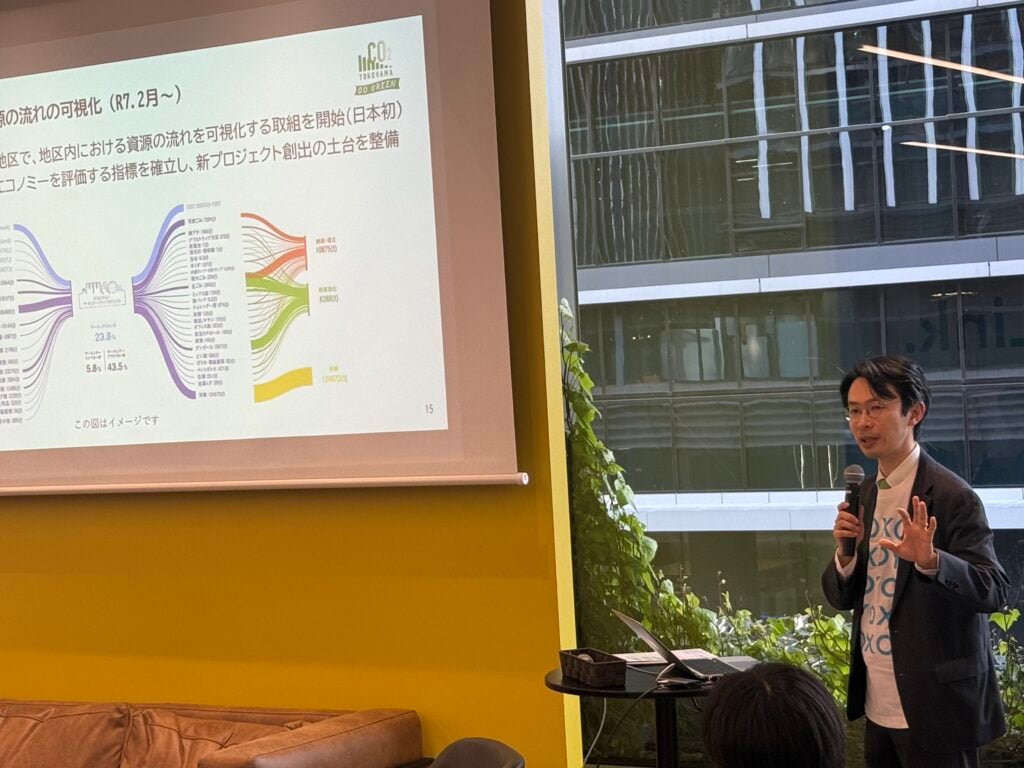
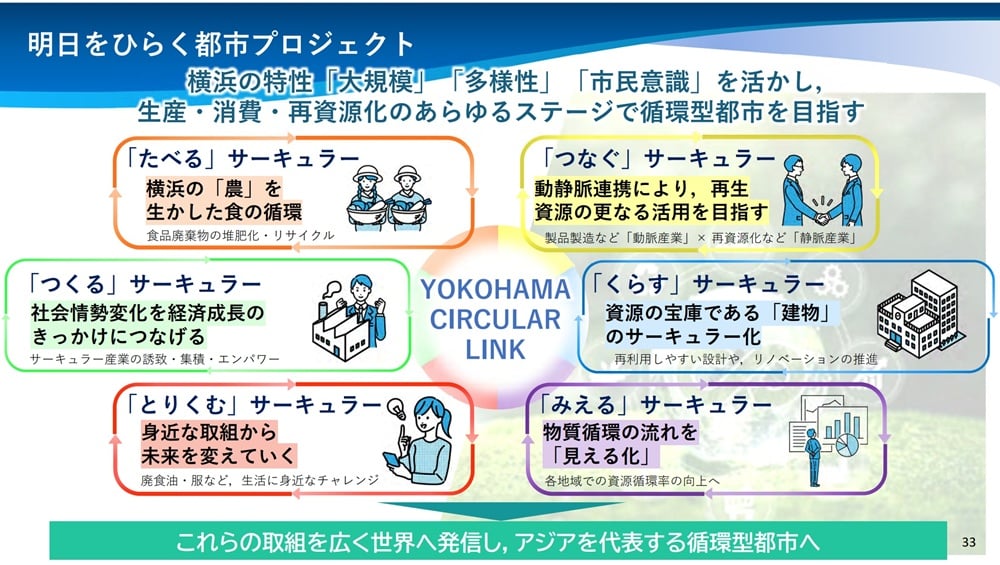
Murao began by introducing “YOKOHAMA CIRCULAR LINK,” a policy framework designed to accelerate the city’s transition to a circular city by leveraging Yokohama’s unique urban characteristics. Organised around six themes — “eat,” “connect,” “make,” “live,” “act,” and “visualise” — the framework promotes initiatives such as composting food waste at schools, circular design in public buildings, and making waste flows visible.
Of particular note are the pioneering initiatives in the Minato Mirai 21 district. Since January 2025, a full-scale “bottle-to-bottle” closed-loop recycling programme has been in operation, collecting approximately 3.2 million PET bottles (64 tonnes) in its first nine months. Murao explained that this closed-loop recycling scheme, involving 30 facilities, can reduce CO₂ emissions during manufacturing by approximately 60%.
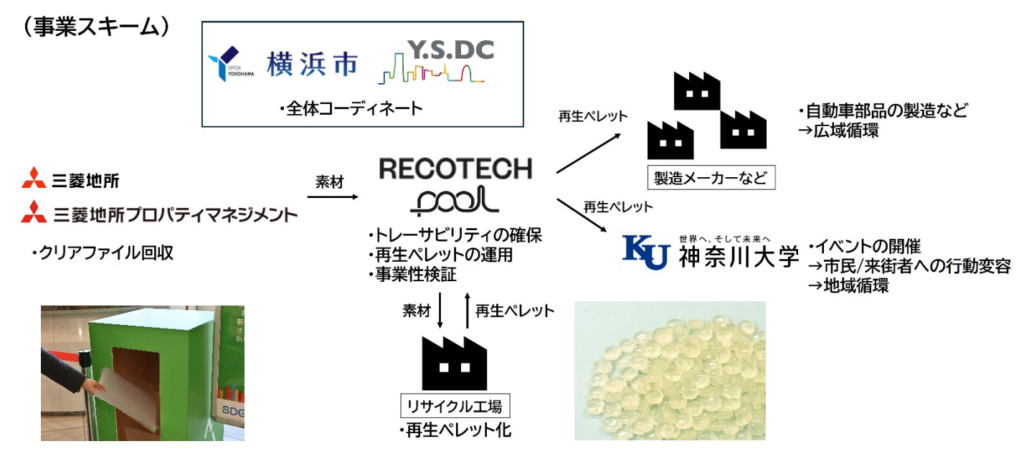
He also introduced a new project launched in January 2026: a “pilot programme to build a material recovery model for clear plastic folders.” The project verifies the feasibility of supplying recycled pellets to manufacturers for use in new products, while also prioritising public environmental awareness. In collaboration with the Kanagawa University FabLab Minatomirai, the city co-hosted a “badge-making workshop using recycled pellets,” developing community-wide engagement activities.
Drawing on these case studies, Murao concluded by sharing key points for advancing public–private collaboration projects. He first emphasised the importance of an “on-the-ground approach” when implementing circular economy initiatives in society: building relationships with partner companies and departments at the operational level, understanding their challenges, and working together to solve them is the key to establishing a cooperative framework.
Second, he highlighted the importance of “prioritising economic viability.” He stressed that it is essential not only to demonstrate social value, but also to design a revenue model that makes the initiative viable as a sustainable business, and to conduct pilots aimed at achieving that.
Third, he underscored the importance of “studying existing rules and making them work for you.” While respecting regulations such as the Waste Management and Public Cleansing Act (Japan’s primary law governing waste disposal) to ensure safety and security, the City of Yokohama supports innovation by encouraging use of schemes such as the trial research system for waste materials. He advised that understanding these frameworks and utilising them in partnership with local government enables projects to proceed in a planned and timely manner.
Murao closed his presentation by noting that GREEN×EXPO 2027, to be held from March to September 2027, is planned to serve as a showcase where visitors can experience the future of the circular economy, and he warmly invited everyone to attend.
Takenaka Corporation’s Circular Design Build®: Transforming the Construction Industry’s Supply Chain
Next, Shoichi Fukui of Takenaka Corporation spoke about circular design practices from the perspective of the construction industry.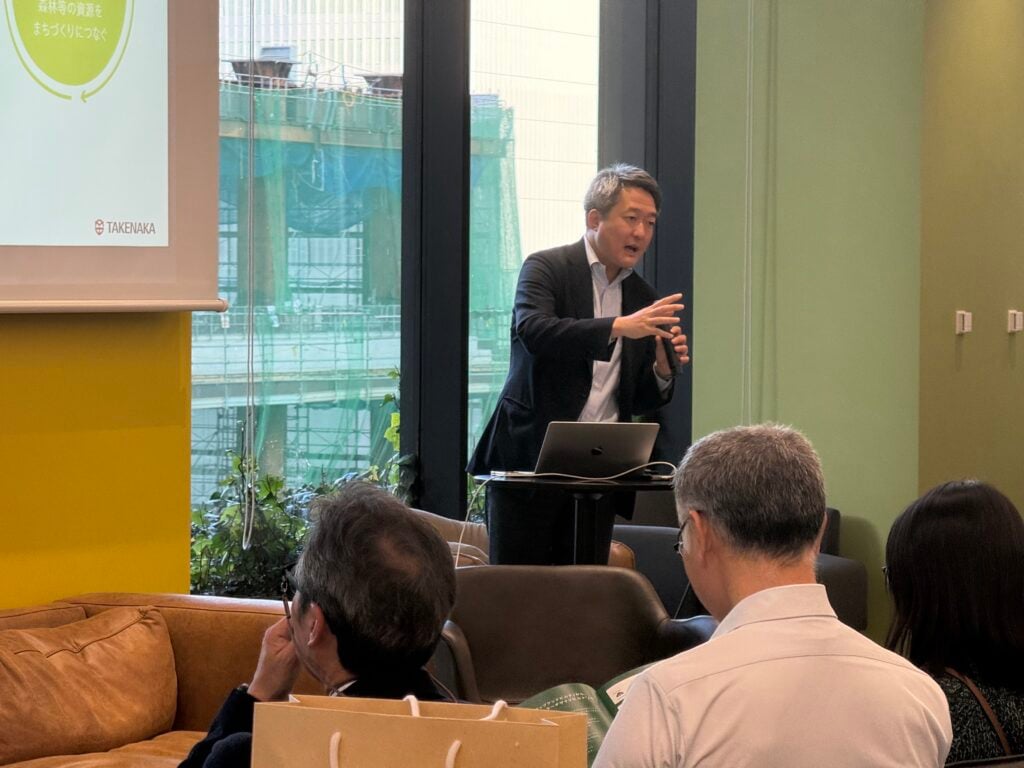
Fukui began by outlining the supply chain challenges facing the construction industry. He noted that the recycling rate for construction waste already stands at around 97%, making it difficult to achieve further quality improvements in recycling from that point. He also cited structural challenges: the long lifecycle of buildings — spanning several decades — makes traceability difficult, and since a building is an assembly of materials from many manufacturers, a single general contractor cannot control the entire process on its own.
To overcome these challenges, the company has adopted “Circular Design Build®.” Fukui introduced three circulation loops as the approach to realising this concept: “Make” (intra-industry collaboration), “Use” (collaboration across the value chain and the recycling industry), and “Connect” (startup collaboration).
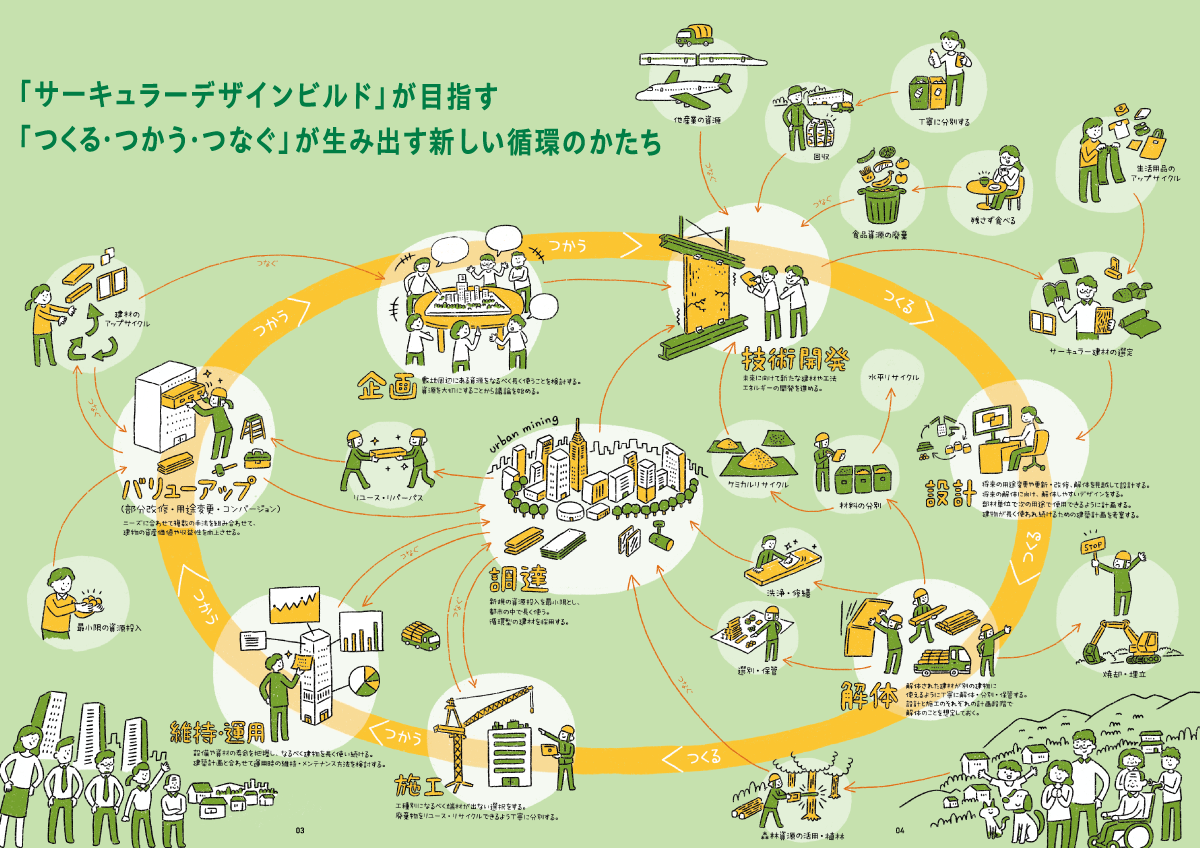
As a concrete example of the “Make” loop, Fukui described how the company has added a search function for circular and low-carbon building materials to its “Material Bank” comparative search system, creating an environment in which circular materials can be selected from the design stage.
For the “Use” loop, he highlighted a focus on aluminium building materials generated during demolition. He described the development of a scheme to separately collect aluminium window frames — whose destination had previously been unclear — and closed-loop recycle them back into aluminium building materials.
For the “Connect” loop, he introduced a partnership with a startup that upcycles used chopsticks into furniture and building materials, as well as experimental initiatives at “BankPark YOKOHAMA,” which makes use of a historic Yokohama building (the former First Bank of Japan Yokohama Branch). This project — which preserves and activates a historically significant building while creating a new hub for vitality and resource circulation — has become a model case for cross-sector collaboration in the field of architecture.
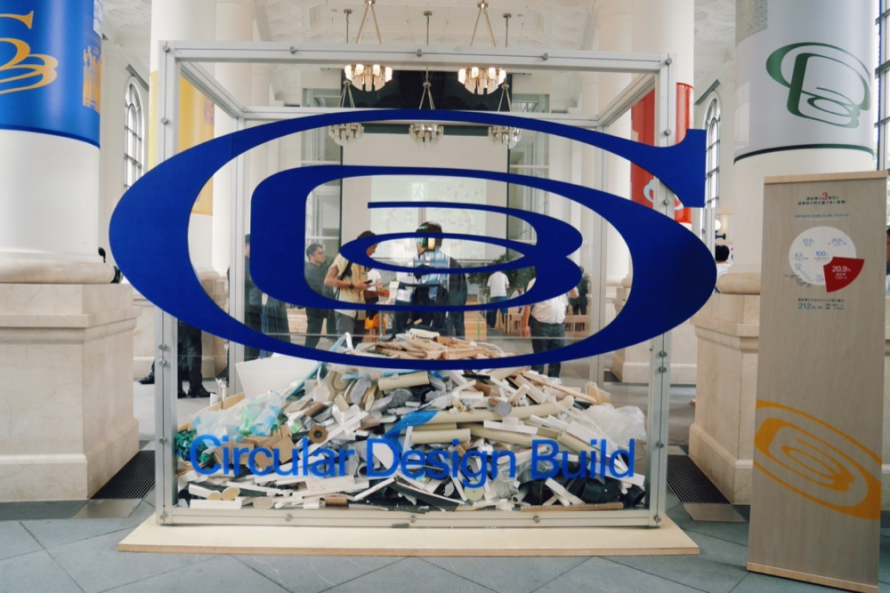
Fukui concluded by saying, “When there is an overwhelming gap in economic rationality, thinking only about the numbers will not move things forward,” and emphasised the importance of a “learn by doing, even on a small scale” mindset. Looking ahead, he also spoke of the need to explore business models that anticipate a shift in the concept of “ownership” in construction and architecture, and to transition from a customer-needs-driven approach to one that starts from “viewing waste as a resource.” He then issued a broad call for partners across all industries to join in building a circular society not just at the level of individual buildings, but across entire neighbourhoods.
kitafuku: Building a Sustainable Business by Expanding Empathy — “Environmental Value Alone Is Not Enough to Last”
Representing the startup perspective, Takaki Matsusaka of kitafuku Co., Ltd. shared practical insights from running a circular economy business through the company’s “Craft Beer Paper” initiative, which transforms “malt spent grain” — a by-product of craft beer brewing — into paper.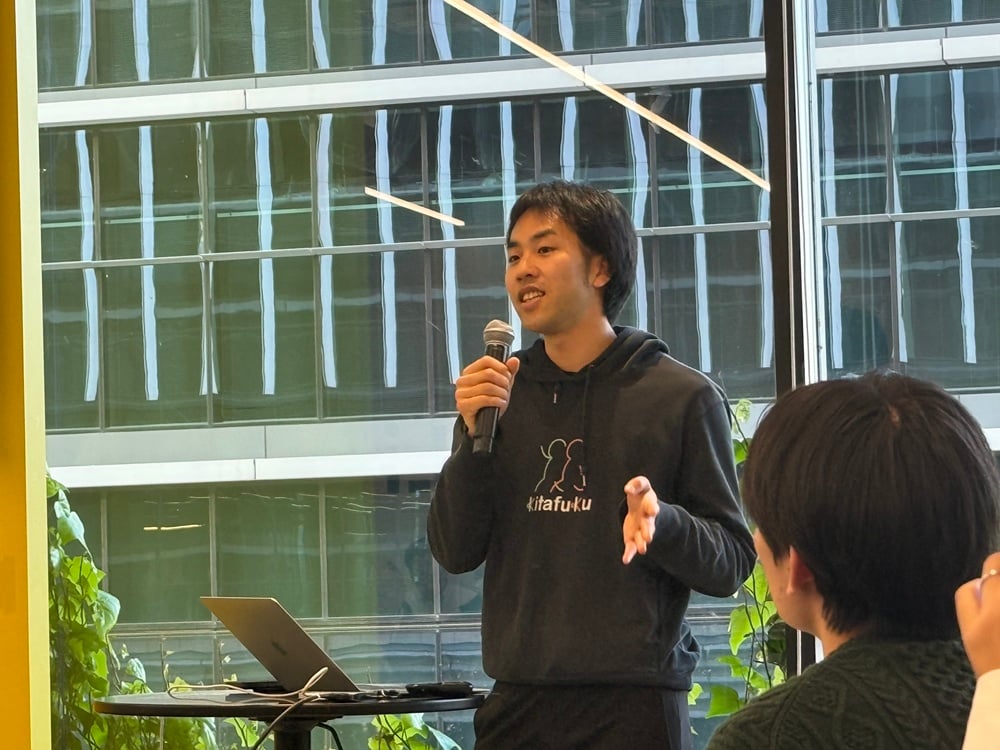
Yokohama has the highest concentration of craft beer breweries in Japan, but behind the scenes, the more beer is brewed, the more malt spent grain is generated. Because moisture-laden spent grain spoils easily and requires enormous energy to dry, much of it ends up being incinerated as industrial waste, placing an environmental, economic, and psychological burden on breweries. Matsusaka presented his solution: “By turning it into ‘paper’ that can be processed while still wet, we can repurpose it without using drying energy and also reduce disposal costs.”
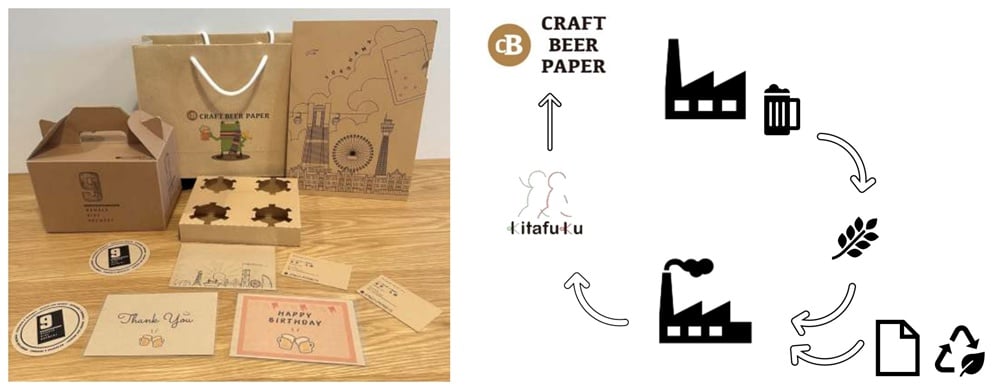
Craft Beer Paper is currently used in business cards and gift boxes, with more than 2 tonnes collected from 10 breweries across Japan and the product adopted by over 100 companies. However, Matsusaka also spoke candidly about the “failures” and “honest realities” along the way. “A business cannot survive on environmental benefit alone, and if decisions are made purely on cost, it stops.”
This is where “empathy marketing” becomes critical. He explained that by carefully communicating the story of breweries’ waste challenges and the upcycling process, customers come to perceive value beyond the price, generating conversations and word-of-mouth among users — and that this is the key to a sustainable business.
He also proposed the slogan “100 people taking one step each, rather than one person taking 100 steps” as a framework for advancing the circular economy at the local level, arguing that a regional circular economy can be realised when government, large corporations, universities, and startups each play to their strengths in a clear division of roles (partnership).
Matsusaka closed by emphasising: “What I want is for the planet to become better as a result of people using our products as part of their business.” He expressed his desire to expand the circle of circulation by addressing challenges as an entire community and making it work as a sustainable business, and concluded with a call for partners to join the effort.
Prototyping “How We Want to Be”: Speculative Circularity
Finally, Professor Daisuke Doyo of Kanagawa University introduced the concept of “Speculative Circularity,” sharing research from his university seminar and prototype practices undertaken with students.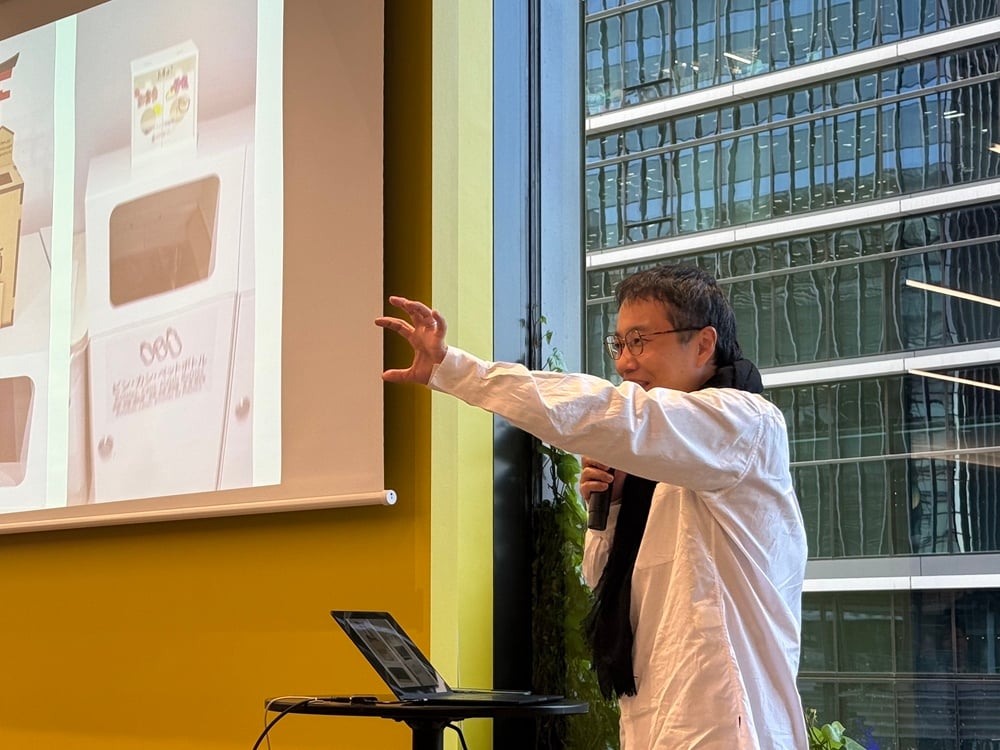
Doyo opened by describing contemporary society — which consumes and accumulates vast resources without metabolising them into value — as suffering from “societal metabolic syndrome.” He argued that overcoming this requires not only symptomatic remedies focused on “what can be done now,” but also the willingness to speculate about “how we want the future to be” and to prototype that vision.
He proposed three steps toward this goal: “Re-Valuing” (reassessing the value of resources), “Re-Function” (adding new functions), and “Re-Society” (embedding these into social systems). As a concrete example, he described a nudge (behavioural change) experiment in which PET bottle cap collection boxes were redesigned to resemble offertory boxes (saisen-bako) found at Japanese shrines. This playful design reportedly increased collection volume by approximately 1.6 times compared with standard collection boxes.
He also introduced the development of “paper yarn” using thinned timber and other materials, undertaken in collaboration with the City of Yokohama. Students learned about the properties of the resource and prototyped it as a uniform fabric with an eye toward use at GREEN×EXPO 2027, making it a practical “Re-Function” learning experience.
Additional case studies shared included a project to create “individual rest spaces (benches)” from boards compressed out of discarded clothing; an in-facility circulation system that grinds 3D-printed objects back into raw material; and “Community Loops,” a scheme developed in partnership with companies to circulate clothing within local communities.
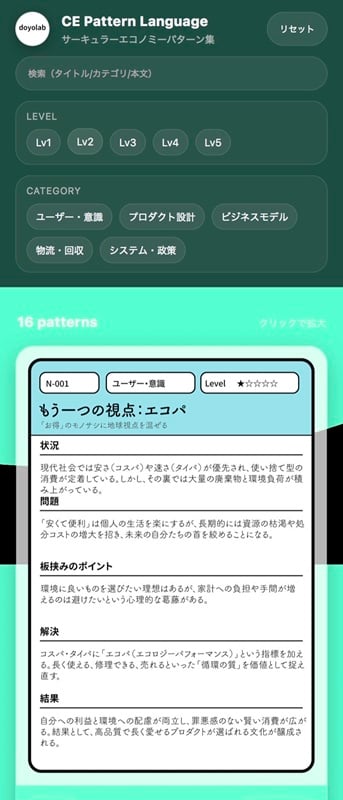
Doyo advocated for the creation of a “pattern language” as a shared vocabulary for advancing the circular economy. By sharing mental frameworks through accessible phrases such as “Eco-Pa (Ecology Performance)” and “A moment in the spotlight, a lifetime of waste,” he argued, people from diverse backgrounds can more easily participate in finding solutions. He concluded by saying, “The ‘outside perspective’ that students bring helps us notice the invisible assumptions we take for granted,” and called on the audience to recognise the importance of co-creation across generations.
Panel Discussion
▽Panellists:
Yuta Murao (City of Yokohama)
Shoichi Fukui (Takenaka Corporation)
Takaki Matsusaka (kitafuku Co., Ltd.)
Daisuke Doyo (Kanagawa University)
▽Moderator:
Yu Kato (Yokohama SDGs Design Center / Harch Inc.)
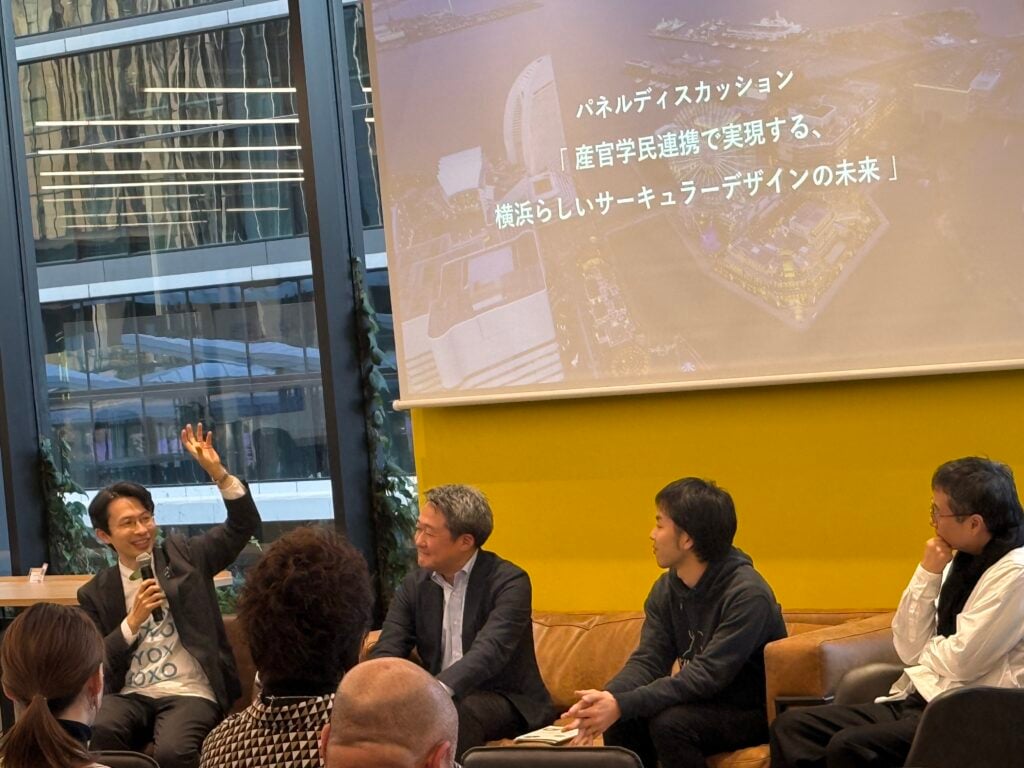
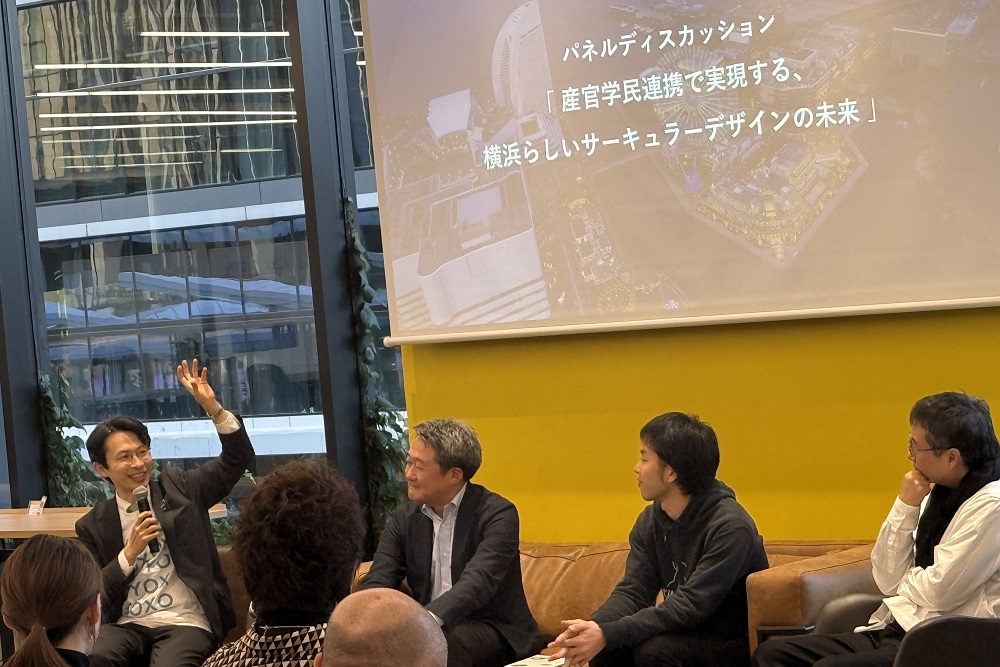
The second half of the event featured a panel discussion on the theme of “The Future of Yokohama-Style Circular Design Realised through Government–Industry–Academia–Community Collaboration.” The panellists — representing government, large corporations, startups, and academia — engaged in a candid debate about how players from such different backgrounds can collaborate to generate impactful projects.
The Keys to Collaboration: “Rationalising the Rules” and “Complementary Roles”
When moderator Yu Kato asked about “tips for collaboration,” Murao of the City of Yokohama offered a perspective from inside local government: “Circular initiatives tend to be perceived as time-consuming and costly. To implement them in society and bring many people on board, it is necessary to create a structure that offers tangible benefits to participants, in addition to environmental and social value.” He went on to say that “the key to collaboration is aiming for a state where choosing circular methods — through measures such as rationalising resource flows — turns out to be easier and more economically advantageous in the end.” As an example, he described how, in the bottle-to-bottle PET recycling programme, the overall system design — whereby consolidating collection across the district rather than collecting separately from each facility compressed transport costs and enabled free waste disposal — became a motivating factor for participating facilities.
Fukui of Takenaka Corporation emphasised the importance of “academia” within the government–industry–academia–community framework. “There are still no established quality standards for circular building materials. When considering quality assurance and risk management over cycles of 40 or 50 years, the backing and support of academics is indispensable,” he said, speaking to the value of university partnerships in technology development. He also described the current state of horizontal collaboration within the industry, where companies — including competitors — are openly sharing know-how to address challenges that no single company can solve alone.
Matsusaka of kitafuku compared the relationship between large corporations and startups to “a large ship and a small boat.” “Large corporations have the power (resources), but it takes time from when they turn the wheel to when they actually change course. Startups, on the other hand, are small boats with less power but far greater manoeuvrability. The moment we think ‘we want to go that way,’ we move first as the boat and build the proof of concept. That kind of division of roles is working well,” he said, drawing on his own experience.
Professor Doyo of Kanagawa University observed that “in an era of too much freedom, it is hard to build deep relationships,” and encouraged the audience to “start simply by talking to each other.”
“Outside Perspectives” as a Breakthrough for Innovation
One of the liveliest moments in the discussion centred on the importance of incorporating perspectives from different fields.
Doyo shared several specific anecdotes about the discoveries that student perspectives can bring. He began with the clear plastic folder recycling project. When he surveyed students about the project, all 20 students present responded: “Rather than recycling them, can we just have the folders?” Doyo recalled with a wry smile: “We tend to make ‘creating a circular loop’ an end in itself, but the students intuitively grasped the most rational and simple value — just reusing them as they are.”
He also shared candid feedback from students on plastic recycling: “If it’s made too clean, you lose the sense of having participated in recycling — please leave some of the mottled pattern so we can feel our contribution.” On clothing circulation, students said things like “if the previous owner’s attachment is too strong, it honestly feels heavy” and “I’m scared of someone seeing the clothes I put in the collection box.”
Doyo reflected: “The quality or story we design with the best of intentions can actually become a psychological barrier for young people. They show us the ‘sense of everyday life’ and the ‘invisible assumptions’ that those of us deeply immersed in a specialist field cannot see.” He shared these observations with the audience, highlighting both the excitement of co-creation with students and the importance of perspectives from outside one’s own domain.
Fukui of Takenaka Corporation echoed this, saying: “When I meet people from fields completely different from construction at sustainability exhibitions, and I ask them about their manufacturing processes, they often take entirely different approaches from the building materials manufacturers we normally work with.” He noted that exchanges with other industries bring fresh insights.
Moderator Yu Kato also commented: “Within an industry, people tend to face the ‘same direction,’ but the insights gained by stepping outside are precisely the seeds of innovation.” The group agreed that the value of government–industry–academia–community collaboration lies not only in complementing each other’s resources, but also in this “crossing of perspectives.”
Diverse Actors Taking Action to Create “What Makes Yokohama, Yokohama”
To close the discussion, each speaker shared their vision for “the future of Yokohama-style circular design.”
Murao said: “Yokohama is both a consumer city and one that has diverse functions — farmland, factories, and more. If we can build a model here where citizens, businesses, universities, and government advance together one step at a time, it could serve as a reference for other regions.” He suggested the possibility of Yokohama becoming a leading model for the circular economy.
Fukui expressed enthusiasm: “With the world’s attention focused on Yokohama ahead of GREEN×EXPO 2027, I want to use this moment to accumulate new value by making Yokohama a field for real-world demonstration.”
Matsusaka commented: “Yokohama has a unique set of players, including messenger companies handling the last mile of delivery. The city’s strength is that if you ask 100 people with diverse backgrounds across the city, you will always find a hint to a solution.”
Doyo expressed his hopes for stakeholder action: “The fact that, in a city this large, citizens and businesses are mixing together and activities are growing — that in itself is remarkable. As people who become interested start taking action, the ‘Yokohama character’ that will be talked about in years to come will be shaped by that process.”
Finally, moderator Yu Kato summarised: “The fact that, despite being a major city, government, industry, academia, and community can build relationships at such close range — that itself is one of Yokohama’s greatest strengths.” The conference closed with a shared affirmation of the importance of diverse actors stepping forward into collaboration and transforming the spaces around them.
Editor’s Note
This year’s conference brought together the full cast of “government, industry, academia, and community” players: policy design and pilot programmes from local government; construction and urban development from a major corporation; product development from a startup; and experimental approaches from a university.
What was particularly striking was that each speaker placed importance not only on technical recycling or product design, but also on human-centred perspectives such as “people’s behaviour,” “empathy,” and “comfort.” It was clear that Yokohama’s circular economy is deepening from a conversation about systems into a conversation about our lifestyles and ways of being.
The conference offered concrete hints for overcoming the barriers to circulation — cost, regulation, and psychological hurdles — from each speaker’s own standpoint: Murao’s “on-the-ground approach” and use of institutional frameworks to “make rules work for you”; Fukui’s attitude of “learning by doing, even on a small scale”; Matsusaka’s “empathy marketing” and “division of roles”; and Doyo’s “pattern language.”
Holding up ideals while grappling with messy, ground-level challenges; designing rational, mutually beneficial systems through dialogue with diverse partners; and realising them one by one. It is the accumulation of that process that will shape Yokohama’s own distinctive circular economy.
【Related page】[1/30] “The Future of Yokohama-Style Circular Design Realised through Government–Industry–Academia–Community Collaboration: Minato Mirai Circular Economy Conference 2026” — Event Announcement
【Related site】City of Yokohama Decarbonisation Pioneer Area Website
【Reference site】Takenaka Corporation
【Reference site】kitafuku Co., Ltd.
【Reference site】doyolab (Doyo Lab)
【Reference site】Yokohama SDGs Design Center