Hitachi, Ltd. announced on September 24, 2026 that it is participating in the Cabinet Office-led Strategic Innovation Promotion Program (SIP; a national program that funds cross-ministerial research from basic research through to social implementation) Phase 3 theme “Building a Circular Economy System,” working to research and develop quality improvement methods and quality evaluation devices to expand the use of recycled materials. The company will develop technology that uses AI to analyze sensor data collected from recycled plastic production lines together with material analysis data, in order to assess variability in quality and the degree of degradation.
SIP is a national project that promotes research and development spanning from basic research to social implementation, transcending the boundaries of government ministries and academic fields. This particular theme is being pursued over a five-year period from fiscal year 2023 through fiscal year 2027, and Hitachi will take part starting in fiscal year 2026, covering the final two years of the program.
In Europe, the End-of-Life Vehicles (ELV) Regulation, which came into effect in August 2026, will require that at least 25% of the plastic used in new vehicle models receiving type approval from September 2036 onward be made from recycled materials. Meeting this kind of demand will require utilizing recycled materials not only from end-of-life vehicles but also from other sectors, such as home appliances and containers and packaging.
At the same time, the quality of recycled plastics—including strength, flowability, and degree of degradation—tends to vary depending on the source of collection, usage history, and manufacturing process. To use recycled materials from different industries in high-quality applications such as automobiles and home appliances, it is essential to understand their quality and characteristics and select materials according to the intended use. However, the sampling-based inspection methods that have traditionally been mainstream make it difficult to fully capture quality variability across an entire lot.
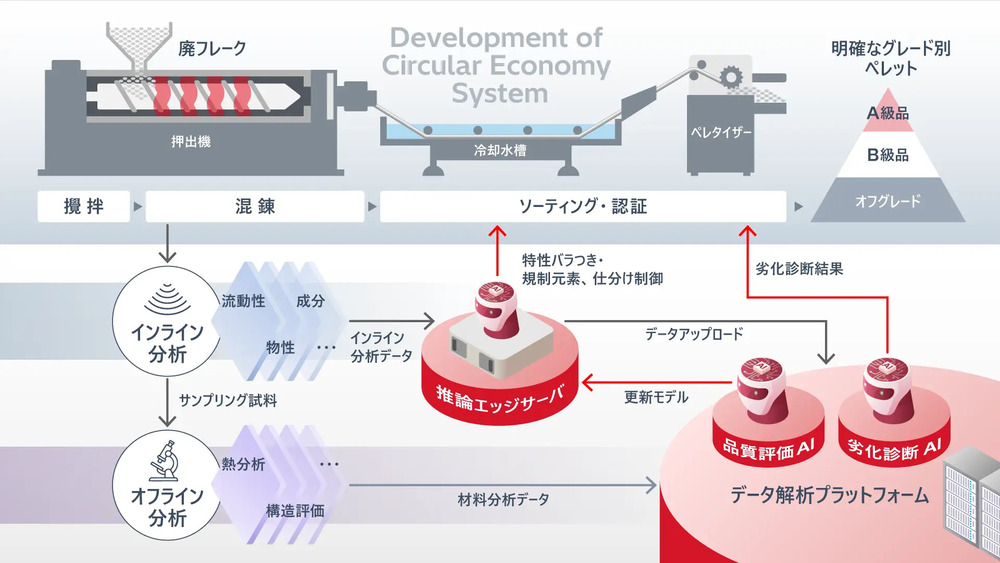
The research and development effort is built around three pillars. The first is a quality evaluation AI that predicts quality variability based on manufacturing conditions and in-line sensor data collected during the process of converting used plastic into pellet-form raw material (re-pelletizing). Because in-line sensors can take continuous measurements without stopping the production process, the aim is to comprehensively assess variability within a lot at the manufacturing stage itself.
The second pillar is a degradation diagnosis AI that analyzes material analysis data and property evaluation data collected offline to identify the causes of degradation and quality variation. Diagnostic results are fed back into the inference AI to continuously refine the quality prediction model. The third pillar involves building a sorting mechanism that uses the outputs of both AIs to classify recycled materials by quality and characteristics, supporting appropriate use of materials for appropriate applications. Hitachi stated that it will draw on its expertise in materials informatics—which combines material data with AI to predict material properties—as well as its measurement and analysis technologies, data analysis capabilities, and physical AI, which understands and predicts the state of real-world objects from collected data.
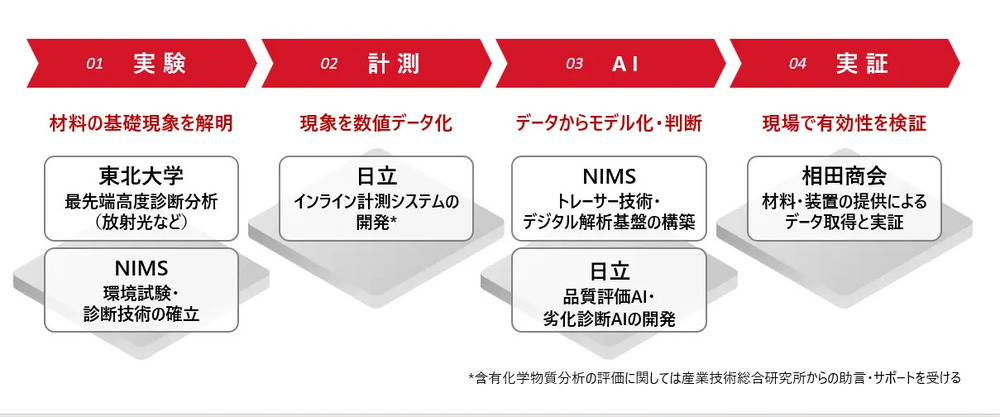
In terms of the implementation structure, Tohoku University and the National Institute for Materials Science (NIMS) will be responsible for conducting detailed analyses using facilities such as synchrotron radiation sources and running tests under various environmental conditions, in order to clarify why recycled plastics degrade and why quality varies. Hitachi will be responsible for developing measurement technology based on these findings, as well as an in-line measurement system that can assess the state of materials without stopping the production line. Building on this, NIMS and Hitachi will jointly develop technology to evaluate the quality of recycled materials and diagnose their degree of degradation, using tracer technology, a digital analysis platform, and physical AI. Aida Shokai Co., Ltd. will provide materials and equipment to support data collection and technology demonstration in real-world settings, verifying the effectiveness of the research outcomes.
Going forward, Hitachi will proceed with developing and verifying the accuracy of the quality evaluation AI from fiscal year 2026 through fiscal year 2027, and from fiscal year 2027 onward will work on developing the degradation diagnosis AI using accumulated data. Initially, the effort will focus on recycled materials derived from in-factory manufacturing processes, where quality variability is low, with future consideration given to expanding application to recycled materials derived from used plastics. Hitachi noted that the technology combining in-line measurement with AI is also expected to find applications in the development of new materials and in scaling up mass production.
【Press release】Advancing AI Technology Research and Development under the Cabinet Office’s “Strategic Innovation Promotion Program (SIP) Phase 3” Theme “Building a Circular Economy System”
【Reference】Strategic Innovation Promotion Program (SIP)
【Related article】Hitachi to Build Elevator Motor Recycling Network with Annual Capacity of 650 Tons