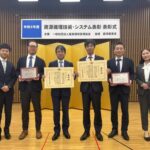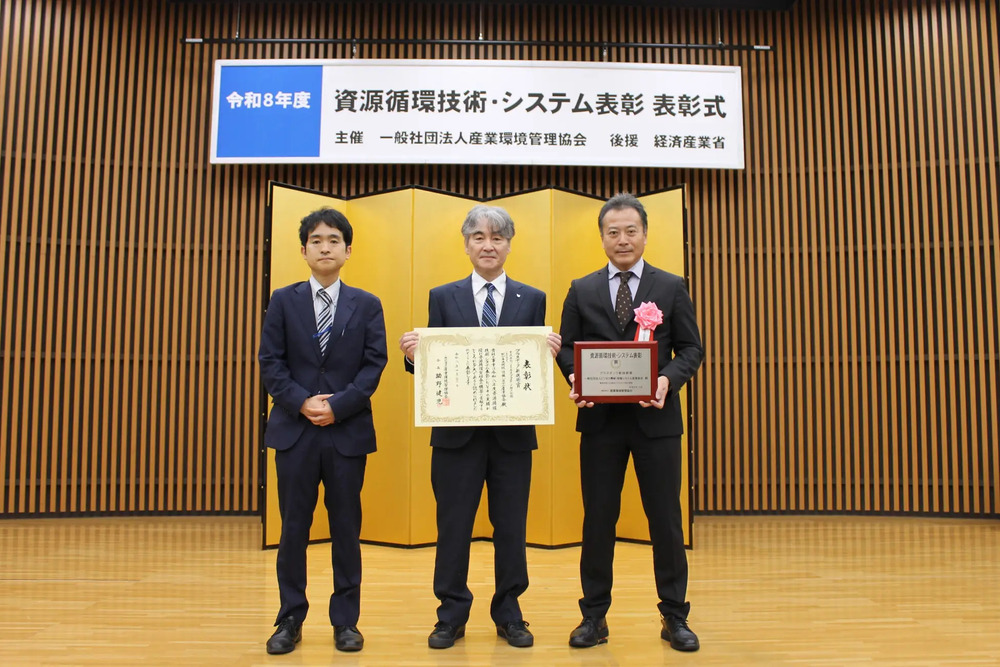
“Industry-wide Development of Recycled Plastic Materials,” an initiative promoted by the Business Machine and Information System Industries Association (JBMIA), received the New Plastics Technology Award at the fiscal year 2026 Resource Circulation Technology and System Awards (52nd edition), hosted by the Japan Environmental Management Association for Industry (JEMAI). The award ceremony was held on October 21, 2026, at the Kikai Shinko Kaikan (Machine Industry Memorial Hall) in Minato Ward, Tokyo, and JBMIA presented the results of its work that afternoon at the “3R Advanced Case Studies Presentation.”
The awards program, run by JEMAI with the support of the Ministry of Economy, Trade and Industry (METI), has recognized advanced technologies, social systems and product developments related to reduction, reuse and recycling (the “3Rs”) since 1975.
In the award-winning initiative, companies across the multifunction printer and printer industry worked together with resin material manufacturers to develop and commercialize a recycled polystyrene (PS) plastic that can be used industry-wide. At the same time, the group built an integrated recycling scheme covering everything from supply to quality assurance. The project was praised for transforming recycling—previously handled separately by each manufacturer—into a cross-industry system, achieving stable supply, high quality and cost efficiency simultaneously, outcomes that had been difficult for individual companies to realize on their own.
In developing the recycled material, the group adopted a method it calls “hybrid PCR” (post-consumer recycled material). This combines recycled material derived from office equipment, which is only available in limited volumes, with recycled polystyrene derived from the four appliance categories covered by Japan’s Home Appliance Recycling Act (air conditioners, televisions, refrigerators and washing machines), which can be procured more stably. This approach raised the proportion of material derived from post-consumer products (the PCR content rate) to 90% by weight, while achieving quality equivalent to virgin plastic.
The group also limited the material to polystyrene—which is generated in large volumes from office equipment and makes it easier to align the performance requirements of different manufacturers—and narrowed the color options to just gray and black, reducing variation in specifications. The initiative was further commended for moving beyond the testing stage to actual adoption in products, successfully establishing closed-loop (bottle-to-bottle style) recycling as a viable business.
Going forward, JBMIA plans to consider expanding the material-specific, industry-wide recycling system it has established to plastics beyond polystyrene. The association is looking to extend the scheme to materials such as ABS resin, polypropylene and polyethylene, with a view to further developing the system.
※The opening image is taken from the press release.
【Press release】“Industry-wide Development of Recycled Plastic Materials” Receives New Plastics Technology Award at the Fiscal Year 2026 Resource Circulation Technology and System Awards|PR TIMES
【Reference】Business Machine and Information System Industries Association (JBMIA)
【Reference】Japan Environmental Management Association for Industry (JEMAI)
【Related article】Toyoda Gosei Commercializes Closed-Loop Recycling Technology for End-of-Life Vehicle Plastic, Applies It to Interior Parts