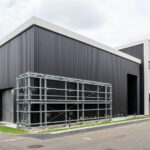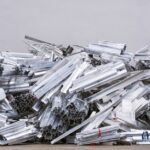
Prime Planet Energy & Solutions (PPES), Nippon Light Metal, Fuji Hatsujo, and Panasonic Operational Excellence announced on August 5 that they have built and implemented a closed-loop (bottle-to-bottle style) recycling scheme in which aluminium scrap generated during the manufacture of sealing plates for EV battery cells is returned to use as material for those same components.
Because aluminium is difficult to keep on-spec once foreign matter or dissimilar alloys are mixed in, reusing it for battery applications demands rigorous quality control at every stage — from scrap generation through collection, transport, and material recovery. Previously, the aluminium scrap in question was recovered mainly as general scrap and directed to different end uses. By aligning the roles of all four companies — covering material supply, material production, parts manufacturing, and battery manufacturing — the partners have now realised a closed-loop resource circulation scheme that returns aluminium scrap to the same battery components.
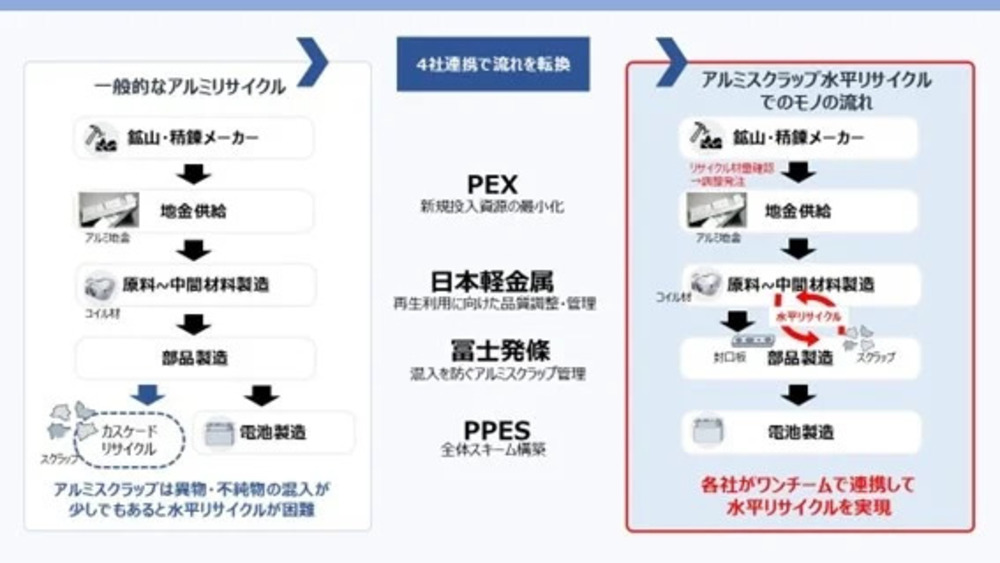
The division of responsibilities is as follows. PPES conceived the closed-loop recycling initiative, encouraged the other companies to participate, and led the realisation of a circular supply chain by designing the overall scheme. Nippon Light Metal is responsible for re-melting and adjusting the composition of collected scrap to recover it as aluminium material meeting the quality requirements for battery applications. Fuji Hatsujo rigorously sorts and manages the scrap generated in its manufacturing processes and provides a stable supply in a condition suitable for closed-loop recycling, serving as the starting point of the circular supply chain. Panasonic Operational Excellence handles scrap collection and distribution management, stabilises pricing through a consignment unit-price system, manages volumes, and connects all parties to sustain continuous closed-loop recycling.
The initiative is expected to reduce annual virgin aluminium ingot consumption by approximately 200 tonnes. It is also said to contribute to reducing the environmental burden associated with new resource extraction and aluminium smelting, lowering raw-material costs by curbing virgin ingot purchases, and mitigating resource-procurement risk through domestic resource circulation.
Closed-loop aluminium recycling is gaining momentum across multiple industries, not only in the EV battery sector.
In construction, for example, LIXIL, Sankyo Tateyama, and Obayashi Corporation are each pursuing closed-loop recycling of aluminium window frames (sashes). LIXIL has partnered with Asahi Kasei Homes and Asahi Kasei Reform to build a resource circulation scheme that collects used aluminium components generated during housing renovation work and reprocesses them using proprietary technology into “PremiAL,” a recycled low-carbon aluminium used in residential aluminium sashes. Sankyo Tateyama has formed a resource-recovery network called “Circular Economy Challengers (CE Challengers)” together with five recycling companies — Abizu, Ibokin, Orix Kankyō, Kokkō, and HARITA — to improve aluminium sash collection rates and secure a stable domestic supply of high-quality recycled raw material. Obayashi Corporation has also partnered with Fuji Sash and Itochu Metals to build a closed-loop recycling flow in which aluminium scrap generated during demolition work is sorted, collected, and reprocessed into aluminium sashes for reuse at its own construction sites.
In the railway sector, HARITA has collaborated with Central Japan Railway Company (JR Central), Nippon Sharyo, Hitachi, Ltd., and Sankyo Tateyama to achieve closed-loop recycling of aluminium components used in Shinkansen (bullet train) rolling stock back into new Shinkansen vehicles. The recycled aluminium has been adopted for the overhead luggage racks and under-rack panels in the standard-class passenger cars of the N700S, the latest Shinkansen model on the Tōkaidō Shinkansen line — said to be the world’s first application of aluminium closed-loop recycling in operational high-speed rail vehicles.
【Reference】Four companies collaborate to achieve closed-loop recycling of aluminium materials used in EV batteries — circulating sealing-plate aluminium scrap back to the same application —
【Reference】Asahi Kasei Homes, Asahi Kasei Reform, and LIXIL collaborate to build a resource circulation scheme for regenerating used aluminium components
【Reference】New resource-recovery network “Circular Economy Challengers” formed to realise closed-loop recycling of aluminium sashes
【Reference】Closed-loop recycling flow established for aluminium scrap generated at construction sites, enabling reuse as aluminium sashes in new buildings
【Reference】Aluminium closed-loop recycling from Shinkansen to Shinkansen achieved
【Related article】Sekisui House adopts 100% recycled aluminium as standard for entrance doors, builds resource circulation scheme for housing components with LIXIL
【Related article】Daikin Industries and Itochu Corporation form comprehensive partnership for closed-loop recycling of commercial air-conditioning units, seek government certification
※ Images sourced from the press release