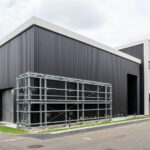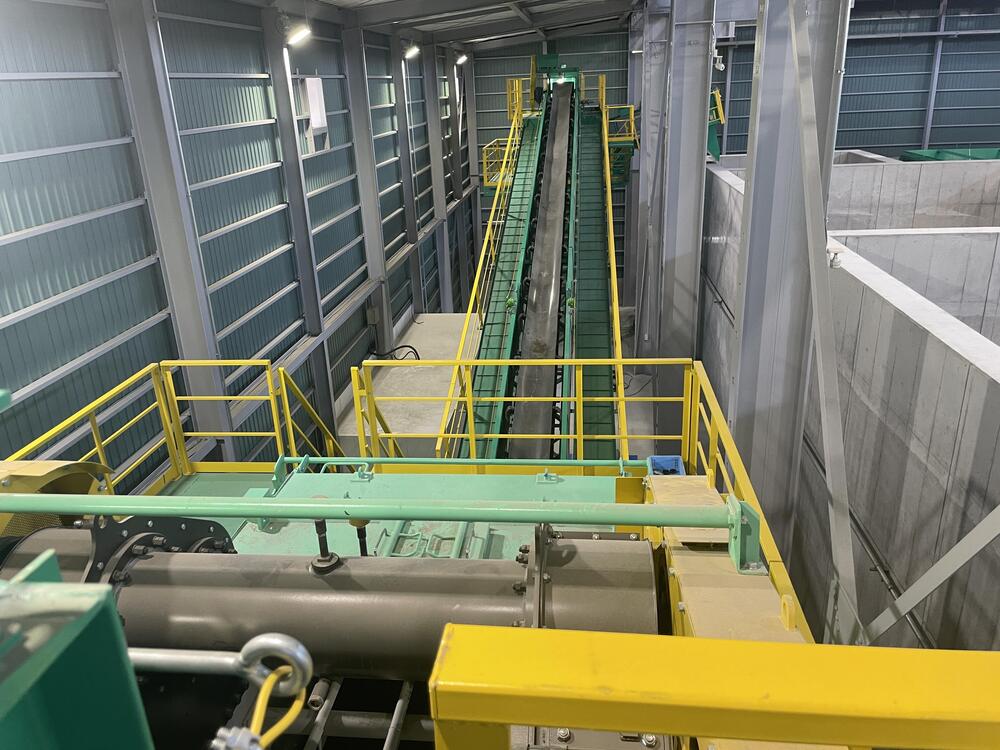
Nikko Co., Ltd. has delivered equipment that blends waste materials to eliminate quality variation and sorts them to a standard size (40 mm or smaller) for Amita Circular Co., Ltd.’s smart factory “ZERO I” (Zerowon) in Himeji, Hyogo Prefecture. The system automates the homogenisation and size-sorting processes to produce resources such as cement raw fuel.
The processing workflow of the delivered equipment consists of four stages.
- Homogenisation: Waste fed in by crane is blended in a twin-shaft kneading mixer. Moisture content and viscosity are adjusted to condition the material for smooth mechanical conveyance and processing. The blending state is monitored by camera, with plans to introduce AI-based image diagnostics for automatic assessment (scheduled for implementation by the end of 2027).
- Size control: The blended material passes through a vibrating screen to determine whether it meets the standard size specification.
- Automatic loop re-crushing: Oversized material is crushed in a twin-shaft shredder and returned to the screen, cycling until it falls within the standard size.
- Automatic conveyance: Only material that meets the standard size is transferred to the product yard.
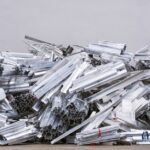
ZERO I can store up to 18 types of waste simultaneously and produces a wide variety of circular resources tailored to customer needs through 100% recycling of waste. The primary product is cement raw fuel for the cement industry. An opening ceremony was held on July 9, at which point the equipment commenced full-scale operation. This automation is expected to establish a stable, end-to-end operational framework covering everything from waste intake to circular resource production.
Amita Circular is progressively implementing a data infrastructure to support the automation of intake, production, storage and shipping, and this equipment operates in conjunction with that automated control system. The company aims to achieve full automation of the entire circular resource production process by around 2027. ZERO I is positioned as the core facility of “Circular 3.0,” the business model promoted by the Amita Group, which goes beyond the physical circulation of materials to support transformation across entire supply chains.
The cement industry has long accepted waste and by-products generated by other industries and municipalities as substitutes for raw materials and energy. According to the Japan Cement Association, in fiscal year 2024, 478 kg of waste and by-products were utilised per tonne of cement produced. The present automation initiative can be seen as an effort to upgrade the raw-fuel production process itself — the upstream stage of this intake workflow.
Nikko intends to support the stable operation of ZERO I going forward through maintenance and servicing of the delivered equipment. Drawing on technologies cultivated in asphalt and concrete plant engineering, the company will strengthen its engineering-led sales approach, offering optimisation of entire production processes rather than simply supplying individual pieces of equipment.
【Press release】Automating the production process for circular resources derived from waste: Nikko delivers automation-ready equipment to smart factory ZERO I (Zerowon)
【Press release】Amita Circular Co., Ltd. launches “ZERO I,” a resource circulation hub powered by information curation, in Himeji (7/9) — A core facility supporting supply chain sustainability transformation through AI and DX
【Reference article】Nikko delivers automation-ready equipment to Amita Group’s resource circulation hub “ZERO I”
【Reference article】Overview of the cement industry
【Related article】Amita HD aims to achieve unmanned circular resource production at new plant
【Related article】Building an ecosystem society where both resources and human relationships circulate — Interview with Amita HD Chairman Kumano