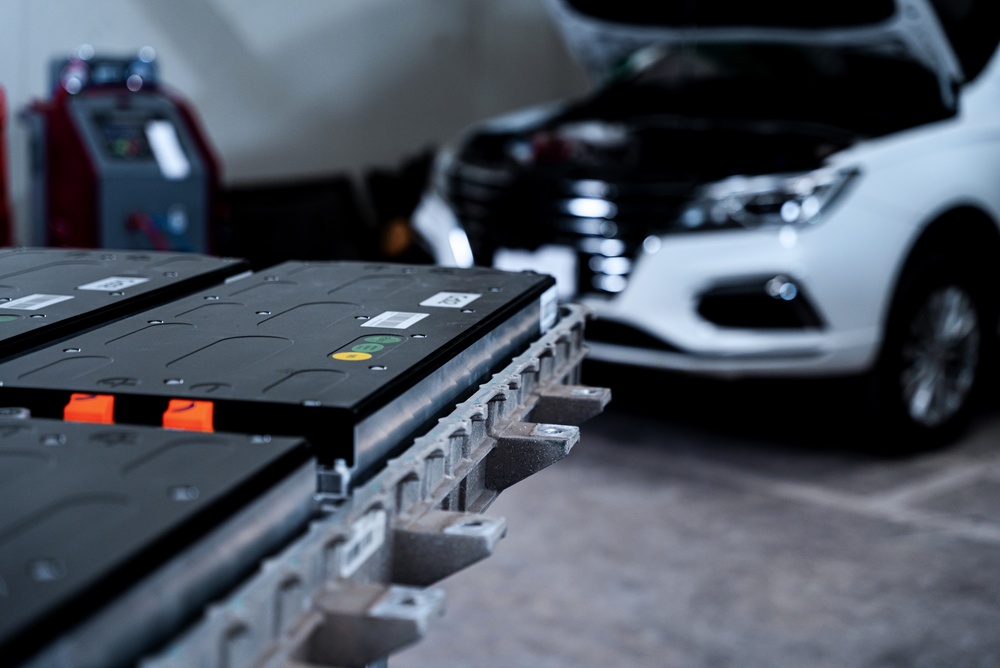
On November 20, 2026, the Japanese Standards Association (JSA), a general incorporated foundation, issued “JIS C 63330-1:2026 Repurposing of secondary batteries – Part 1: General requirements,” a Japanese Industrial Standard (JIS) that sets out procedures for evaluating the safety and performance of used automotive lithium-ion batteries—such as those from EVs—when repurposed for stationary energy storage systems and similar applications. The content aligns with the international standard IEC 63330-1:2024, which was established in 2024 based on a proposal from Japan.
The new JIS first defines procedures for safely removing batteries from first-life equipment such as EVs, and for inspecting them for external damage such as deformation or electrolyte leakage. By protecting workers from electric shock or short-circuit accidents and screening out hazardous defective units at an early stage, the standard aims to reduce unnecessary evaluation costs and rework.
The standard also establishes evaluation criteria for determining a battery’s current residual performance and remaining service life, based on records of serious faults requiring emergency shutdown of the battery system—such as those preventing fire, overheating, or electrolyte leakage—as well as historical data on charge-discharge cycles and temperature. By minimizing the need for full disassembly down to component level and lengthy charge-discharge testing, the standard is said to enable low-cost, reliable quality assessment.
On the design side, the standard specifies requirements both for cases where batteries are reused in the same system configuration as their first-life application, and for cases involving changes to hardware or software design. This is expected to make it easier for energy storage system manufacturers and others to determine appropriate safety designs and control modifications suited to specific use cases, helping to prevent business risks such as design errors or product recalls.
Annex A further provides an example of a common data template for sharing information on battery condition and the requirements of new applications. By enabling automobile dismantling companies to accurately record and share data on appearance and usage history, and to pass this information smoothly on to downstream evaluation businesses and energy storage system manufacturers, the standard is expected to facilitate data sharing across different industries and encourage new entrants from other sectors—both recognized as key challenges in realizing a circular economy.
This standard was developed against the backdrop of challenges surrounding the reuse of used batteries. Lithium-ion batteries used in EVs and similar vehicles often retain sufficient storage capacity and performance even after their first-life use in vehicles ends, raising expectations for their reuse. However, used batteries vary widely in history—including mileage and usage environment—and reusing them without understanding their degree of degradation can risk smoke or fire accidents caused by electrolyte leakage or electrode instability. Until now, the absence of objective safety and performance evaluation standards meant that the costs of ensuring safety and quality assurance posed a major barrier to new entrants in the battery reuse business.
JSA states that establishing this JIS will lower quality assurance costs for market entrants, helping to expand Japan’s domestic reused-battery market, which is expected to grow to roughly ¥120 billion (approximately $800 million) by 2030. In addition to contributing to the circular economy through the effective use of scarce resources such as lithium and cobalt, the standard is also expected to support the achievement of carbon neutrality by 2050, as affordable, reliable reused batteries become more widely used for balancing renewable energy supply and as emergency power sources.
【Reference】JIS Established Setting Objective Safety and Performance Evaluation Standards for Used Automotive Lithium-Ion Batteries from EVs and Other Vehicles
【Reference】JIS C 63330-1:2026 Repurposing of secondary batteries – Part 1: General requirements
【Related article】MobiSavi and Ehime Nissan to Begin Pilot Operation of EV Battery Collection and Reuse Hub, a Step Toward a Regionally Self-Contained EV Resource Circulation Model
【Related article】Building a System for EV Battery Reuse: METI and the Ministry of the Environment Release Draft Report on Reviewing the Automobile Recycling System
【Related article】Hitachi High-Tech Develops Method for Instantly Evaluating Lithium-Ion Battery Degradation and Remaining Lifespan, Promoting Greater Efficiency in Reuse and Remanufacturing