The Ministry of the Environment has released the results of its first progress check on the Fifth Fundamental Plan for Establishing a Sound Material-Cycle Society (循環型社会形成推進基本計画, approved by the Cabinet in August 2024), compiled following deliberations by the Central Environment Council’s (中央環境審議会, an advisory body to the Ministry of the Environment) Subcommittee on a Sound Material-Cycle Society (66th meeting).
The Central Environment Council conducts an evaluation and check of policy progress roughly once every two years to ensure steady implementation of the Fundamental Plan for a Sound Material-Cycle Society. This marked the first such check for the Fifth Fundamental Plan, with deliberations held from June 2025 and compiled into a progress-check report.
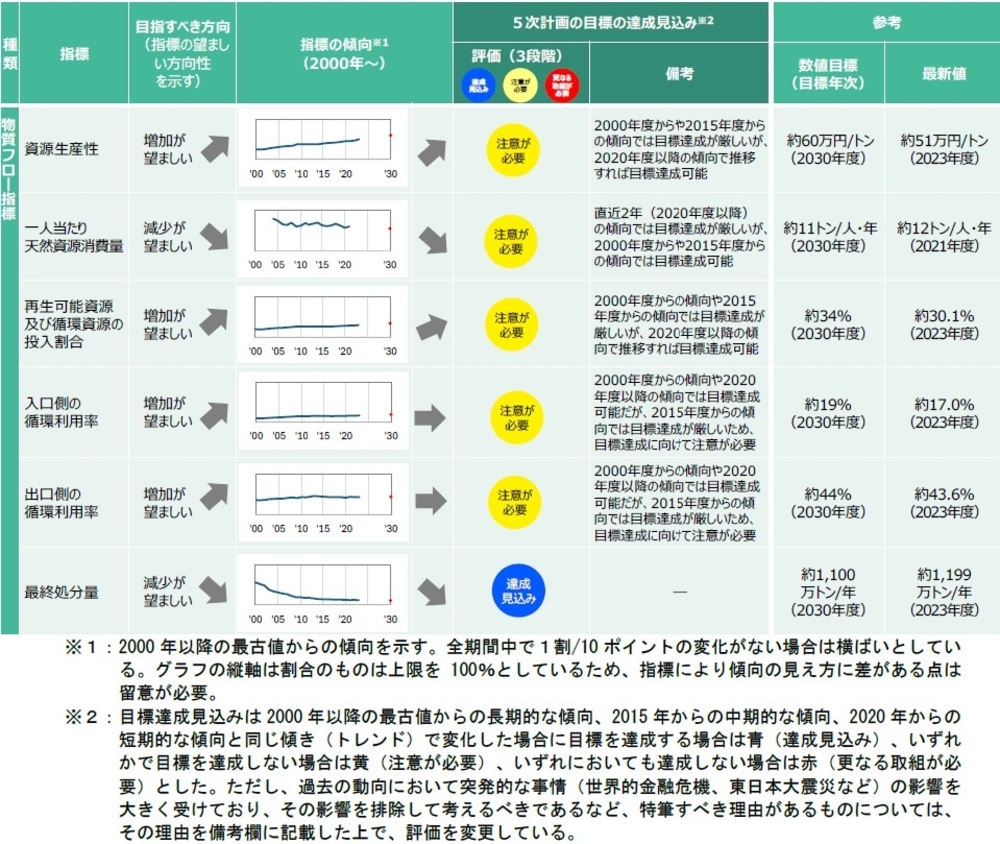
The check used 10 indicators that together represent the overall picture of a sound material-cycle society: six material-flow indicators and four initiative-based indicators. For each indicator, the likelihood of achieving the fiscal year 2030 target was assessed.
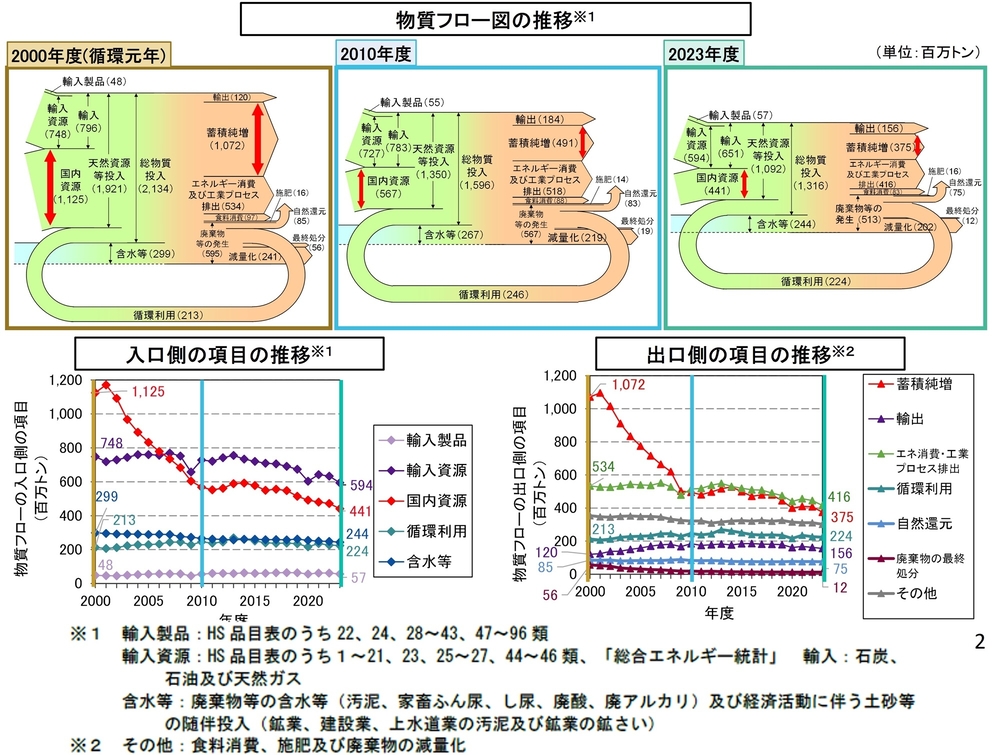
Resource productivity reached approximately ¥509,000 per tonne in fiscal year 2023, showing an upward trend driven by both rising GDP and declining input of natural resources. However, against the fiscal year 2030 target of ¥600,000 per tonne, the indicator was assessed as “requiring attention.”
Natural resource consumption per capita stood at approximately 12.1 tonnes per person per year in fiscal year 2021, while the input ratio of renewable and circulated resources reached approximately 30.1% in fiscal year 2023. Both were assessed as “requiring attention.”
The input-side cyclical use rate reached approximately 17.0% in fiscal year 2023. While this has remained roughly flat since fiscal year 2013, it has shown a long-term upward trend, driven in part by declining input of natural resources. The output-side cyclical use rate reached approximately 43.6% in fiscal year 2023, having peaked in fiscal year 2013 and since remained flat to declining. Both indicators were judged as “requiring attention.”
Meanwhile, final disposal volume declined to approximately 12.0 million tonnes per year in fiscal year 2023, a reduction of about 79% compared with fiscal year 2000. This indicator was assessed as on track to achieve its target.
Among the initiative-based indicators, the market size of circular-economy-related businesses expanded to approximately ¥70.6 trillion in fiscal year 2023, putting it on track to meet the fiscal year 2030 target of ¥80 trillion or more. On the other hand, public awareness and behavior regarding the formation of a sound material-cycle society were assessed as “requiring further effort,” with only 69.7% of respondents saying they consciously practice green purchasing.
Greenhouse gas emissions from sectors related to the transition to a circular economy totaled approximately 595 million tonnes of CO2 per year in fiscal year 2023, continuing a downward trend. Of this, emissions from the waste management sector stood at 33.2 million tonnes of CO2 equivalent in fiscal year 2023 — a significant decline from the peak of 44.4 million tonnes of CO2 equivalent in fiscal year 1997 — but have remained at a roughly flat level since fiscal year 2010.
This check designated two priority areas from the Fifth Fundamental Plan for closer examination: “thorough resource circulation across the entire life cycle through collaboration among businesses for resource circulation” and “building diverse regional resource-circulation systems and achieving regional revitalization.”
For the first priority area, input-side and output-side cyclical use rates and final disposal volumes were newly tracked by material category (fossil-based, metal-based, non-metallic mineral-based, and biomass-based). The volume of biomass plastics introduced (150,000 tonnes in fiscal year 2022, against a fiscal year 2030 target of approximately 2 million tonnes) showed a large gap from the target and was assessed as “requiring further effort.” Meanwhile, the reuse market size (approximately ¥3.5 trillion in fiscal year 2024) showed an increasing trend, and the stock of certified long-life quality housing (approximately 1.74 million units in fiscal year 2024, against a fiscal year 2030 target of approximately 2.5 million units) was progressing toward its target but was assessed as “requiring attention.”
The report also presented progress on related targets, including doubling the volume of recycled plastics, replacing 10% of fuel usage with sustainable aviation fuel (SAF), halving food loss volume, increasing the recycling volume of e-scrap containing rare metals to approximately 500,000 tonnes by 2030 (a 50% increase from 2020), reducing the volume of clothing discarded from households by 25%, and expanding the number of municipalities recycling used paper diapers.
For the second priority area, the number of local governments working on forming regional circular and ecological spheres (地域循環共生圏, a Ministry of the Environment initiative to build self-sustaining, mutually complementary regional communities) increased to 233 municipalities in fiscal year 2023, although the pace of increase was noted to be slowing. Waste incineration volume per person per day reached approximately 662 grams in fiscal year 2023, and was assessed as “requiring attention” against the fiscal year 2030 target of approximately 580 grams. Meanwhile, the proportion of facilities supplying waste-derived energy externally reached 43.1% in fiscal year 2023, progressing steadily toward the fiscal year 2027 target of 46%. Regarding the formulation of long-term, wide-area consolidation plans, the Ministry of the Environment has asked prefectures to complete their plans by the end of fiscal year 2027, but the report noted that the current state of plan formulation remains limited.
The results of this progress check are scheduled to be fed into the Central Environment Council’s General Policy Subcommittee as input for the progress check of the Sixth Basic Environment Plan (環境基本計画), to be conducted in fiscal year 2026. The Ministry of the Environment stated that it will continue to promote its various policies, including those in the priority check areas, to advance the formation of a sound material-cycle society through the transition to a circular economy.
【Reference】On the First Progress Check of the Fifth Fundamental Plan for Establishing a Sound Material-Cycle Society
【Reference】First Progress Check Report on the Fifth Fundamental Plan for Establishing a Sound Material-Cycle Society