Toyotsu ChemiPlas Corporation, Sanyo Chemical Industries, Ltd. and Evonik Industries announced on October 13, 2026 that the three companies have launched a joint initiative to produce and utilize recycled polyol using chemical recycling technology for polyurethane foam.
Polyurethane foam is widely used in automotive seats, mattresses, furniture and more. However, most used foam is still disposed of through landfilling or incineration. Incineration generates CO₂, and landfill capacity is also becoming increasingly constrained. Moreover, this results in the loss of resources that could otherwise be reused. The material recycling methods widely used until now—crushing foam and remolding it—have mainly resulted in downcycling into lower-value applications, and have not sufficiently achieved circulation back into raw materials for higher-value uses.
Chemical recycling of polyurethane typically involves regenerating polyol through a decomposition reaction, but conventional technology has faced challenges with large amounts of by-products and undecomposed components, resulting in insufficient purity of the recycled polyol obtained. This has meant that mixing with virgin polyol has been a precondition, making it difficult to use the material as 100% recycled feedstock. It has also posed a hurdle to practical implementation in terms of quality stability and compliance with Japan’s domestic chemical substance regulations.
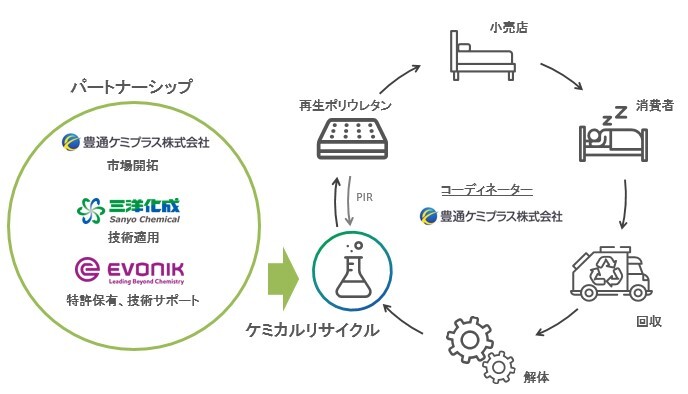
In this initiative, Toyotsu ChemiPlas will serve as coordinator, leveraging its collection network and logistics capabilities to build the overall scheme and drive the project forward. By combining Evonik’s chemical recycling technology with Sanyo Chemical’s polyol design and process technology, the companies aim to address the conventional challenges of low purity, high impurity levels, and energy-intensive processes requiring high temperatures and long processing times. They aim to produce and reuse recycled polyol with higher purity and more stable quality while reducing energy load. Specifically, they will advance the development of a scheme to collect discarded polyurethane foam and offcuts generated during manufacturing processes, and regenerate polyol from this material.
Overseas, there are also efforts underway to chemically recycle used mattresses. One example is German chemical giant BASF. The company developed a process to decompose flexible polyurethane and extract the original polyol, and in 2022 announced a collaboration with Austrian foam manufacturer NEVEON. By 2023, the companies were able to produce, at ton scale, polyol made solely from used mattresses as feedstock, which NEVEON used to manufacture mattresses containing 80% recycled material in their polyol component. However, when BASF introduced these mattresses at its own business hotel, the company noted that widespread commercial use of recycled polyol was still some way off, and that it would be necessary to engage stakeholders across the entire value chain.
The press release also introduces polyurethane foam derived from 100% recycled polyol produced using Evonik’s chemical recycling technology. Going forward, the three companies will jointly evaluate the entire value chain, from collection and sorting through to the production of high-purity recycled polyol and remanufacturing into products. In addition to rigorous quality evaluation, they will also conduct further verification of existing life cycle assessment results using data obtained through the project, with the aim of commercializing the technology and implementing it in Japanese society.
*The image in this article is cited from the press release.
【Press release】Toyotsu ChemiPlas, Sanyo Chemical and Evonik launch initiative on chemical recycling of polyurethane foam
【Press release】Toyotsu ChemiPlas, Sanyo Chemical and Evonik launch initiative on chemical recycling of polyurethane foam
【Reference】Towards a circularity in recycling of mattresses (BASF)
【Reference】Milestone in the recycling of end-of-life mattresses (NEVEON)
【Reference】BASF and NEVEON provide hotel with recycled mattresses (NEVEON)