On July 21, 2026, Teijin announced the development of a new thermosetting carbon fibre reinforced plastic (CFRP) that combines a heat-activated self-repair function with high recyclability. The material maintains mechanical properties equivalent to conventional CFRP while enabling both damage repair and resource circulation.
CFRP — carbon fibre impregnated with thermosetting resin — is widely used in aircraft, automobiles, sporting goods and other applications thanks to its strength and light weight. Conventional thermosetting CFRP, however, cannot be melted or remoulded, and most post-use waste has historically been disposed of by incineration or landfill. As pressure mounts to reduce greenhouse gas (GHG) emissions across entire product life cycles in response to global warming, developing new materials with a lower environmental footprint has become an urgent challenge.
Teijin has been working to reduce GHG emissions and waste through initiatives such as its environmentally conscious carbon fibre brand “Tenax Next.” Drawing on its long-accumulated expertise in polymer material design, the company has now developed a new resin that can be recycled through remoulding or resin decomposition and also features a heat-activated self-repair function. By incorporating this resin into CFRP, Teijin has created a circular thermosetting CFRP that contributes to reducing environmental impact.
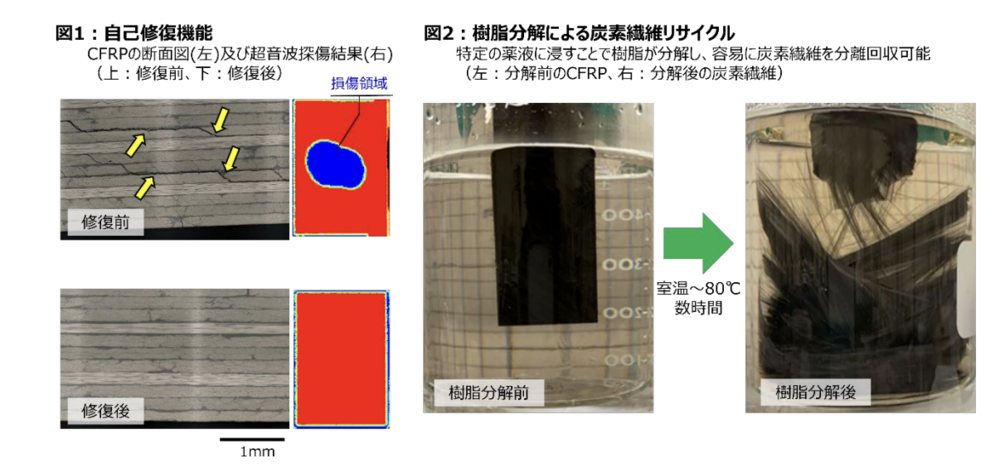
The newly developed material has three key features.
First, it has a heat-activated self-repair function. Brief heating at a specified temperature repairs damaged resin layers, allowing degraded CFRP to continue in service rather than being discarded, thereby extending product life.
Second, the CFRP can be remoulded and recycled. Conventional thermosetting CFRP cannot be remoulded once formed, because the resin does not melt or flow when reheated. The new material, however, exhibits flowability within a specified temperature range even after forming, making recycling by compression moulding and similar processes possible.
Third, carbon fibre and resin can be separated more easily. Conventionally, separating carbon fibre from end-of-life CFRP required prolonged combustion in a high-temperature furnace exceeding 400°C, imposing a heavy environmental burden. The new material can be decomposed by immersion in a specific chemical solution, enabling easy separation of the carbon fibre and delivering recycling with a lower environmental impact and superior productivity.
Teijin aims to begin providing samples in fiscal year 2028, advancing research and development in collaboration with universities and research institutions. The company plans to target applications primarily in aircraft, automobiles and industrial machinery — sectors with strong demand for weight reduction, improved durability and lower environmental impact. With an eye to future mass production and social implementation, Teijin will pursue integrated optimisation spanning material design, component design and recycling processes, while also advancing application development and supply chain construction through partnerships with other companies.
※ Part of this development was supported by the Strategic Innovation Promotion Program (SIP — a cross-ministerial R&D funding scheme administered by the Cabinet Office’s Council for Science, Technology and Innovation) under the theme “Building a Circular Economy System” (research-promoting organisation: the Environmental Restoration and Conservation Agency of Japan).
Beyond Teijin, development of circular-use solutions for thermosetting CFRP is advancing elsewhere in Japan.
At the end of October 2025, Toray announced a new technology for recycling carbon fibre from a wide variety of thermosetting-resin-based CFRPs while preserving fibre strength and surface quality. Using a novel decomposition agent, the process breaks down CFRP at lower temperatures than conventional methods, and the resulting recycled carbon fibre retains more than 95% of the strength of virgin fibre. Toray has also produced a carbon fibre nonwoven fabric from the recycled fibre and has begun providing samples for automotive interior and exterior, construction, and electrical and electronic applications.
Mitsubishi Chemical Group is developing an integrated business covering everything from CFRP recycling to reprocessing, building a circular business model. Its subsidiary Mitsubishi Chemical Advanced Materials provides customisable services — from scrap collection to high-purity fibre recovery — through its recycled carbon fibre intermediate and semi-finished product brand “CarboNXT.”
Teijin itself has long offered “Sereebo,” a highly recyclable thermoplastic carbon fibre reinforced plastic (CFRTP), which has been adopted for components such as the cargo bed of GM pickup trucks in the United States. The newly announced self-repairing, recyclable thermosetting CFRP is positioned as a further option in this continuing line of development.
Government-backed projects are also under way. On May 20, 2026, NEDO (the New Energy and Industrial Technology Development Organization) launched the “Next-Generation Aircraft Waste and Recycling Industry Development Project,” which aims to build a supply chain for reusing CFRP recovered from retired aircraft as aircraft components. Over five fiscal years from 2026 to 2030, five organisations — including the Tokai National Higher Education and Research System, SUBARU and JAXA — are participating to develop technologies such as cutting techniques for large CFRP waste materials and continuous manufacturing of recycled CF base materials. The project targets a reduction of approximately 11,700 t-CO₂ per year across the aviation industry as a whole by 2040. CFRP recycling in the aviation sector — one of the application areas Teijin has identified — is thus being advanced in parallel by this national project.
【Press Release】Development of a New Thermosetting Carbon Fibre Composite Material Combining Self-Repair Function and High Recyclability
【Reference】Carbon Fibre Composite Materials for Next-Generation Engineering (Mitsubishi Chemical Advanced Materials)
【Reference】From Materials Supplier to Tier 1 Supplier (Teijin)
【Related Article】Toray Develops New CFRP Recycling Technology Retaining Over 95% of Fibre Strength, Also Creates Japanese-Paper-Style Nonwoven Fabric
【Related Article】NEDO Launches Aircraft CFRP Recycling Project, Targeting Reuse as Aircraft Components by Fiscal Year 2030
※ Images in the article are sourced from the press release.