
The Green Chemistry Research Group (運営委員長: Chairperson Daisuke Sasaki), a specialist study group of the Society of Polymer Science, Japan, that explores the synthesis and recycling of environmentally conscious polymer materials, held a symposium titled “Circular Economy in the Apparel Industry: Sustainable Fashion” on March 5 at the AIST Waterfront Complex (the National Institute of Advanced Industrial Science and Technology’s Tokyo waterfront facility).
As the environmental burden of the fashion industry’s “mass production, mass consumption, and mass disposal” model becomes a global challenge, the symposium brought together specialists from across the value chain and the recycling industry — government, textile manufacturers, apparel companies, recyclers, and consumer-support organisations. Each shared their current situation, challenges, and latest initiatives, and lively discussion was exchanged on the path toward sustainable fashion.
National Guidelines and an Action Plan for Sustainable Fashion
First, Tatsutaro Murai of the Ministry of the Environment’s Environmental Regeneration and Resource Circulation Bureau explained the current state of clothing disposal in Japan and the government-led policy measures for transitioning to a circular economy.
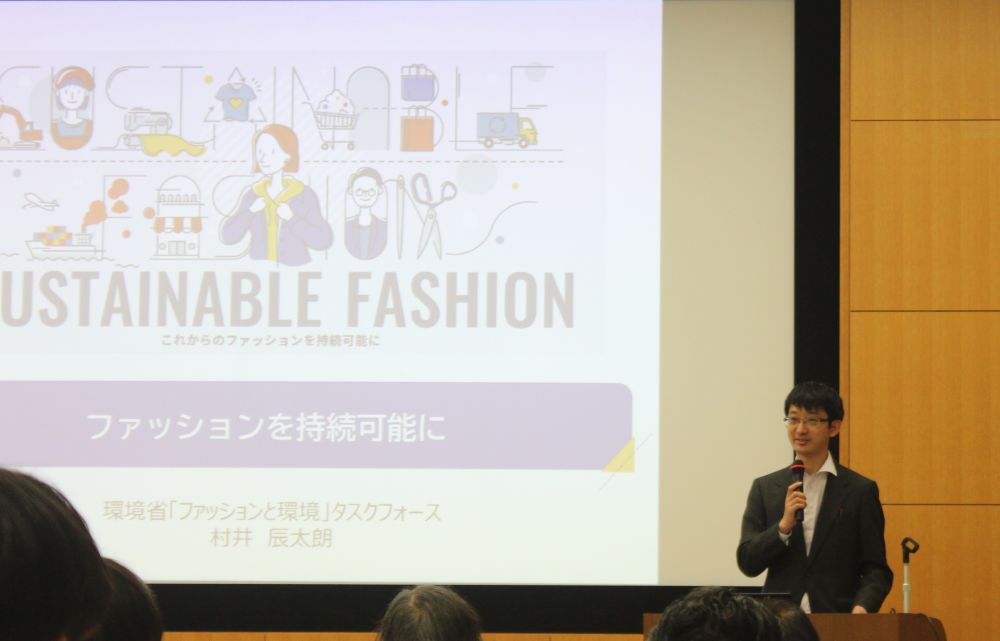
A stark picture was presented: the full lifecycle of clothing in Japan generates 95 million tonnes of CO2 per year, and a 2024 survey found that of the 822,000 tonnes of clothing newly supplied domestically, approximately 70% — some 558,000 tonnes — is discarded without ever being used. In response, the government’s Fifth Fundamental Plan for Establishing a Sound Material-Cycle Society (approved by Cabinet in August 2024) sets a target of reducing the volume of clothing discarded from households by 25% by fiscal year 2030 compared with fiscal year 2020.
Murai emphasised the importance of advancing policies at every stage — from collection and regeneration through to design and sales — while also encouraging behavioural change among consumers. In January 2026, a draft “Circular Fashion Promotion Action Plan” was published to reduce household clothing disposal; it commits to building a nationwide collection system that allows consumers anywhere in Japan to separate and drop off clothing, and to creating mechanisms that extend garment lifespans, with strong cross-ministerial coordination.
“Fibre-to-Fibre” Resource Circulation: The Challenge of Separating Composite Materials
Next, Yukihiro Shigemura of the Technology and Production Division at Teijin Frontier Co., Ltd. introduced fibre-to-fibre recycling technologies and challenges from a textile manufacturer’s perspective.
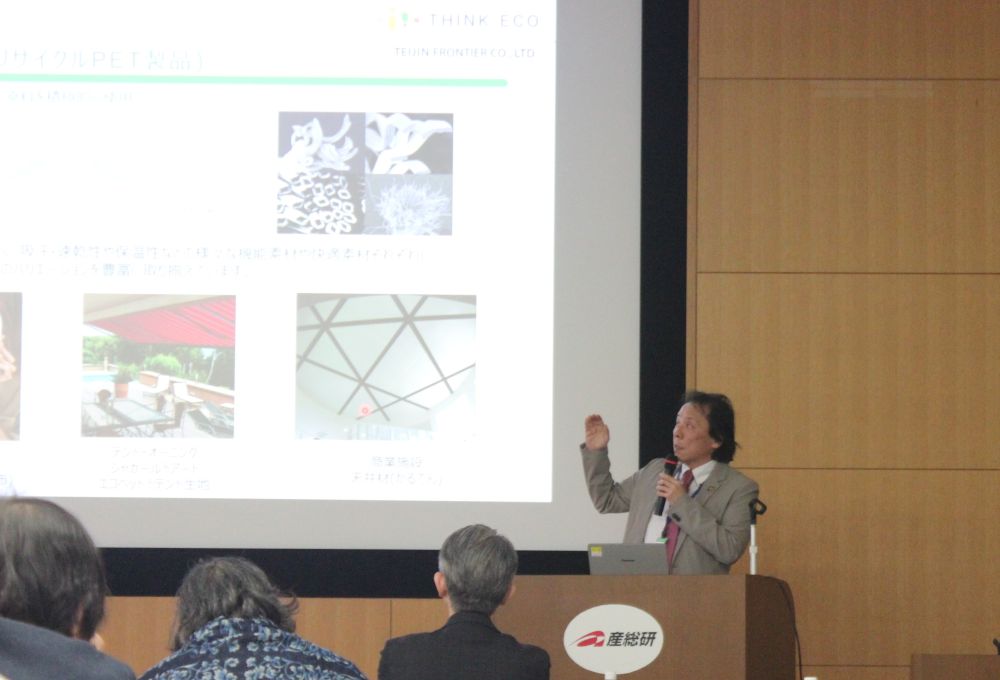
The company has offered “ECOPET®” — made from used PET bottles — since 1995, and has led chemical recycling technology using post-consumer garments since 2000. However, as European environmental regulations (such as the Ecodesign for Sustainable Products Regulation, ESPR) become increasingly stringent, conventional technologies alone are no longer sufficient for Japan’s textile industry to maintain international competitiveness.
The greatest obstacle is that more than 70% of garments currently in circulation are “composite materials blended from two or more types of fibre.” A circular system cannot be established with single-material recycling technology alone. Teijin Frontier has therefore joined forces with domestic textile manufacturers including Toray and Nippon Wool Textile Co., Ltd. to establish a new consortium, the Consortium for Fiber to Fiber. Working also with the Research Institute of Innovative Technology for the Earth (RITE), the company revealed that it is pursuing the development of composite-material separation technologies — incorporating chemical, mechanical, and biotechnological approaches — as an “all-Japan” collaborative effort.
In-Store Clothing Collection and the Social Value Created Through Garments
Michitake Hasebe, Head of the ESG Promotion and Corporate Division at Aoyama Trading Co., Ltd., then spoke about the company’s recycling project “WEAR SHiFT,” which leverages its network of more than 700 stores nationwide.
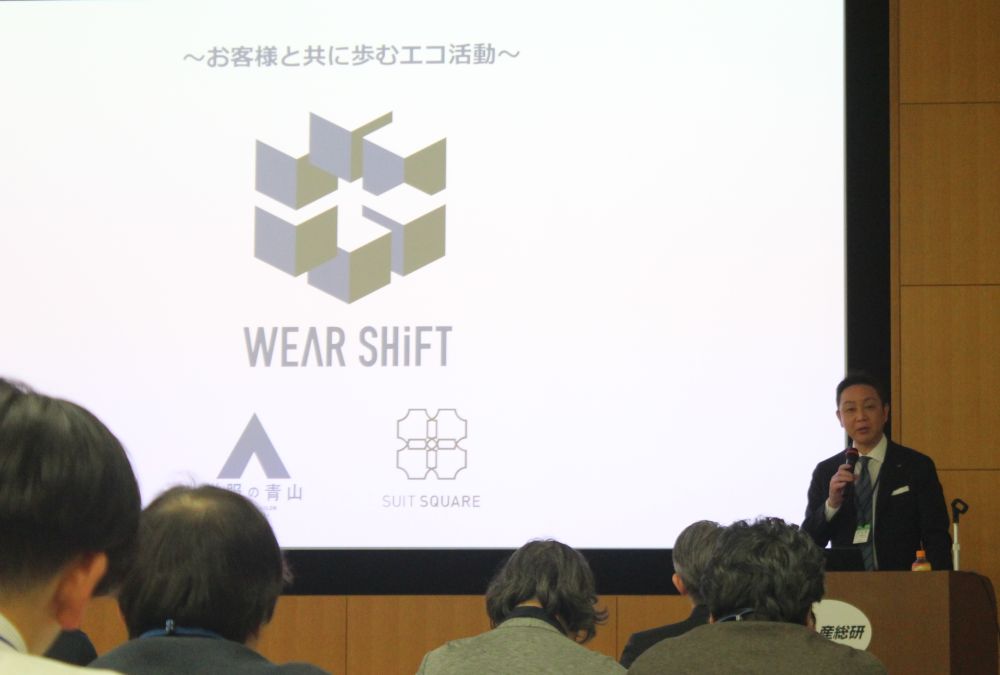
The company has been continuously collecting trade-ins and unwanted clothing since as early as 1998. Its defining feature is that it accepts clothing from brands other than its own. In fiscal year 2024, the volume collected reached approximately 347 tonnes, 99% of which was reused or recycled.
However, Hasebe noted that the proportion of collected clothing that can be closed-loop (fibre-to-fibre) recycled — regenerated into wool coats, suits, and similar items — remains only a few percent of the total. The majority currently relies on cascade recycling (downcycling) into automotive interior materials, packaging cushioning, or “disaster-relief blankets” as important outlets.
While confronting this reality, the company also donates the disaster-relief blankets it produces to local governments on remote islands and in hard-to-reach areas, and conducts forest conservation activities through “AOYAMA no Mori” (AOYAMA’s Forest) via donations linked to the volume of clothing collected — connecting its current recycling scheme to broader social contribution. These sustained efforts were recognised with the Good Life Award’s Minister of the Environment Award (Excellence Prize).
A 92-Year-Old Recycler on the Reality of Used-Clothing Collection and the Need to Redesign the System
Shuji Fujita, a Director of Nakano Co., Ltd., then took the stage to highlight the current state and challenges of clothing recycling from the front lines of the waste and recycling industry.
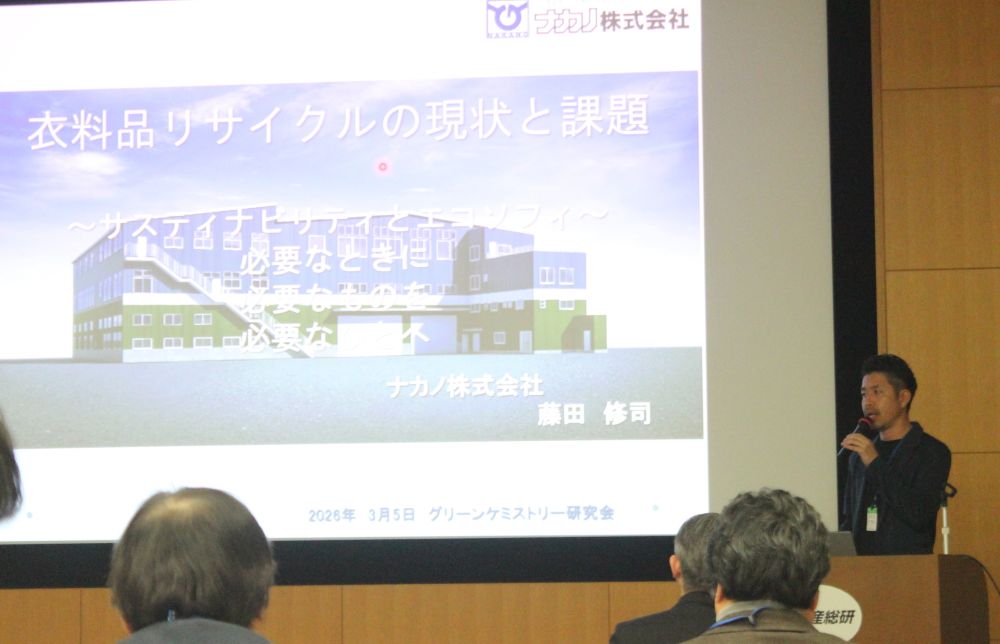
Founded in 1934, Nakano Co., Ltd. handles everything from the sorting of used clothing and textiles to their export. Fujita traced the history of Japan’s textile recycling industry — which dates back to before World War II — while describing the harsh realities of today. Of the approximately 1.3 million tonnes of unwanted clothing generated in Japan annually, only around 30% is recycled. He pointed out that as fast fashion has driven down the unit price of garments, composite materials have proliferated, making it impossible to absorb the costs of material recovery; and that overseas exports of used clothing are also approaching their limits due to mismatches between demand and quality.
Fujita introduced his company’s own “Yomigaeri” (Revival) product series — which re-spins used clothing into gloves and other items — while pressing home the urgent challenges faced at collection sites. Sorting collected clothing currently depends entirely on human hands and judgment, and as composite materials become ever more prevalent, separating garments into recyclable grades is extremely difficult. Moreover, traditional outlets such as industrial wiping cloths and re-spun fibre have already reached saturation point. He conveyed a strong sense of crisis: “Simply increasing collection volumes without creating new outlets will leave us with nowhere to send the material.” He stressed the need for new collaboration to create “fourth and fifth outlets” through advanced technologies.
Turning Consumers into “Agents of Circulation”
The final speaker was Arisa Kamada of unisteps (a general incorporated association that bridges consumers and the fashion industry), who put forward proposals on consumer behavioural change and supply chain transparency.
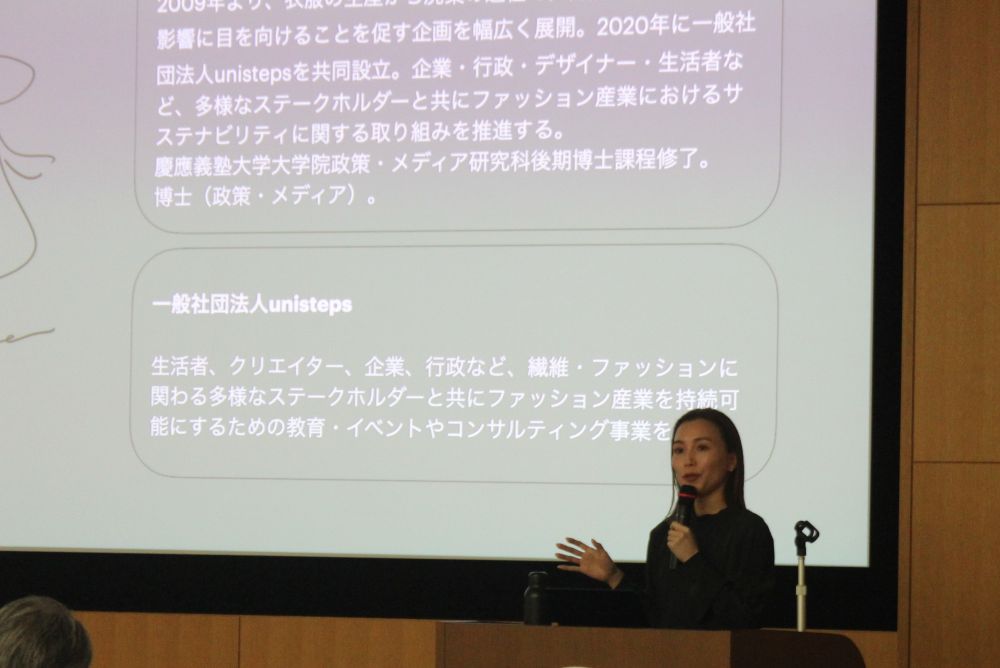
Kamada noted that the average period of use for modern garments is shortening, and pointed to the consumer mindset of “owning lots of clothes but having nothing to wear.” She argued that the transition to circular fashion depends not only on technology and regulation, but critically on how consumers make choices and use what they own.
unisteps runs exhibitions featuring a “long-tag T-shirt” — a garment whose tag lists by name every process and every person involved in its manufacture — as well as field trips to actual sewing factories and used-clothing sorting facilities such as those operated by Nakano Co., Ltd. By raising consumers’ awareness of what actually happens to a garment after it is placed in a collection box, individuals are transformed from mere “targets of awareness campaigns” into “key components — active agents — of the circular system,” on a par with design, production, and distribution. Kamada concluded that the key to implementing the circular economy lies not in assigning blame to any single party, but in making information open and building a relationship in which companies and consumers together “pass a garment’s lifespan from person to person.”
A Broad, Ecosystem-Wide Approach Is What the Apparel Industry’s Circular Economy Requires
What this Green Chemistry Research Group symposium made clear is that a circular economy in the apparel industry can never be achieved by a single breakthrough technology or the efforts of one company alone.
The policy guidelines mapped out by the Ministry of the Environment, the composite-material separation technologies being pursued by Teijin Frontier, the collection infrastructure provided by Aoyama Trading, the clothing sorting and recycling that Nakano continues to tackle, and the consumer behavioural change that unisteps fosters — all of these must work in concert. There is an urgent need to design an ecosystem in which all stakeholders — spanning the full value chain, the recycling industry, and consumers — recognise their respective roles and collaborate as an interconnected whole, rather than operating in isolation.
This was a symposium in which one could feel genuine momentum toward a co-created future for a sustainable fashion industry — one in which technology, policy, business models, and consumer lifestyles are all mutually linked.
【Reference】Green Chemistry Research Group
【Related Article】The Future of Plastics Circulation Through Industry-Government-Academia Collaboration: A Report from the Society of Polymer Science Japan’s Green Chemistry Research Group