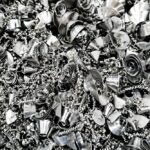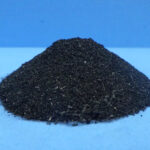
Toray Industries, Inc. announced on September 30, 2026 that it has developed a solvent material recycling technology that uses a solvent to separate and recover polyphenylene sulfide (PPS)—a resin used in automotive parts and electrical/electronic components—from waste materials containing it. Rather than breaking down the PPS contained in waste materials all the way to raw material level, the technology dissolves the resin as-is in a solvent and separates it from other materials. According to the company, a small-scale demonstration using this method is the first of its kind in the industry (as of September 2026, according to Toray’s own research).
Demand for PPS is growing, particularly in the automotive and electrical/electronics sectors. At the same time, as regulations related to resource circulation are strengthened, especially in Europe, the importance of post-consumer recycling (PCR)—reusing products and components collected after consumer use as raw materials—is increasing across industries including automotive. However, separating foreign matter when recovering and recycling PPS from used products has been difficult, making the establishment of recycling technology a challenge.
Because PPS is highly resistant to chemicals and difficult to dissolve, few solvents exist that can dissolve it. Drawing on the knowledge it has accumulated over many years in PPS manufacturing technology, Toray developed a method to dissolve only the PPS contained in waste material, then solidify it again to extract it—achieving separation and removal of foreign matter including auxiliary materials such as glass fiber. As a result, the recycled PPS obtained from waste material reportedly retains a molecular weight and melting point equivalent to virgin PPS. Because this technology eliminates the need to break plastic down to the raw material level, Toray expects it to reduce energy consumption compared with chemical recycling—which breaks the material down before remanufacturing it—while also enabling more efficient removal of foreign matter.
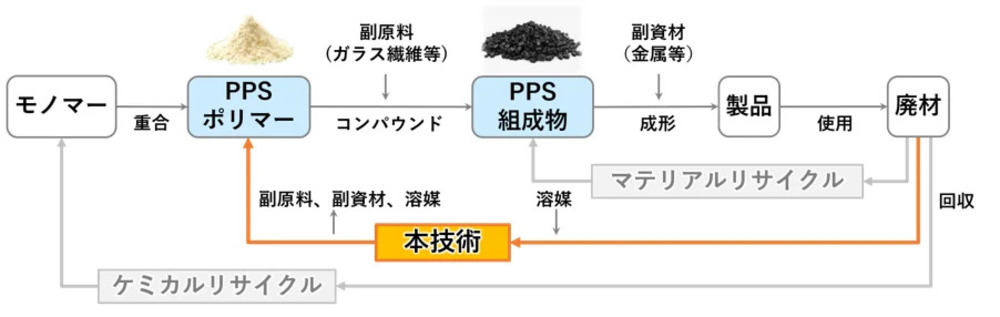
Based on preliminary estimates from its basic research, Toray confirmed the possibility that recycled PPS produced using this technology could reduce greenhouse gas emissions—from raw material production through to product manufacturing—by approximately 30% compared with the company’s PPS made from virgin raw materials. The company will continue to verify this reduction effect through ongoing demonstration studies.
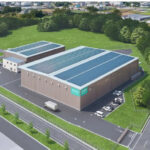
Having completed its basic research, Toray is now conducting scale-up demonstration trials with support from METI’s (the Ministry of Economy, Trade and Industry) “FY2024 Subsidy for Promoting Structural Transition to a Decarbonized, Growth-Oriented Economy (Project to Strengthen Resilience of Autonomous Resource Circulation Systems through Industry-Government-Academia Collaboration).” The company aims to begin commercial sales by around 2030, and intends to build a resource circulation system—spanning everything from the collection of PPS-containing waste materials to the reuse of recycled PPS—in partnership with stakeholders including the automotive and recycling industries.
※Images in this article are cited from the press release
【Press release】Industry first: new recycling technology developed to separate and recover PPS from PPS-containing waste materials
【Reference】Public call for subsidy operators (implementing organizations) for the FY2024 “Project to Strengthen Resilience of Autonomous Resource Circulation Systems through Industry-Government-Academia Collaboration”
【Related article】Goldwin, Toray and Idemitsu build low-carbon nylon supply chain adopted for THE NORTH FACE products
【Related article】Recycling composite fibers with enzymes and microorganisms: Teijin Frontier, Toray and four other companies establish new consortium for bio-recycling technology development