※This article is reprinted from “Ideas for Good.”
[Kyoto Circular Economy Special Feature]
This special feature is a joint project by IDEAS FOR GOOD and the City of Kyoto exploring the present and future of the circular economy in Kyoto. How can the spirit of “shimatsu no kokoro” (a Kyoto ethic of using things carefully and without waste) and the circular ways of living and manufacturing that have been passed down through Kyoto’s thousand-year history be developed into innovations that shape the Kyoto of the future—and into circular businesses that will carry on for the next thousand years? Together with the City of Kyoto, local businesses, and Akihiro Yasui, a policy advisor to the City of Kyoto, we explore the value and potential of Kyoto from a circular economy perspective. (Kyoto Circular Economy Special Feature Top Page)
Have you ever wondered where the clothes you hand over so they won’t become “waste” actually end up?
We pull them out of the closet, stuff them into a bag, and drop them off at a collection box or a secondhand shop, believing that this way “the clothes will reach someone new.” But the reality is not so simple. Only a small fraction of donated clothing is actually reused; much of it is incinerated or “recycled” into industrial materials such as wiping cloths (used in factories) or sound-insulating materials for cars.
In Japan, roughly 770,000 tonnes of new clothing are sold each year, while about 670,000 tonnes are discarded. Of that, 510,000 tonnes are incinerated or landfilled, only about 10,000 tonnes are reused domestically as secondhand clothing, and a mere 70,000 tonnes are recycled (into wiping cloths, shoddy fiber, etc.) (*1).
The reason so much ends up incinerated is that most clothing is made from “blended fibers”—combinations of two or more materials such as cotton and polyester—which makes textile-to-textile recycling extremely difficult. Even when such fabrics are recycled, it is nearly impossible to extract pure, vividly colored threads from the mixed fibers, resulting in a dull, “dust-like” material. Such colors are hard to use in new clothing, so much of this recycled material quietly ends up as industrial material instead.
Tackling this deep-rooted problem with a bold new approach—sorting and recycling clothing not by material but by color—is colourloop, a company based in Kyoto. Founder and CEO Motoko Uchimaru has developed a proprietary technology called the “Colour Recycle System®,” which sorts and recovers discarded fibers by color. We spoke with Uchimaru, who transforms discarded fibers into valuable resources through color, about her work and her vision for the future of circulation.
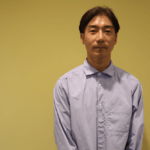
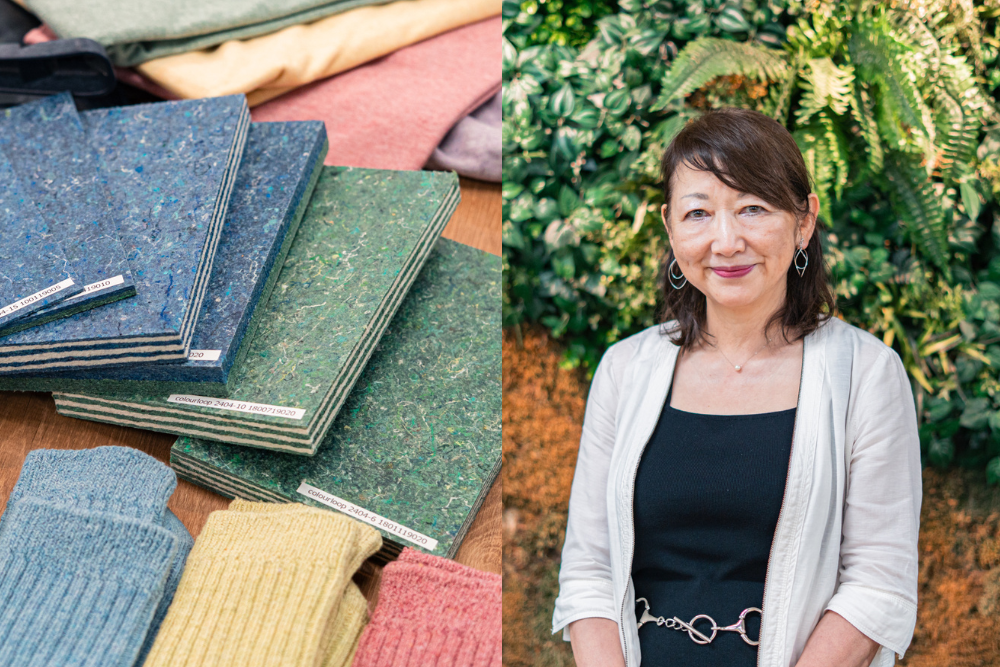
 CEO of colourloop Inc. Graduated top of her class in Textiles from Middlesex University (UK). Holds a PhD in Engineering from the Kyoto Institute of Technology. Worked as a textile designer in Kyoto, developing materials for fashion and interior design. After learning of the realities of discarded fibers, she began to question the endless cycle of production and started researching textile recycling as a graduate student at the Kyoto Institute of Technology. Seeking a more appealing way to make use of discarded fibers, she founded colourloop Inc. with the belief that by offering consumers materials and products they find genuinely attractive, the value of recycled goods can be raised, ultimately contributing to a circular society.
The Dilemma of “Blended Fibers” Facing the Fashion Industry
As a longtime textile designer working with yarns and fabrics in the worlds of fashion and interior design, Uchimaru had long been troubled by the enormous volume of fiber waste generated behind the glamorous facade of the industry.
Driven by the conviction that “simply making more is not the answer,” Uchimaru turned to research. While immersed in textile recycling research as a doctoral student at the Kyoto Institute of Technology, she came face to face with a structural problem plaguing the industry.
“65% of the clothes we wear are made from two or more types of material. About half of those (47%) use three or more materials. For example, a cotton base might be chosen for comfort, but polyester is added because cotton wrinkles easily. Polyurethane is added for stretch. A bit of rayon is added for sheen. Before you know it, you end up with a blend of four or five different fibers.”
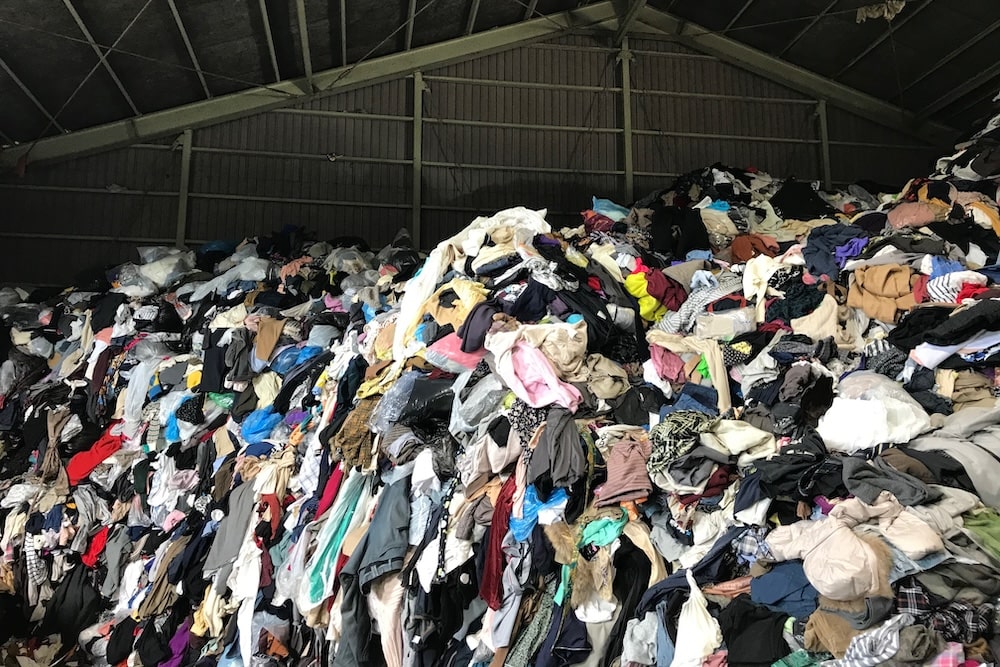
Even if fibers could be sorted by material, the mixing of many different colors results in a “dust-like” hue that dramatically reduces the value of the product. Without solving this problem, there is no future for textile recycling, she says.
“When you mix light, the three primary colors combine to form white. But when you mix physical pigments, the result tends toward black. So instead of a beautifully calculated gray, you often end up with an unpleasant, muddy gray that doesn’t lend itself to appealing products. That’s why I decided to start by creating things that ordinary consumers would find genuinely attractive, as a way to get people interested in recycling in the first place.”
The answer Uchimaru arrived at was simple yet revolutionary: if sorting by material is so difficult, then sort by color instead.
“When I thought about what makes a material appealing, color was really the key factor. That’s how I began researching color-based sorting for recycling. First, I roughly sorted clothing by category, then worked out rules for avoiding unpleasant colors. By starting with the end product in mind and then figuring out the rules, it became much easier to create new things.”
Turning Discarded Fibers into “Coloring Material” Through a Shift in Thinking
Solving this textile recycling problem is exactly what colourloop’s “Colour Recycle System®” was designed to do. Regardless of material, discarded textile products are sorted by color and unraveled, transforming them into yarns, sheets, and boards that retain their original color—without any additional dyeing process. It’s an approach that reconceives discarded fibers not as waste, but as “coloring material.”
Products created through the Colour Recycle System® can be reused repeatedly: simply collect and re-sort them by color once again. Even faded or frayed clothing can still be used as fiber material.
“After sorting by color, we can unravel the fibers and turn them into pigments or reinforcing materials. We can also mix them with resin to create molded products, blend them with pulp to make paper, or turn them into cotton-like batting to make felt or yarn.
Because this system uses the fibers themselves as the coloring material, the resulting products have deep, distinctive hues and a unique texture—and since no new dye is used, the environmental impact is also lower.”
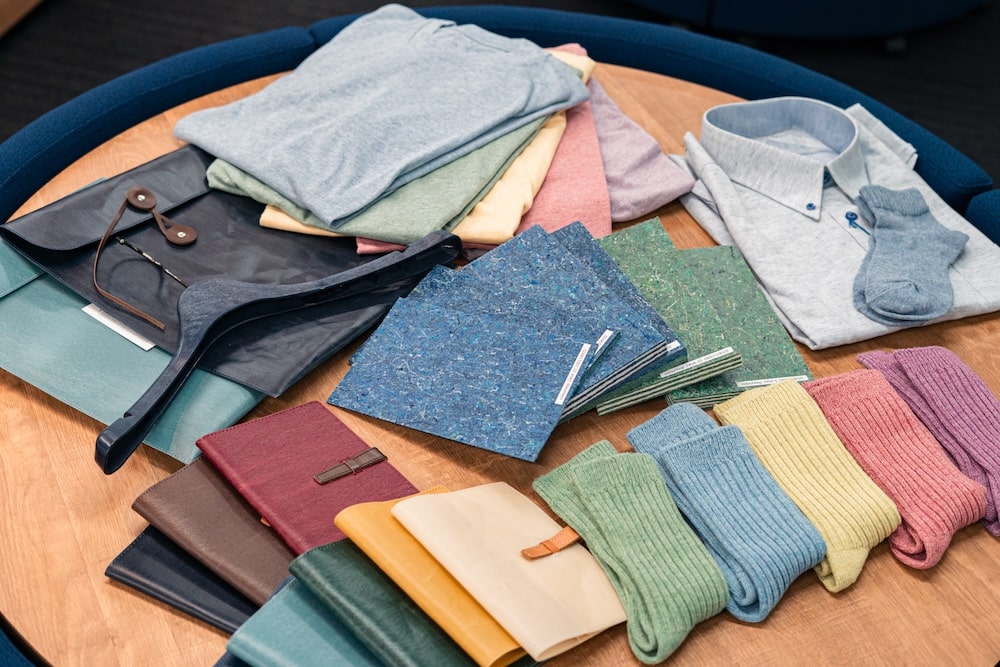
A key strength of recycling by color rather than by material is that it can handle the kind of chaotic, mixed-fiber blends that have traditionally been considered impossible to recycle. It produces materials free of the dull, muddy tones once seen as an unavoidable drawback of recycled goods. In fact, the distinctive blend created by mixing various fibers together produces a rich, warm character all its own—perhaps a color that carries a story woven from memory and time, something virgin materials simply cannot offer.
Creating Material Value Through Technology and Design
One of the company’s strengths is its fusion of conventional, engineering-focused recycling technology with a designer’s sensibility, resulting in recycled fiber materials with truly unique characteristics. One example is “TEXLAM,” a board material that uses discarded fibers as a reinforcing agent.
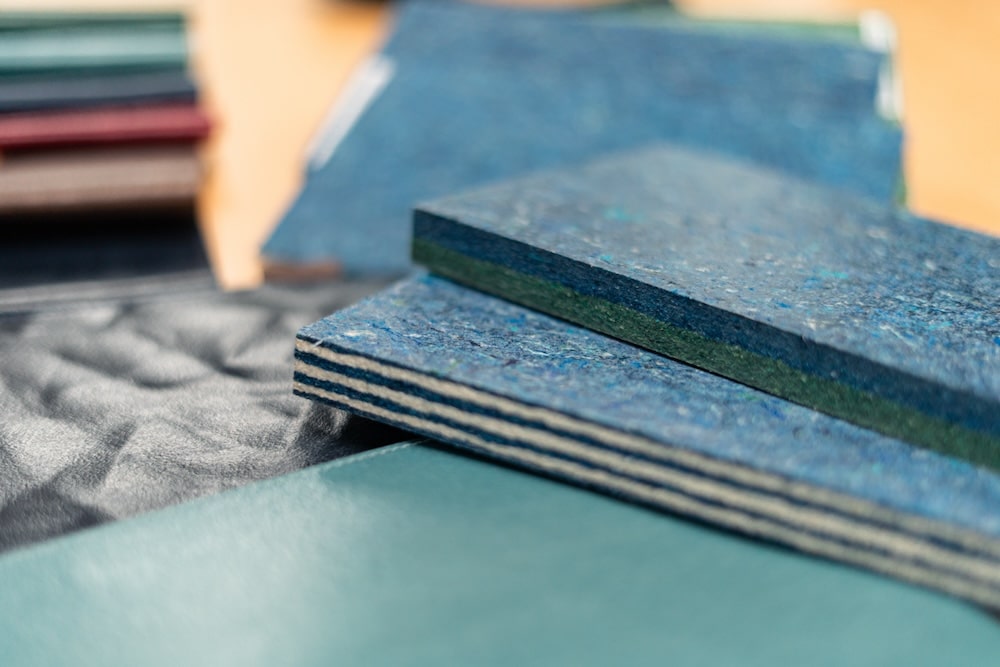
“A key feature of TEXLAM is that its thickness, density, and cross-sectional design can be freely adjusted. For example, if it’s used for a tabletop, we can increase the density for greater strength; if lightness is needed, we can lower the density.
The manufacturing process for this board was developed over many years of research at the Kimura Laboratory at the Kyoto Institute of Technology, and I added the design element—color and texture—to it. We are also working on paper made from discarded clothing, as well as ‘fiber-to-fiber’ closed-loop recycling that upcycles miscellaneous blended clothing. These are all challenges aimed at addressing the reality that about 65% of the clothes we wear are made of blended fibers.”
The company has developed a variety of other materials as well. “ReFIQ,” a sheet material made from discarded clothing, can be easily cut with scissors or a utility knife, yet retains high tensile strength (*2). It can also be finished with delicate laser-engraved patterns, combining functional value—strength—with the aesthetic appeal of a texture unique to fiber-based materials.
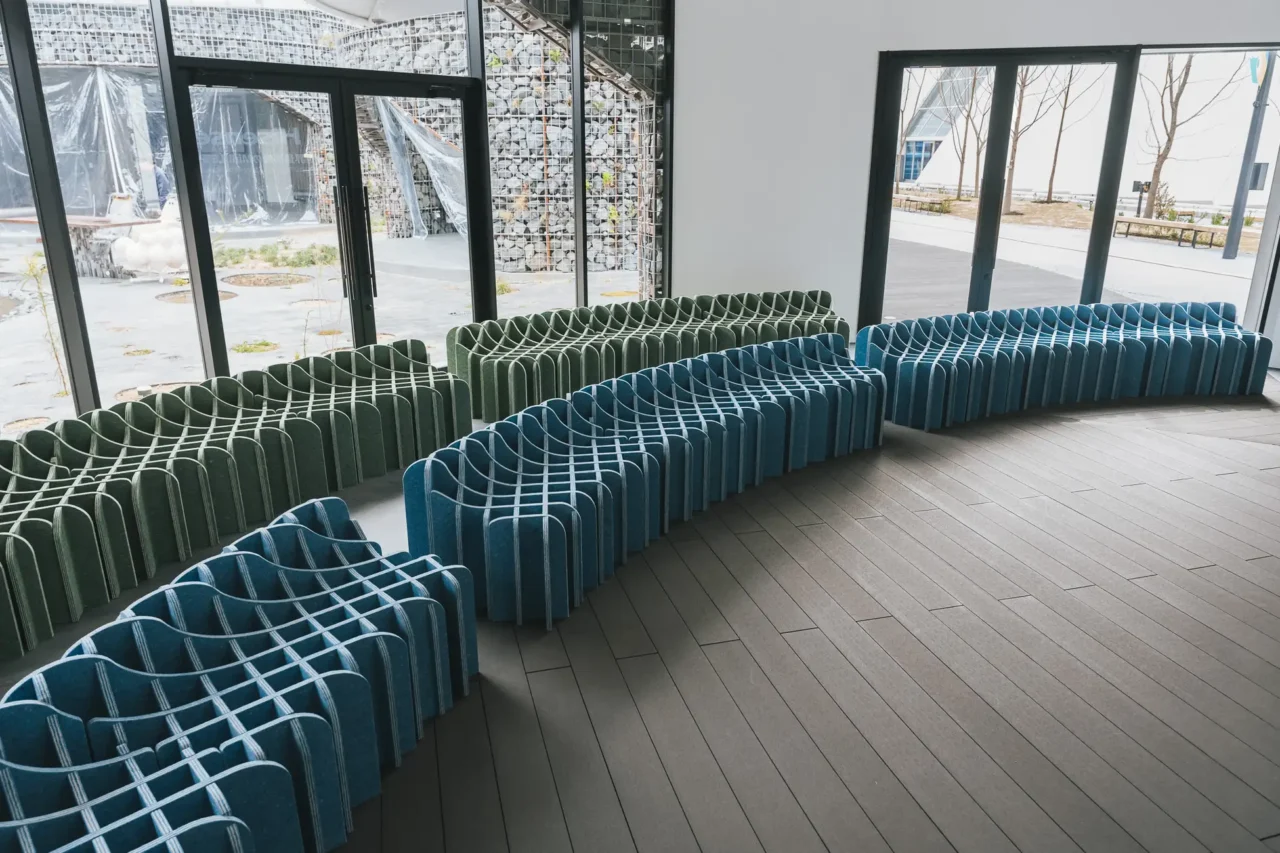
Making the most of these properties, a bench made from TEXLAM board—created by recycling discarded clothing equivalent to about 3,000 T-shirts (at 100 grams per shirt)—was installed at Expo 2025 Osaka, Kansai, welcoming countless visitors.
Bringing Material Circulation to Society: Recycling Weaves New Stories
The circulation of materials born from discarded fibers is steadily expanding into society through collaborations with schools and companies.
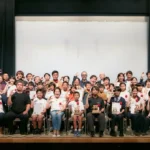
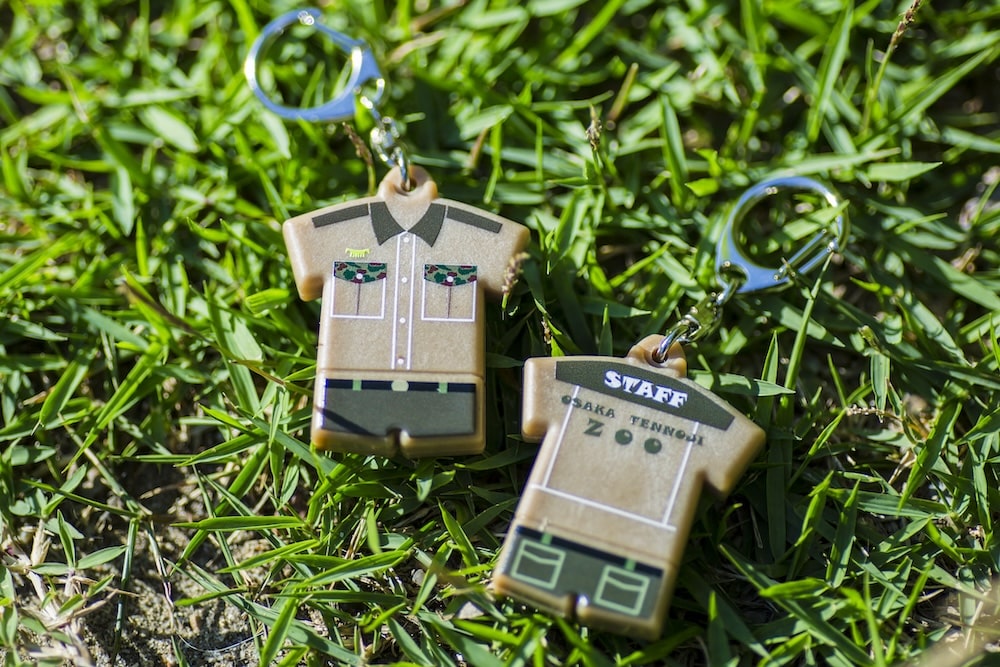
At Kyoto Municipal Kyoto Oike Junior High School, a project was realized in which graduating students’ school uniforms—worn together for three years—were collected and turned into miniature uniform keychains to give back to the students. The uniforms, imbued with memories of school days and friendships, were given new form and preserved.
“We’re collaborating with the uniform manufacturer Murata-do on uniform upcycling. Murata-do collects graduating students’ uniforms from junior high schools, turns a portion into commemorative items, and reuses the rest as interior material for cars. Projects like this carry strong sentimental value and have been very well received by everyone involved.”
Having connected materials—and memories—in this way, Uchimaru now envisions something even bigger, yet rooted firmly in the local community.
“Ideally, I’d like to see local production for local consumption. If possible, I want to see color-sorted collection happen right here in Kyoto, with the resulting materials turned into products used by the City of Kyoto or local government. That would make it a citizen-wide effort, completing the loop entirely within the region. Right now, we sometimes see news footage of discarded clothing piling up overseas after being shipped abroad, but I believe each region should take responsibility for cleaning up its own waste.”
Discarded fibers collected and re-fiberized within Kyoto, turned into new products, and used by citizens as equipment in public facilities—this kind of citizen-participation model could well become a movement that changes people’s mindsets and gives rise to new stories that fit naturally within the local community and its environment.
“Looking ahead, I hope we can build a society where recycled materials take center stage. Fibers that have finished their life as clothing can be reborn as entirely different products. Just like metal and glass, I hope fibers, too, can be kept circulating within society as much as possible.”
Even after their life as clothing or everyday items comes to an end, fibers can go on writing new stories. The future envisioned by colourloop is one scene in a circular society where the value and memory of things are woven together, again and again.
Editor’s Note
The idea of sorting by color rather than by material shows us that questioning entrenched assumptions and shifting our perspective just slightly can shed light on problems that once seemed impossible to solve. colourloop’s challenge offers hints not only for the textile industry, but for how we might approach all kinds of problems.
Technology backed by rigorous research, combined with design that moves people’s hearts—only when both work together does sustainability transform from an obligation into something everyone wants to take part in as a matter of course. Just like the traditions that have been passed down for generations, this circulation of materials that began in Kyoto will likely continue to take on new forms and enrich everyday life for years to come.
*1 Ministry of the Environment (Japan) commissioned survey: FY2024 survey on measures to promote a circular fashion industry, 2024 edition, material flow of clothing | Mitsubishi UFJ Research and Consulting
*2 Tensile strength refers to the amount of force a material can withstand before breaking when pulled.