*This article is reprinted from “Ideas for Good.”
[Kyoto Circular Economy Feature]
This feature is a special project created through a partnership between IDEAS FOR GOOD and Kyoto City to explore the present and future of the circular economy in Kyoto. How can the spirit of “shimatsu no kokoro” (the mindset of using things thoughtfully and without waste) and the circular lifestyle and craftsmanship culture that have been carried on for a thousand years in the ancient capital of Kyoto be developed into innovations that will shape Kyoto’s future—and how can businesses create circular models that will continue for the next thousand years? Together with Kyoto City, local businesses, and Akihiro Yasui, a policy advisor to Kyoto City, we explore the value and potential of Kyoto from the perspective of the circular economy. (Kyoto Circular Economy Feature Top Page)
A favorite shirt with a stain, tucked away in the back of the closet. A blouse full of memories, faded from the sun. Have you ever given up on clothes that could still be worn, telling yourself “I can’t possibly wear this in public anymore,” and let them go?
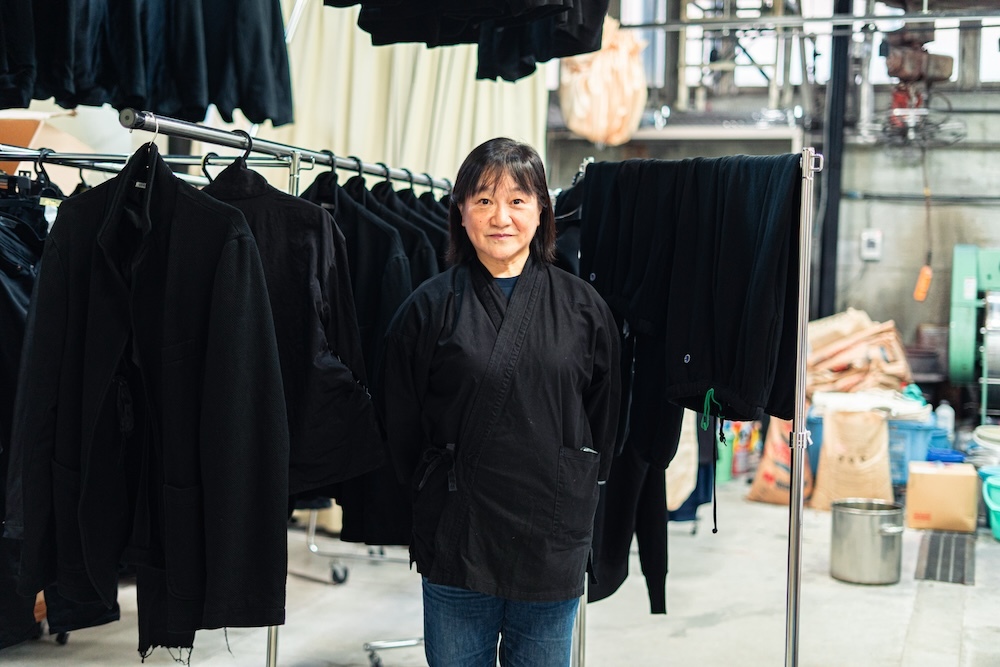
In Kyoto, there is a place where such clothes are rescued from their fate of being thrown away and given new life. It is Bamba Dyeing Works, a long-established Kyoto kuro-montsuki (black formal crest kimono) dye house with a history spanning more than 150 years.
Facing the crisis of a declining kimono culture, the company overcame the challenge with a bold move: applying its black-dyeing techniques for kuro-montsuki to the “redyeing of Western-style clothes.” Through the revival of clothing, the company is also reviving a culture of cherishing and using things for a long time. We spoke with Maki Bamba, the fifth-generation head of the company, about this philosophy and the story of the innovation that is carrying tradition into the future.
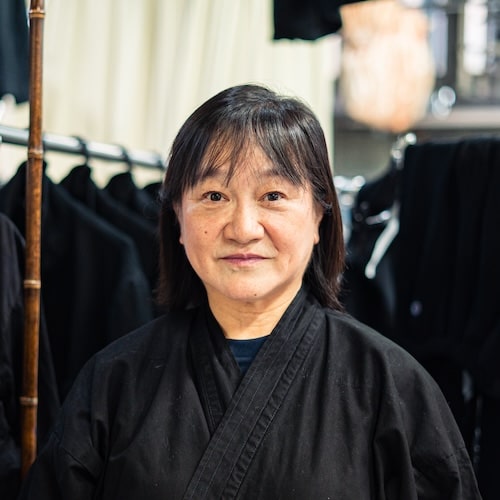
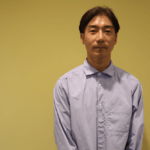
After graduating from Ueda Yasuko Fashion College, she worked as a textile designer. In 2008, she took over as the fifth-generation head of the house, known as Hiiragiya Shinshichi. Making use of her skills in Western-style dressmaking, she shifted the business’s focus from dyeing kimono toward redyeing Western clothing. Together with her son, the sixth-generation successor, she continues to pursue the depths of black dyeing.
“A Black Blacker Than Black”: The Raven’s Wing Black His Father Pursued
The history of Bamba Dyeing Works began in the midst of the upheaval of the Meiji-era return of domains and people to the emperor, in 1870.
“Our company was founded in 1870. The first-generation head came to Kyoto from Gifu and set up a black-dyeing workshop. At the time, dyeing was done with natural dyes, and what was called ‘black’ was actually often more of a brown—known as chazome, or tea-dyeing. By the second generation, since the national railway uniforms were navy blue, navy dyeing—konzome—became the mainstay. Then, in the third generation’s time, chemical dyes were introduced, making it possible to achieve a deeper, more beautiful black than ever before using only a small amount of dye. Black dyeing became the core of the business from then on.”
A major turning point came in the era of the fourth-generation head, Maki’s father. At a funeral, he looked at his own company’s kuro-montsuki and felt that what should have been black actually looked gray. From there, he began working closely with a dye supplier, spending two years developing an original, deep black he called “Shumei-guro,” aiming for the ideal color of a raven’s wet black feathers.
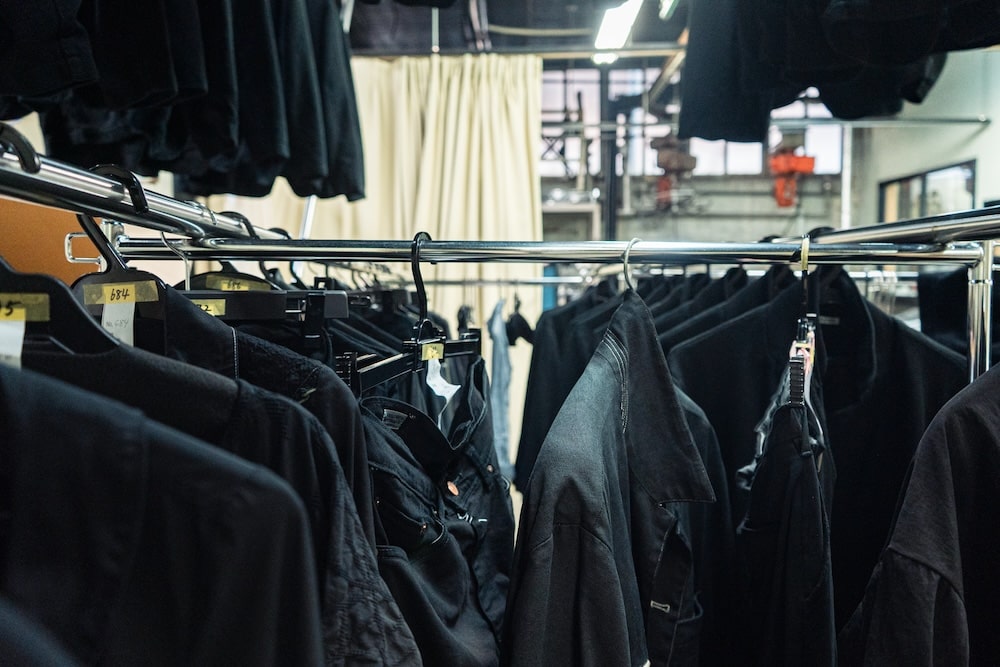
“When it was finally完成 [completed], we received comments from all over Japan saying, ‘This black is amazing.’ I heard that in just one month, we received 30,000 orders. It’s hard to imagine how we managed—it was chaos, and I remember it well.”
The emergence of this overwhelming black, Shumei-guro, sent shockwaves through the industry. Among the roughly 130 competitors in Kyoto at the time, word of it spread rapidly, cementing Bamba Dyeing Works’ skill and reputation as unshakeable.
A Workshop Dyed Black, and the Next Chapter of History
But the tide of the times was cruel. The culture of wearing kuro-montsuki and black kimono itself began to decline, and work at the studio gradually dried up.
“I had absolutely no intention of taking over the family business. I loved Western clothing, worked as a textile designer, and honestly, I was more suited to selling small accessories I’d made myself in a corner of the workshop.”
Then, Maki’s father—a lifelong pursuer of black—was told he had only two years to live. It seemed the curtain was about to fall on 150 years of history. One day, when Maki peeked into the workshop, she found her father pouring out from the vat the dye that had been carried on and replenished across generations.
“There’s no one to take over, so I’m going to close it down.”
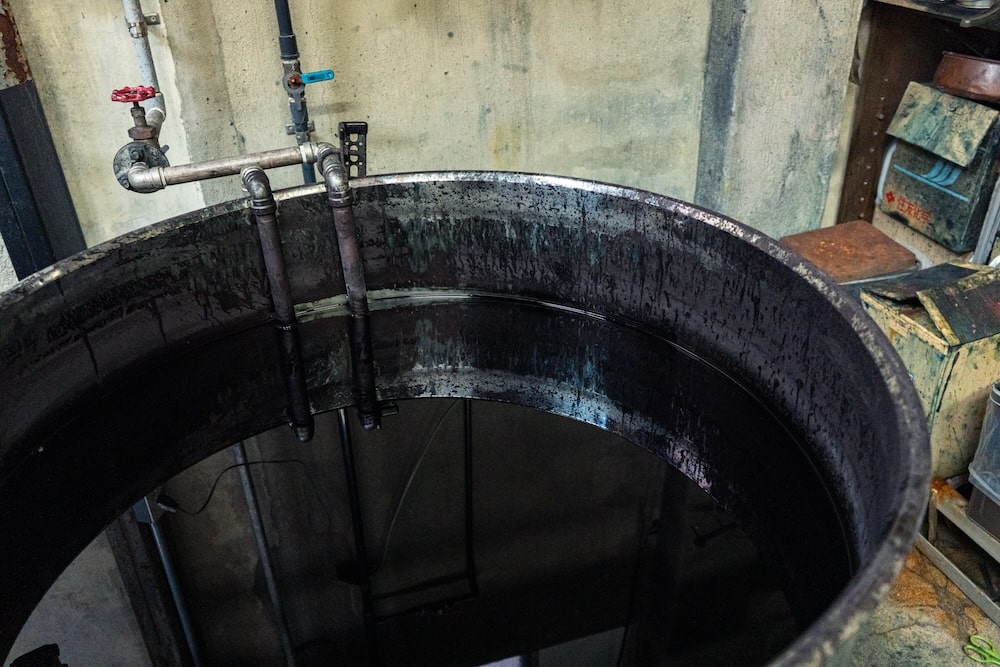
Watching the workshop turn completely black before her eyes, Maki blurted out without thinking, “What a waste—I’ll do it.”
“My father said, ‘Don’t be ridiculous,’ but he left a little of the dye behind for me anyway. Later, when I read his diary, I found out he had actually been happy that I said I would take over.”
What an Ink-Stained Vest Taught Her
Although her father entrusted her with the workshop, dyeing kimono was completely unfamiliar territory for Maki, who was a specialist in Western clothing.
“I knew how to dye Western clothes, but I had no idea how to properly dye kimono.”
She bowed her head to a craftsman who had once worked at the studio, asking, “Why is it done this way?” over and over, learning the techniques one by one.
“What gave me the idea for a new direction was my daughter, who was in junior high school at the time. She came home with a brand-new white vest stained with sumi ink and said, ‘Mom, dye it black.’ That’s when it hit me—’this is it.’ After redyeing it, it looked brand new again, and my daughter was overjoyed.”
That incident led Maki to build a simple website herself and launch a black-dyeing service for Western clothing. This was back when the internet wasn’t yet widely used, but orders gradually increased. That first step became the catalyst for Bamba Dyeing Works to broaden its focus from “kimono” to “Western clothing,” adapting to the needs of the times.
Complaints as an Opportunity to Refine the Business
In the early days of the black-dyeing service for Western clothes, there were no shortage of failures.
“There was a time I shrank a wool sweater. Another time, I returned a dyed suit without pressing it, and the customer got angry, saying, ‘How can I wear this all wrinkled?’ But even so, I see being scolded as a chance. If I fix what I’ve been told, I won’t be scolded for the same thing again.”
That complaint about wrinkles in a suit led her to make beautiful pressing a standard part of the service. Drawing on her dressmaking skills, she now offers services that go beyond simple redyeing.
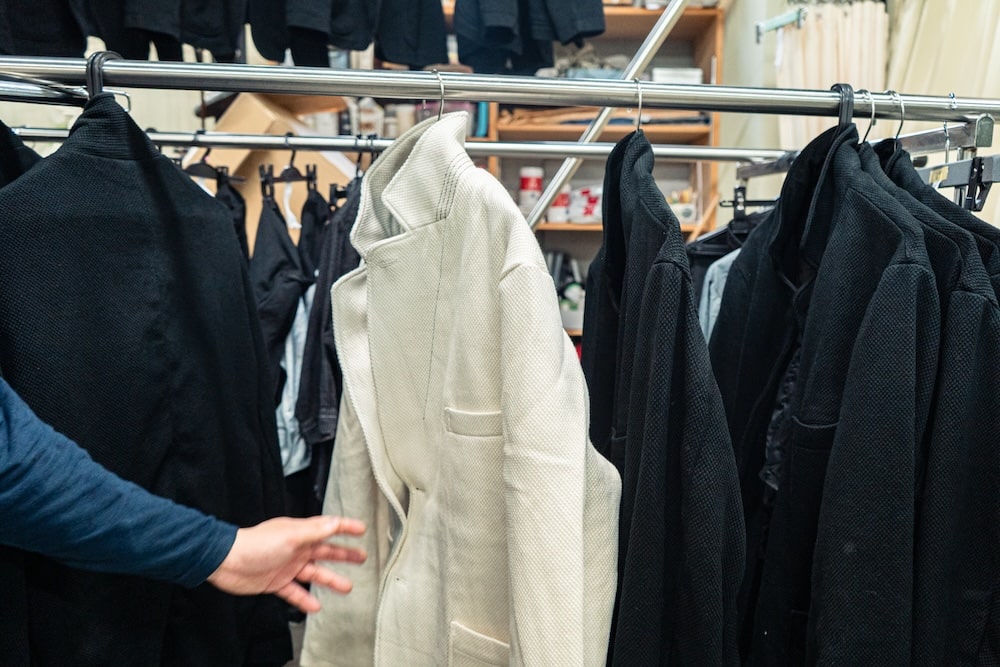
“If there are loose threads, I can fix them, and I can suggest repairs as needed. Being able to sew is my strength, so now I can not only dye but also finish with neat repairs. Seeing customers clap their hands with joy, saying things like ‘I sent it in to be redyed, and it came back looking brand new,’ is my greatest source of happiness.”
Clothes that were destined to be thrown away come back transformed beyond their owners’ imagination—this sincere approach spread by word of mouth, steadily widening the circle of customers.
A Black That Converses with the Times, Drawing the Future
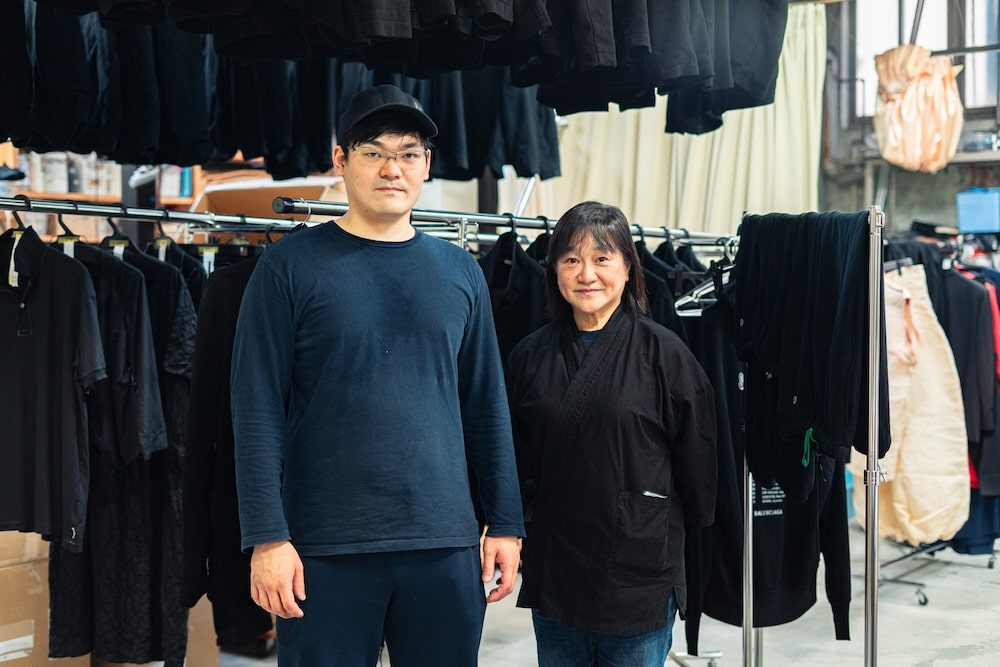
Today, Bamba Dyeing Works is passing the baton to Maki’s son Kengo, the sixth-generation head. While Maki pursued a “natural black” suited to Western clothing, in the sixth generation’s era, apparel makers began requesting “a black blacker than any other.” In response, they adjusted Shumei-guro—the black developed by the fourth-generation father—for use on Western clothing, creating a technique for a black that shines even on modern garments.
“If we had only continued doing kimono dyeing the old way, our company would have disappeared long ago. It’s because we’ve changed with the times that we’ve been able to continue this far.
Going forward, I hope to collaborate with apparel shops dealing with unsold inventory, items faded from sun exposure during display, or products that must be discarded due to color mistakes—redyeing them black and reselling them as a new product line. Kyoto has many hotels and inns, and I’d love for them to redye unused in-house garments, like loungewear, in black and sell them as reused items.”
Through workshops held at the studio, Maki is also eager to convey the shift happening now—from an era of throwing things away to an era of continuing to cherish and use things. Given that Kyoto is a city that draws people of all generations who come to learn about its history and culture, the potential for this kind of work is likely to keep expanding.
From tea-dyeing to navy dyeing, and then to black dyeing. From the black of kimono to the black of Western clothing. And from natural black back to Shumei-guro—at each turn, the company has listened to the voices of the times and kept changing.
“There are parts that must not be changed, and parts that must be changed. We protect what should be protected, and we properly change what should be changed.”
What began as a challenge to revive a single garment has grown into a much larger challenge: reviving a traditional industry itself. Just as it breathes deep black back into faded clothing, Bamba Dyeing Works is clothing the tradition of this ancient capital in new color, creating “change in order to preserve.”
Editor’s Note
We tend to associate the word “tradition” with something unchanging and static. But Maki Bamba tells us that “protecting tradition means continuing to change.” The journey of Bamba Dyeing Works shows us that tradition is a dynamic practice—a voyage in which one keeps a firm grip on the rudder of essence while navigating the turbulent currents of the needs of the times.
A single garment sleeping in a closet is not merely an “object.” It is also a vessel holding personal memories and family stories. The act of “redyeing it black” may be, in a world where circulating resources is increasingly valued, a way of encouraging us to use things longer—a hopeful choice that lets us weave the story forward into the future while cherishing our memories.
[Reference site] Kyo no Kurozomeya (Bamba Dyeing Works Co., Ltd.)
Kyoto is home to assets nurtured over 1,200 years of history—the spirit of “shimatsu no kokoro,” a circular way of life, and a culture of craftsmanship—that continue to shine across the ages. As global challenges such as climate change and biodiversity loss grow more serious, realizing the circular future we need requires the creativity to bring this wisdom to life today and carry it into the future. That is why Hearch Inc., which runs IDEAS FOR GOOD, is launching a learning program in October 2025 that combines the circular wisdom rooted in the city of Kyoto with cutting-edge, future-oriented circular economy knowledge, to envision and realize the future we want to create together. “Decode Culture, Design Future”—unravelling wisdom, crafting innovation. A circular future that carries tradition forward, starting from Kyoto.
Website: https://cbdskyoto.jp/
Photo by Asuka Sasaki
Edited by Natsuki