As the transition to a circular economy accelerates, collaboration between the upstream (production) side — responsible for product design and manufacturing — and the downstream (recycling) side — responsible for collection and recycling — is more important than ever. In particular, the resource circulation model is at a major turning point, as the market now demands not only greater quantity of recycled materials but also higher quality and assured traceability. Against this backdrop, SATO, a company with strengths in automatic identification technology, and Nakadai, a recycling business, found each other.
The Story of SATO and Nakadai
SATO is a manufacturer that leverages automatic identification technologies — such as barcodes and IC tags — to provide labels, printers, and related solutions across a wide range of industries, with multiple bases in Europe. As a producer, the company has been promoting the collection and recycling of end-of-life products from the perspective of extended producer responsibility (EPR), and had been exploring how to achieve resource circulation for its own products (B2B). It was in this context that SATO encountered Nakadai, a recycling company handling a broad range of materials including electrical and electronic equipment. Through repeated discussions, both companies came to recognise that they shared the same vision: high-quality resource circulation. Nakadai is a long-established company with approximately 90 years of experience specialising in intermediate waste processing — particularly recycling. In recent years, it has redefined its business from simple recycling to the more advanced concept of a “resource circulation business,” treating waste as a new “material” and focusing on its stable supply.
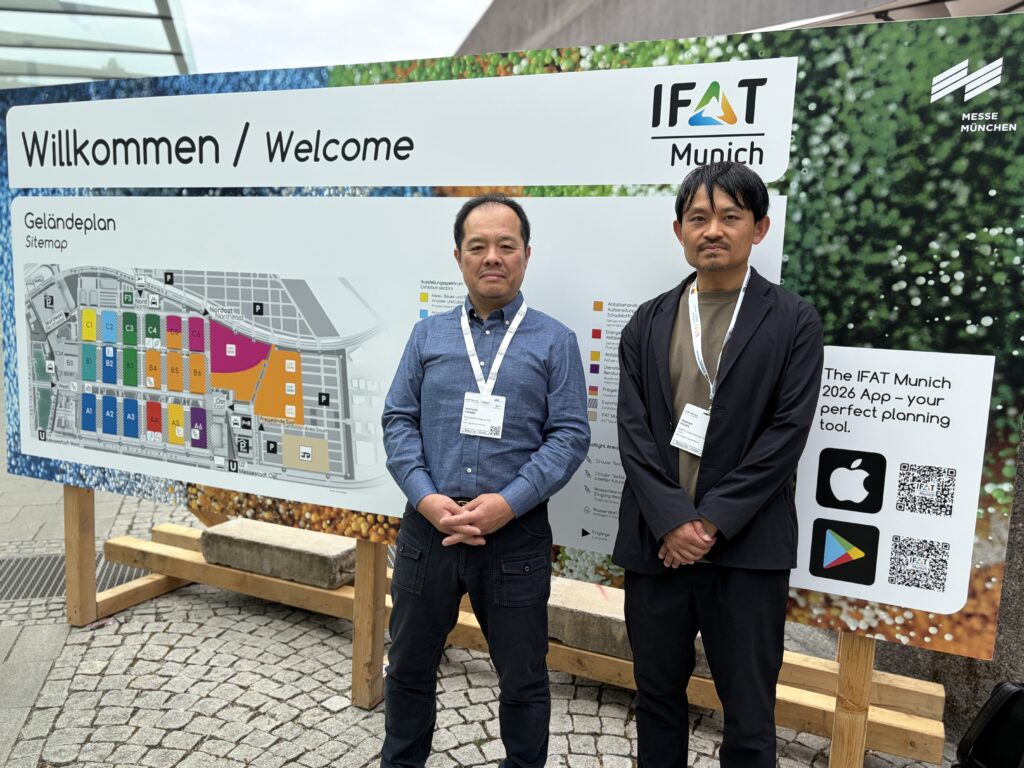
The two companies therefore conducted a proof of concept (PoC) combining Nakadai’s expertise in precision disassembly※ with a digital product passport (DPP) to underpin both the methodology and traceability of that process. Building on those results, they set out to launch an overseas business, with the European market firmly in their sights — a market where the Ecodesign for Sustainable Products Regulation (ESPR) will make DPPs mandatory for a large number of product categories. Both companies have now begun investigating the European market, and as part of that effort they visited IFAT, one of the world’s largest environmental technology trade fairs, held in Munich in May.
※ Nakadai’s definition of “precision disassembly”: As used in this article, precision disassembly refers to the pre-sorting and pre-disassembly stage in electrical and electronic waste recycling, through which components and materials of high resource value are extracted. Please note that this definition does not necessarily align with how the term is used in other industries.
Transitioning to a circular economy is difficult for any single sector or company to achieve alone. Many industries here in Europe recognise that partnerships and collaboration are indispensable for advancing circularity — because the circular economy requires the upstream and downstream segments of a product’s life cycle, which rarely intersected under the linear economic model, to work together across different industrial sectors. A business model is emerging in which companies positioned at various points along the value chain contribute their respective expertise, share and improve already-established technologies through collaboration, and thereby enter new markets built around circular-economy-oriented businesses — a transition that demands a high degree of technical specialisation.
As the EU strengthens extended producer responsibility as part of its circular economy policy, producers bear ever-greater responsibility for their products once they reach end-of-life in the downstream sector. EPR schemes, which previously focused mainly on collection obligations, have expanded in scope as attention shifts to the circularity of resources. Producers are therefore increasingly required to take responsibility for the products they manufacture throughout their entire life cycle. SATO, as a manufacturer of printers and labels, is embarking on this journey — and to do so, it needs the knowledge and expertise of recyclers who are committed to producing the high-quality recycled materials that the circular economy demands.
How do companies from the upstream and downstream sides of the product life cycle — both committed to the circular economy — come to meet at the same point? Driven by this question, the Circular Economy Hub editorial team joined SATO’s Mr. Hirata and Nakadai’s Mr. Nakadai on their European study tour and spoke with both of them on the floor of IFAT.
Q: Could you start by telling us how Nakadai and SATO came to collaborate in the context of advancing the circular economy?
Mr. Hirata: Our collaboration with Nakadai goes back to 2023. Our company plans, designs, and manufactures its own products. As a manufacturer thinking about resource circulation for its own products, recycling is of course a necessity. However, since we were not able to handle it in-house, we were looking for a recycler — and that is when we happened to meet Mr. Nakadai. It started with a consultation about resource circulation for our own products. As I learned more about Nakadai’s business, I realised there were a great many challenges, and I thought that perhaps our automatic identification technology solutions could help address some of them — so I raised the idea. Mr. Nakadai agreed, and we began working on concrete initiatives. For example, we conducted a PoC using AI to visualise the volume of waste stored in a waste storage facility. Last year, we also ran a PoC in which we attached a DPP to our printers to promote collaboration across the value chain and the recycling industry. Since then, we have continued discussions across a wide range of areas.
Our business is on the upstream (production) side, but we had the idea that we might also be able to develop a business in the downstream (recycling) space. Since we are not well-versed in the waste and recycling industry, Nakadai has also helped us understand the challenges that exist there.
Mr. Nakadai: We recyclers do not simply process waste — we sort and disassemble it so that it can be sold as a material. In other words, we produce materials from waste and sell them to customers. From the perspective of producing materials, we need to manage where our raw material source — the waste — comes from, how much arrives from which company, and what materials can be extracted through sorting and disassembly. For us, waste is not something we collect when it piles up; it is the raw material from which new materials are created. When I heard SATO’s pitch, I thought they might be able to help us manage and trace this part of the process — and they confirmed that they could. As an extension of the PoC, the idea emerged that this could be linked to DPPs in the context of resource circulation. This was of course with the EU’s planned rollout of DPPs across a large number of product categories firmly in mind.
Looking at the EU’s circular economy policies and the many regulatory tools that accompany them, I thought that the flow of processing waste and transforming it into new materials would eventually be required of SATO’s printers as well — and that we were entering an era in which everything that happens to a product after it leaves the factory would need to be fully traceable. So we decided to try using SATO’s products to see what was possible, without spending too much on it.
Q: How do you see things developing from here?
Mr. Hirata: One element is attaching a DPP to our own products. But that is not the end goal — we wanted to develop concrete use cases using DPPs. By experiencing this ourselves, we gain know-how that we can then offer to others. We are also looking at expanding this into a broader business. However, there is a significant difference in impact between attaching a DPP temporarily as part of a project and doing so on an ongoing basis. Full-scale implementation therefore still has various challenges to resolve, and we are not there yet.
The plan to grow the business by offering DPP know-how externally is something we will be pursuing together with Mr. Nakadai going forward. This also connects to our purpose in coming to IFAT this time. We had heard that precision disassembly was not widely practised in European recycling, and we wanted to raise awareness of Mr. Nakadai’s precision disassembly technology. So we decided to attend IFAT — billed as one of the world’s largest environmental technology trade fairs — to observe the local European situation firsthand, introduce our work to relevant players, and gather feedback.
Mr. Nakadai: I had been thinking that tightening regulations in Europe would make precision disassembly necessary in order to raise the quality of collected materials, and that implementing DPPs — loaded with data on disassembly know-how and processes — would become indispensable. I thought that coming to IFAT would let us see these trends in action.
Q: What are your candid impressions after actually walking the IFAT show floor?
Mr. Hirata: My honest impression is that it is quite different from Japan. Large-scale equipment and machinery stand out — transport tools, shredders, collection boxes, and the like. Because high-volume processing is the baseline assumption, I noticed a very large number of solution products designed to handle the “intake” stage smoothly and in bulk.
Mr. Nakadai: The mainstream European approach — collect large volumes first, then work on improving quality — is, in my view, somewhat at odds with the resource circulation narrative that is being discussed today. Manufacturers who actually use recycled materials start from quality and then scale up the volume. That is why quality has to come first. The more you try to collect volume first and then run it through various machines to eventually achieve quality, the easier the “intake” stage becomes — but the subsequent processes grow more complex, require more equipment, and costs escalate.
The logic of conventional recycling is one where there is a buffer: rather than achieving “100% pure material A,” something like “95% purity is good enough” is acceptable. But I do not think that meets the standard required by manufacturers who maintain strict quality controls. Manufacturers want recycled material A that is close to 100% pure. For those customers, the logic of collecting volume first simply does not apply.
What I saw at IFAT was a model of collecting large volumes of waste first, then using high-precision conveyor belts and sorting machines to improve the quality of the collected material. That is not bad recycling by any means, but I found myself questioning whether this is truly the kind of capital investment that belongs in a resource circulation context. I also wondered whether it would be difficult to form partnerships with people whose thinking is premised on a recycling approach that places the greatest emphasis on “volume.”
Precision disassembly is often said to be cost-prohibitive. It is true that there is a significant barrier: if you pursue quality first, volume falls short and costs become unviable. If you insist on quality, the volume any single company can supply may be limited. But I believe that the essence of a resource circulation supply chain lies precisely in the collaboration of tens, or even hundreds, of such companies coming together.
Thinking about the DPP framework in the EU — its application is imminent — I also felt that attaching a DPP to recycled materials collected through the collection systems represented by the machinery on display at IFAT might not function adequately. In that sense, I even had the impression that the machinery prominently exhibited at IFAT is moving in the opposite direction from the requirements being strengthened by EU regulations. That said, this trade fair is not the whole picture, and I felt there is still much to learn — including through discussions and collaboration with people who are trying to achieve circularity using DPP-based information in other fields.
Q: Based on your impressions this time, does the industry itself need to change its thinking, or the circular economy will not be realised?
Mr. Nakadai: Listening to panel discussions at the venue, there was talk of the many EU regulations related to the circular economy that are set to take effect by 2030, and of the many things the industry needs to address. However, if the equipment being sold at this trade fair is introduced in 2026, it will be in use until at least 2033. In other words, I got the sense that things may not change significantly until at least 2033. It is certainly true that the industry’s mindset needs to change — but at the same time, I think the industry itself has not yet felt a strong enough reason to change. Put differently, the pressure from manufacturers is not yet strong enough.
Q: What are each of you taking home from this trip?
Mr. Nakadai: It is a difficult one, but I am accepting this as one reality. I had hoped to find operators who, like the project we conducted with SATO, recover high-quality materials through careful disassembly work — but unfortunately we did not encounter any at IFAT. However, as regulations evolve, the need to adopt precision disassembly will inevitably arise. In that sense, I do hold out hope that there may be an opportunity to bring our technology to Europe.
Mr. Hirata: I also think it was very meaningful to have grasped one reality. What matters now is what action we take next, based on what we have learned. Japan has more than 20 years of history in recycling home appliances, automobiles, containers and packaging (under frameworks such as the Containers and Packaging Recycling Act), and this has become something of a culture. Recycling technology has been nurtured within that culture. Mr. Nakadai has taken it further, putting precision disassembly into practice to raise the quality of recycled materials. In that respect, I share Mr. Nakadai’s view that no exhibitor at this IFAT was making that case — which means, conversely, that it could be a source of competitive advantage. I feel we should continue to focus on precisely this point: precision disassembly aimed at recovering high-quality recycled materials.
As for finding collaboration partners, I did come away with some doubts about whether Germany is truly the right fit. We need to look more closely at the industrial structure and compatibility of individual countries. Going forward, I would like to continue while adjusting our approach.
Editor’s Note
“Quality over quantity.” Simple to say, but this reporting brought home just how deeply structural the challenges are when it comes to making that shift in the recycling industry.
The enormous shredders and high-precision sorting lines spread across the IFAT venue in Munich were emblematic of the current state of the European recycling industry. The industry’s logic of pursuing scale in collection volumes has its own internal rationale. Yet, as Mr. Nakadai pointed out, the question of whether the current mainstream model can meet the requirements of the EU regulations converging around 2030 — given that equipment has a useful life of at least seven years — is a weighty one.
At the same time, recyclers oriented toward precise sorting and disassembly for the purpose of improving recycled material quality do exist in Europe, as do businesses that hold that philosophy. The need for such an approach is in fact recognised across the industry, including at the regulatory level, and various projects are underway. However, barriers of demand and cost have prevented it from becoming mainstream, and its presence is particularly hard to see at large trade fairs. Another contributing factor is that current regulations governing the manual disassembly and pre-shredding sorting of waste electrical and electronic equipment (WEEE) are primarily aimed at removing hazardous substances, and are not directly linked to the production of high-quality recycled materials.
Local recyclers point to the absence of demand as the greatest challenge. A major Nordic recycler noted that “the entire industry needs to change its thinking.” If a “product standard” for high-quality recycled materials — premised not merely on circularity but on closed-loop recycling — can be established in the market, it could become mainstream. This resonates with Mr. Nakadai’s words: “If you insist on quality, the volume any single company can supply may be limited — but the essence of a resource circulation supply chain lies in the collaboration of tens, or even hundreds, of such companies coming together.” Achieving that will require strong pull from multiple directions: regulation, the market, and customers alike.
Interviews conducted with:
Kazuya Hirata, General Manager, Tagging Ecosystem Planning, Key Account Promotion Division, International Business Headquarters, SATO Holdings Corporation
Sumiyuki Nakadai, Representative Director, Nakadai Holdings Co., Ltd.