※ This article is republished from “IDEAS FOR GOOD.”
Reducing waste, circulating resources, and lowering environmental impact—few people today would argue against such goals. Yet whether any of this is actually happening in the town where you live is quite another matter. Even when individuals do their part in daily life, the ultimate fate of their waste is determined by local sorting rules and recycling infrastructure. Those municipal systems do not change overnight.
So why does progress stall? Behind the inertia lies a structural dilemma facing local governments. As they grapple with population decline and increasingly diverse resident needs, the workload on municipal offices keeps growing, leaving staff perpetually stretched. In that environment, no matter how environmentally beneficial a new initiative may be, it is genuinely difficult for a local authority to adopt and operate a new system. On top of that, every community has its own long-established ways of life and social relationships. Resource circulation efforts that proceed without understanding the local context can end up becoming a burden rather than a benefit.
What is needed, then, is a practitioner who combines Zero Waste® expertise with the ability to listen carefully to local governments and communities—and to roll up their sleeves and handle the painstaking coordination work alongside them. ZERO WASTE FUTURES, a programme launching in April 2026 by Zero Waste Japan (一般社団法人ゼロ・ウェイスト・ジャパン, a general incorporated association), is designed to train exactly that kind of person.
What kind of people does it take to engage sincerely with communities and rebuild the foundations of society? And what future does this new programme envision? We spoke with Akira Sakano, Representative Director of Zero Waste Japan, about the thinking behind it.
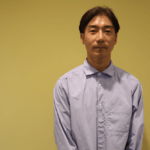
Speaker profile: Akira Sakano
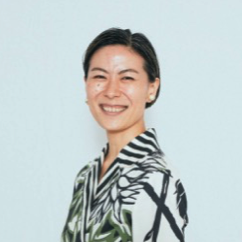 Former chairperson of the Zero Waste Academy (NPO法人ゼロ・ウェイストアカデミー), the NPO responsible for waste policy in Kamikatsu, Tokushima Prefecture—the first municipality in Japan to declare a Zero Waste goal. She has contributed to advancing local waste reduction and spreading the Zero Waste concept both in Japan and internationally. She served as co-chair of the World Economic Forum Annual Meeting (Davos) in 2019. Since 2020 she has been working at Zero Waste Japan to develop models for a circular society. In 2021 she co-founded Green Innovator Academy, a leadership development programme for social change toward decarbonisation. She joined ECOMMIT Co., Ltd. in 2023 and in 2026 became Japan’s first Chief Circularity Officer. She is a World Economic Forum Young Global Leader for 2025.
Working alongside communities revealed the need for “facilitators”
Having been present at the front lines of waste reduction efforts in multiple communities, Akira Sakano encountered walls that know-how and technology alone cannot overcome. Even when good systems exist in society, plans remain on paper unless there are people on the ground to make them run.
Why was a programme born to bridge the gap between the outside and inside of local government, between theory and reality—and what kind of learning does it aim to foster?
Q. Could you tell us about the background and the trigger that led you to launch this programme at this particular moment?
As Zero Waste Japan, we have been working alongside a certain number of communities on waste reduction, and over the past few years I have felt a steady rise in social demand for spreading Zero Waste® at the local level. That also means there are more and more communities with the potential to actually implement Zero Waste® if they receive proper support—and my own conviction about that demand is one of the reasons we launched this programme.
At the same time, I feel that even now our organisation alone cannot fully meet that demand. We have co-created various courses and programmes on the circular economy and resource circulation with other companies and organisations, but it has become clear that those alone are missing elements needed to build the practical capacity to advance Zero Waste®.
We wanted to nurture not people who simply “finish a programme and move on,” but practitioners who go on to apply what they have learned as part of their work and who could eventually work alongside us. That desire is what gave birth to ZERO WASTE FUTURES.
Q. Why do you focus specifically on developing the “people” who support local governments?
In this programme, we place great importance on cultivating people who can fill the role of “facilitator.” When it comes to creating change in a community, the first essential is someone who is firmly rooted in that community and can raise the flag and say, “Let’s make this happen!”
However, having lived in Kamikatsu—the first town in Japan to declare a Zero Waste goal—for about five years while working to advance Zero Waste® there, I know all too well both the difficulty and the limits of a single central figure trying to carry everything alone. For that person to keep running without giving up, the internal structure within the community is of course important, but I believe it is equally vital to have someone who moves back and forth between the inside and outside of local government and provides continuous, multi-angle support for implementation.
Q. What kinds of people will participate in this programme, and what will they learn?
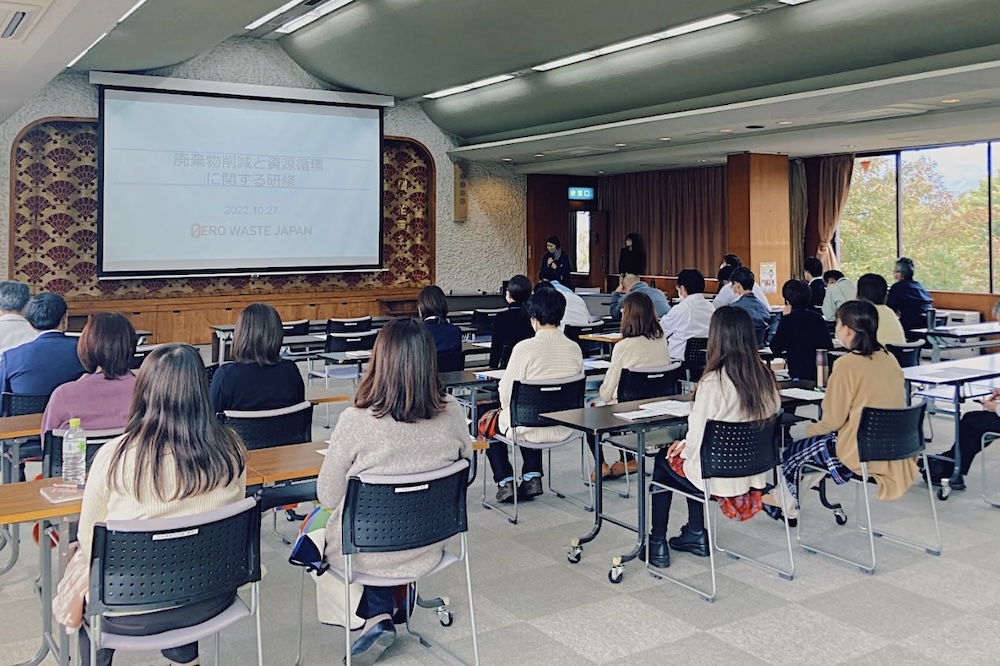
In designing the programme, we prioritised helping participants develop both a “bird’s-eye view” to observe global trends and a “worm’s-eye view” to observe local realities on the ground—and the ability to move between the two in order to understand a community in three dimensions. Building on that, participants will study existing case studies so they can propose initiatives suited to specific communities, and we plan to hold a residential fieldwork session where participants enter actual sites and experience conditions firsthand.
Given this content, I think the programme will be a chance to find a foothold for people who want to implement Zero Waste® at the community level but don’t know where to begin, as well as for those who are already embedded in a community but feel uncertain about how to engage with the local government.
For those who already work with local governments in other fields, or who are already skilled in a facilitator role and want to add waste management to their toolkit, the programme should provide specialist knowledge in waste management. And for those who want to tackle environmental issues but feel that passion alone is not enough to bring a wider community on board, it will be a place to acquire the knowledge that underpins that passion and to learn how to engage others effectively.
Because no one can be separated from “waste,” communities can change
Pursuing Zero Waste® addresses only one facet of the challenges a community faces. It is by no means an instant solution to every local problem.
Even so, “waste” is a theme that no one living in a community can be unrelated to, and it has the power to rebuild community bonds. How should a coordinator act so that residents—the true protagonists—can accumulate successes and cultivate the community’s own “strengths”?
Q. What kind of person do you envision a “Zero Waste Coordinator” to be?
I think a Zero Waste Coordinator is someone who holds firm convictions yet acts as a “facilitator”—someone who creates the conditions for local governments and community members to exercise their own capabilities and play an active role in moving toward Zero Waste®.
This programme will provide opportunities to develop the foundational knowledge, analytical skills, and reflective thinking that underpin that role. To do that, it is also necessary to draw out and strengthen each participant’s individual strengths. I hope that diverse facilitators will emerge, each finding their own way of being.
Q. When the inaugural cohort spreads out across Japan and begins to make an impact, how do you imagine Japan’s communities will change?
Because waste concerns everyone, I believe that when something related to waste starts moving in a community, the ripple effects are actually enormous. Through the process of advancing Zero Waste®, new social businesses can emerge in a community; new local connections can be formed and existing ones strengthened; and this can even lead to improvements in welfare services. Communities that are already demonstrating the broad potential of Zero Waste®—both in Japan and abroad—do exist.
Of course, such effects cannot be produced immediately, and there is no single “right answer” that guarantees success. But that is precisely why I believe that as more communities take on Zero Waste®, local resilience is strengthened and the seeds of each community’s distinctive character begin to grow.
Editor’s note
In 2026, the situation facing communities across Japan is severe. As both the economy and society contract, environmental consideration can easily become a cost that makes daily life harder. Akira Sakano’s point that “Zero Waste® will not immediately make a community better” is an important one. Bringing “environmentally good things” into a community while turning a blind eye to this reality risks becoming an act of self-indulgence.
That is precisely why a presence committed to facilitating—rather than leading—matters so much. We hope this programme will produce practitioners who are resolved not to consume communities, but to keep grappling with their challenges alongside them.
Programme overview
| Programme name | ZERO WASTE FUTURES |
| Dates | April 25, 2026 (Saturday) – August 1, 2026 (Saturday) |
| Venue | Tokyo (in-person sessions) and online |
| Capacity | Approximately 10 participants |
| Eligibility |
※ In-person attendance is mandatory for the opening session (April 25), the mid-programme residential retreat (June 13–14), and the final presentation (July 25) |
| Fees | Corporate: ¥500,000 (excl. tax) Individual: ¥300,000 (excl. tax) ※ Payment deadline: April 15, 2026 (Wednesday) ※ Both figures are per person ※ Accommodation, transport, and meal costs for in-person sessions are the responsibility of each participant ※ A scholarship scheme is available for students and others who have difficulty paying the full amount for financial reasons. Please raise this during your interview. |
| Details |
|
| Applications | Please apply via the link below Application form |
| Deadlines | First deadline: March 20 (Friday) 23:59 Second deadline: March 25 (Wednesday) 23:59 ※ Applicants who apply by the first deadline will be given priority for interviews ※ If applications are oversubscribed, recruitment may close at the first deadline |
| Organiser | Zero Waste Japan (一般社団法人ゼロ・ウェイスト・ジャパン) |
※ “Zero Waste” is a registered trademark of Zero Waste Japan (一般社団法人ゼロ・ウェイスト・ジャパン).
【Reference】Recruiting inaugural cohort for “ZERO WASTE FUTURES,” a programme to train specialist facilitators supporting municipal Zero Waste promotion
【Related article】What leadership does the transition to a circular economy require? A look back at the first year of Shizenkan University’s Circular Future Design Centre