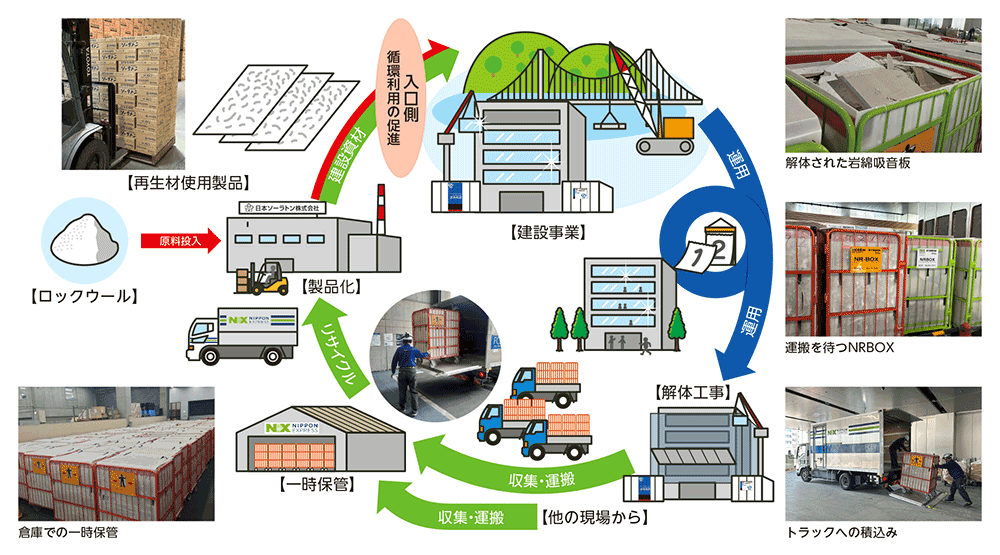
Shimizu Corporation announced that it has recovered approximately 560 tons of rock wool acoustic ceiling panels as materials at a demolition site for the (tentatively named) Shibaura Project Phase II demolition works in Minato Ward, Tokyo, by making use of the wide-area certification scheme (a system under which the Minister of the Environment authorizes manufacturers to collect their own products nationwide for recycling, bypassing the usual municipality-by-municipality waste collection permits). According to the company, this marks Japan’s first initiative to achieve material recovery of rock wool acoustic ceiling panels at a demolition site.
Recycling at construction sites has mainly progressed in new-build projects, where offcuts and similar materials are relatively easy to collect. At demolition sites, by contrast, various types of waste are mixed together, making it difficult to sort target products and verify their quality, so material recovery has not advanced sufficiently. In addition, while waste must be removed quickly from demolition sites, manufacturers handling recycling face constraints on when and how much they can accept, making it a challenge to coordinate the demolition schedule with manufacturers’ acceptance timing.
According to the company, this project involves what is currently the tallest office building undergoing demolition in Japan. The developer, Nomura Real Estate Development, has been pursuing various resource circulation initiatives for this project, of which this latest material recovery effort is one.
Three companies worked together to build a system for efficiently sorting and collecting the rock wool acoustic panels generated at the demolition site and transporting them in line with the manufacturer’s acceptance schedule: Shimizu Corporation, which is handling the demolition; Nihon Thoraton, a member of the Yoshino Gypsum group that manufactures the rock wool acoustic panels; and Nippon Express, a member of the NIPPON EXPRESS HOLDINGS group, which handles waste collection and transport.
Before demolition began, Nihon Thoraton conducted a detailed survey of the site. Based on this, the company identified and sorted out the rock wool acoustic panels used in the building’s ceilings that it had manufactured and that could be recovered as materials.
Collection made use of a dedicated collection container called “NRBOX,” developed by Nippon Express. NRBOX is a cage cart with double doors that allows the contents to be checked at a glance when loading, enabling reliable sorting by item type.
The collected rock wool acoustic panels were transported to a Nippon Express-owned warehouse, which served as a transfer hub and temporary storage site, with transport timing adjusted to match Nihon Thoraton’s acceptance schedule. According to Nippon Express, this approach eliminated the time lag that would otherwise occur between the demolition site and the recycling facility. Between November 13, 2025 and April 27, 2026, approximately 560 tons of rock wool acoustic panels were collected using 1,871 NRBOX units.
The wide-area certification scheme allows manufacturers and other businesses, once certified by the Minister of the Environment, to collect their own products that have become waste across a wide area and recycle them as raw materials or otherwise dispose of them appropriately. As a special exception under the Waste Management and Public Cleansing Act (Japan’s primary law governing waste disposal and management), this removes the need for the waste collection and transport permits that are normally required separately from each municipality.
Shimizu Corporation aims to improve resource productivity—creating greater value from fewer resources. Under its group environmental vision “SHIMZ Beyond Zero 2050,” formulated in May 2020, the company has set a target of keeping the final disposal rate of construction waste below 3.0% by fiscal year 2030. Going forward, the company plans to accelerate efforts to reduce the final disposal rate of construction waste by leveraging the wide-area certification scheme—which enables nationwide collection of target products—together with transfer hubs that resolve logistics bottlenecks, promoting cross-project collection and material recovery as well as recovery of multiple material types.
【Press release】Japan’s First: Material Recovery of Rock Wool Acoustic Panels Achieved at a Demolition Site
【Press release】Nippon Express Builds Logistics Scheme for Material Recovery of Rock Wool Acoustic Panels in Shibaura 1-chome Demolition Project—Achieving Material Recovery of 560 Tons of Rock Wool Acoustic Panels Through Transport Coordination Using a Transfer Hub
【Related article】Shimizu Corporation and Institute of Science Tokyo Begin Research Toward “Building Upcycling” That Makes Use of Existing Structures
【Related article】Ministry of the Environment Selects 8 Advanced Plastic Resource Circulation Projects, Expanding Demonstrations in Construction and Retail Sectors Including Cainz and Shimizu Corporation